Sunday, June 28, 2009

Only Human

What a Piece of Work Is Man
Cast of the musical Hair
Gerome Ragni, James Rado & Galt MacDermot


Only Human

Rembrandt Laughing
Rembrandt van Rijn
http://en.wikipedia.org/wiki/File:Rembrandt_laughing.jpg


The song puts one of Hamlet’s famous soliloquies to music. It is a beautiful statement of the human condition that is rendered a bit difficult to interpret within the construct of the play because Hamlet is either mad or pretending to be mad when he says this. Perhaps madness, too, is a part of the human condition and that fabric Hamlet is trying to weave, his words and his actions making the warp and the woof of the metaphorical cloth. Harold Bloom titled one of his books Shakespeare: The Invention of the Human suggesting that it is in Shakespeare that we see our humanity defined for the first time. I think this is not entirely true, because what makes a work of literature survive the generation for which it was written is its ability to capture something of the human condition that resonates with us all. Oedipus and Odysseus may have been kings but their responses to the circumstances in which they found themselves was very human and it is to their humanity that we respond when we read their stories.

Still, there is truth to the suggestion that we discover a part of our humanity through the stories that we read, even if they are not exclusively the stories of Shakespeare. Stories illustrate values, help us see the world from other points of view, remind us that we are not alone, that others in other times have felt the things we feel have struggled with the same sorts of things that we struggle with. Stories help us discover our humanity, our place in the larger communities in which we live and our identity as individuals.

The painting is unusual for Rembrandt, or at least it seems so to me. His most memorable portraits are of serious old men; this seems especially true of his self-portraits. But here he is in the midst of a laugh, perhaps a laugh at his own seriousness. But this is part of what it is to be human; to laugh and to enjoy whatever is happening around you. George Bernard Shaw said, “Life does not cease to be funny when someone dies, as it does not cease to be serious when people laugh." Living well involves both the humorous and the grave. Getting through the most difficult and trying times often involves laughing at our circumstances.

Terry Eagleton in The Guardian this weekend reviewed a newly published collection of the letters of Isaiah Berlin. The title of the article is “Urbane sprawl” which captures the tone of the letters and Berlin’s good nature, at least in the eyes of Eagleton. Berlin was a man who thought deeply about many things, was a liberal by some definition of the word, and a professor of politics at Oxford University. He was an odd sort of Englishman in that he was a Latvian Jew, the child of Hasidic parents who made himself quite at home at the most English of universities. This too captures what it means to be human, to adapt to new surroundings and to make those surroundings ours, hopefully to be accepted, at least in part, on our own terms. Most of us have had something of the emigrant experience, to have moved from a place that is familiar to us to a place that is very unfamiliar, even if it is only moving from one town to another, or one state to another.

As a child my parents moved about once every year or two. This meant as a child making new friends on a regular basis and adapting to new surroundings, new teachers, new neighbors. We once had a next door neighbor who was on some occasions very welcoming and warm and on others very strange. On one occasion she place a lawn sprinkler on her son’s slide so that it flooded our yard, but in the process of flooding our yard flooded hers. Of course once the sprinkler was removed it had the appearance that the flooding originated with us and that due to our neglect her yard had been flooded. She lodged a complaint to this effect with the local authorities, so did my parents. A police car arrived on both our driveways at about the same time. Fortunately this sort of thing did not happen often. The end result, though, of these many moves was a reluctance to form relationships for fear they would be lost with another move.

Camille Monet at Work
Claude Monet
http://en.wikipedia.org/wiki/File:Claude_Monet_Camille_au_métier.jpg


The paintings above and below capture two views of the human condition. Both paintings are by prominent Post-Impressionist painters. The paintings do not just capture a scene but an attitude towards what is happening in each scene. The painting above is of a woman at work and she appears to be content with her work. Her surroundings are comfortable and pleasant. She is indoors but she is surrounded by greenery; plants that appear to thrive in an environment that is not entirely their own. There is sunshine and no doubt regular meals. Perhaps that is all anyone needs to be comfortable, to be left alone with the bare necessities for life.

There is a hunger on the part of many, perhaps most, to find a way to make their work not just meaningful but pleasant. Fagin in Oliver Twist for all his troubling characteristics seems to enjoy his work, dishonest though it is, in a way that his partner Bill Sykes does not. Most stories of people at work, at least the ones that come immediately to mind, do not involve people enjoying their work, and those that do are not always honest, are like Fagin and Sir John Falstaff.

My favorite work-a-day gentleman is Melville’s scrivener Bartleby. Many at some point during the day would like to respond to an unpleasant instruction with “I would prefer not to.” I know many of my students would. But there are of course other students who would not respond in this way and maybe this suggests that our attitude towards work is sometimes within our control, that we can change the way we look at our work and find something pleasant and enjoyable in it by changing our attitude towards it. Perhaps we need a Tom Sawyer in our lives convincing us that what we really want to do if we want to be happy and satisfied is to white wash this fence.

On the Threshold of Eternity
Vincent Van Gogh
http://en.wikipedia.org/wiki/File:Vincent_Willem_van_Gogh_002.jpg


This painting by Vincent Van Gogh captures a more troubling side of our existence. There is the suggestion that the man in the painting is near death, at least that is what the title suggests to me. I think it was a Boston politician who said, “everyone wants to go to heaven but no one wants to die.” Van Gogh began his adult life with a strong desire to be an evangelical preacher. It is something at which he was not successful. He took up painting instead. But there may be a bit of the preacher in some of his paintings. If the man in the painting has a family, that family is left out of the picture and he is alone to confront his mortality, which would be true even if others were in the room, but the room’s emptiness emphasizes the individual nature of the man’s struggle.

Jack London’s novel The Sea Wolf captures various aspects of life and death and the meaning of both. Throughout the novel Humphrey Van Weyden (known throughout the story as Hump) is trying to survive as best he can in as unforgiving an element as is imaginable. His antagonist, Wolf Larsen believes that life and comfort are rewarded to the strong and the weak exist at the pleasure of the strong. It does not appear likely that someone as weak as Hump is at the beginning of the novel could survive in such a world, though, because he is the one telling the story, he must have. By the end of the novel the roles are reversed and the once indomitable Wolf Larsen finds himself in the position of the man in the painting.

Our Town
Thornton Wilder
Masterpiece Theater


This is the opening to Thornton Wilder’s play Our Town. In the play the lives, deaths, and meanings of the various characters and their accomplishments are examined. The story is told simply. The deaths of various characters throughout the play, with one exception, are treated almost as asides, reminiscent of Kurt Vonnegut’s “and so it goes” to mark the deaths of characters in his novel Slaughterhouse Five. To each of us death is a matter of great importance, but as is suggested by Vonnegut, Wilder, and Wolf Larsen, it is not a matter of great importance to the world around us. This suggests that living well, and by that I mean not just fully but virtuously as well, is our only legacy and that it is a legacy we leave first to ourselves.

The play is produced without scenery or props and the simplest of costumes. We are told the play is set in a small New Hampshire town, but it could be anywhere, though perhaps not anytime. It is localized in small town America and the small town is largely being erased by access to a global community. In the Middle Ages few saw the world beyond their village and to a large degree the public (and possibly the private as well) school classroom is localized in a village and most students do not escape that village until they go off to college or the world of work. Sometimes that village is an urban inner-city village and sometimes a quaint small town in the country, not unlike Grover’s Corners. I think there is something good in this, something that can, even in the worst of environments, nurture, though, it seems that we are all being put through a 21st century version of urban renewal and being located into a rather large global city (it does not seem quite right to call this a village).

Our Town
Iris DeMent


This song has the same title as the play and illustrates another aspect of “Our Town” the town that belongs to us; the town that watched us grow and nurtured us. The song is somewhat pessimistic in that it suggests we not only cannot go home again, we cannot stay at home if that is where we are. Life involves moving on and leaving things behind. If it is true that “nothing good ever lasts”, it equally true that nothing bad ever lasts, or it needn’t. Part of growing up is leaving home, and replacing the good times of our youth with other good times.

There was a review by Alain de Botton of the book The Art of Being Human by John Armstrong. The book is an attempt to recapture the purpose of philosophy, to help us live wisely and well. It is an argument for teaching and preserving culture, not the popular culture, but the more elitist culture that belongs to history, tradition, and the various canons of the different arts, because culture helps us to understand and develop our outer self that lives in the material world and our inner self that is more abstract and more spiritual.

Bottan in his review quotes a passage from the book about Abbot Suger, a medieval reformer. “Suger's primary concern is to raise people from mass to elite culture. And his way of doing this is not by being snobbish or hard on ordinary enjoyments. He takes the view that mass culture is just an undeveloped, beginning way of addressing exactly the same things that high culture serves more directly and with greater insight. We desperately need to bring to inner development the sort of clarity and respectability that goes with making your way in the material world." I think this is the argument for teaching great literature and great art. It is also an argument for using popular culture, whether it is its books, films, music, or art, to edge students inch by inch into the “greater insight” of the “elite culture.”

A culture worth preserving and passing along cannot be simple and easy to learn, because culture comes with baggage. When Shakespeare has Iago say, “Who steals my purse steals trash” he (Shakespeare or Iago, take your pick) has a clear idea of what constitutes trash. Iago’s trash is not our trash, though the concept may be the same. Is it necessary to know what Iago or Shakespeare saw if they made a visit to the town dump? Probably not. But the things that rest in this dump tell us something about the people that use it and that tells us something about the people who created and attended the Elizabethan theater, just as our trash heaps say something about us. It is part of what makes the Elizabethans human and it is largely because we do not understand the humanity of the Elizabethans that their culture is so foreign to us. Trash, like old clothes and worn out shoes, make them human.

Monday, June 22, 2009

Counting Costs, Assigning Values

Money Changes Everything
Cyndi Lauper


Counting Costs, Assigning Values

The worship of Mammon
Evelyn de Morgan
http://en.wikipedia.org/wiki/File:The_worship_of_Mammon.jpg


The song suggests that values, relationships, and other aspects of daily living are changed once money becomes involved. In the painting we see someone depicted as worshipping mammon. Mammon is not money but the term given to its influence. Money in and of itself is just a thing, it is not inherently good or evil, it is an individual’s attitude towards money that is good or evil. The miser is a recurring comic character. He is seen in Moliere’s play The Miser and in Ben Jonson’s play Volpone.

Ben Jonson imagined two audiences for his plays, one that got the jokes and laughed at them and one that not only got the jokes and laughed at them, but also reflected on the nature of the joke and what was being ridiculed. This second audience might recognize in themselves some of those values held up for ridicule and as a result might actually be improved as people. They would at least be a bit more self-aware. When it comes to money it is not unusual to recognize people who have been corrupted by it and to hold those people up to ridicule without realizing our own susceptibility to this weakness.

There was an economic advisor for a recent governor of my state of Massachusetts who justified paying those that worked for the government a lower wage than those doing similar work outside the government. He did not deny that the work these people did deserved the higher wage, he justified lowering the wage as a way of lowering taxes. If by paying a substandard wage the taxpayer could keep more of her or his money than it was all right to pay a substandard wage. I think this is worshipping mammon, it is allowing a relationship towards money to interfere with our sense of right and wrong.

St. Paul says the workman is worthy of his hire and to deny the workman his hire is wrong. What is especially unnerving about the actions of this state official is that he involved the whole state in this dubious attitude towards money. There may have been many other reasons he could have given to justify lowering the wage, but he chose this one and I think that is revealing. When money becomes involved honest people sometimes do things we do not normally associate with honest people. I understand that taxes are a troubling issue and that many believe they pay too much in taxes and that there is no easy answer to this problem. But I think we should be honest about what we are doing. If we do not want to pay the going rate for a service than give up the service, don’t deny those providing the service. That is the responsible thing, I think.

Death of the Miser
Hieronymus Bosch
http://en.wikipedia.org/wiki/File:Hieronymus_Bosch_050.jpg


The painting above depicts a scene almost like that from A Christmas Carol when Scrooge with the Ghost of Christmas Yet to Come visits the scene and aftermath of his own death. In the painting the miser is dying, we see a gentleman that looks very like death personified coming in at the door. Others are scavenging through the miser’s belongings. The painting suggests that those around the miser share the miser’s attitude towards wealth and “portable property.”

Looking at the painting we may think the miser is getting what he deserves, he has hoarded his wealth and denied others their due (or at least because he is called a miser we might assume he denied others their due). But just because the man is dying does not entitle those around him to his belongings, any more than Scrooge’s housekeeper was entitled to Scrooge’s bed curtains. If we in looking at this painting justify the actions of those around the miser, perhaps we need to look to ourselves a bit, to follow Jonson’s advice and laugh at the joke but also reflect on our own behavior and attitudes.

Avaritia (Greed), 1558
Pieter van der Heyden after Pieter Bruegel the Elder (Netherlandish, active by 1551, died 1569)Engraving; only state
http://www.metmuseum.org/toah/hd/brue/ho_26.72.31.htm


The engraving suggests a horrific quest for wealth and property. There are people scrounging up cash and goods while others are undergoing various forms of torture. Many of those collecting the merchandise are demonic in their appearance and many of those that do not look demonic are engaged in demonic behavior. The scene is one of great destruction and suggests that the infatuation with wealth spiritually ravages the individuals that yield to this infatuation while ravaging the physical landscape and those that live upon it in the process.

Avarice is one of the cardinal sins and was often during the Middle Ages and Renaissance depicted as it is in the paintings above. In stories by Chaucer and Boccaccio this attitude towards money is often given prominence. The story Chaucer has his Pardoner tell captures this attitude towards wealth and avarice quite well. The irony of the story is that the Pardoner that tells it does not believe in the moral of his tale, but sees the moral as a way of exploiting his hearers and of satisfying his own avarice.

I think that there is a satiric quality to the paintings as well as to the stories of Chaucer, Moliere, and Jonson. Satire ridicules the imperfections that are its objects. They often make us laugh because the satire reveals these imperfections for what they are and those that are the objects of the satire often end up looking very foolish. Jonathan Swift said of satire, “Satire is a sort of glass, wherein the beholders do generally discover everybody’s face but their own; which is the chief reason for that kind of reception it meets in the world and that so very few are offended with it.” This is essentially the point Jonson was making about his two audiences, though Swift seems less optimistic in that if there is a second audience like the one described by Jonson whose characters’ are reformed by the satire it is a very small audience.

These thoughts about money and how it is used and conserved were prompted by an article. “A Literary Legend Fights for a Local Library”, in The New York Times. It is about Ray Bradbury trying to help a local library on the verge of being closed. In the town where I teach the local library is struggling to survive. It had to discontinue its membership in a cooperative of local libraries that enabled it to make resources available to the community that the community itself could not afford. Many communities do this; it enables a library with limited funds to enlarge its collection of books, music, and films by joining its collection to that of other libraries in the area.

The same issue is raised with funding cuts to schools and services that help the most vulnerable in our communities. We tell ourselves we cannot afford to help others; we have too many problems of our own. In this economy there is some truth to that statement, but what happens to a people who in the name of conserving their own resources deny necessary resources to others. Perhaps it can be said that adults that are struggling bear some responsibility for those struggles, they made unwise choices, did not think ahead. But what of the children? When library budgets are cut, it is the children that are hurt the most, as is also true when school funding is cut.

The extra-curricular activities and after school programs that are often the first to go are often the programs and activities that get some students into school in the morning. I have many students whose grades decline as soon as the sports they play finish their seasons. If the sport were taken away many of these students would not pass their courses, some would stop coming to school. That is, of course, the student’s choice and we are not to blame if students make poor choices, or so some would say.

“Money Makes the World Go Around"
From Cabaret


Perhaps money does make the world go around, perhaps that is all that is truly important. In fairness money presents many difficulties. The film, Cabaret is set in Germany at a time of massive inflation during an international depression. The song could mock attitudes toward money, but at the same time there was a great need for money or for something that would keep food on the table and a roof over one’s head. Samuel Gompers, one of the leaders of the union movement in America said that businesses had a moral responsibility to earn a profit. Many people’s well being depended on the ability of companies to make a profit and pay a decent wage. When does a company in its quest to generate more profit cross the line and go from fulfilling a moral obligation to provide for its employees to worshipping at the feet of Mammon?

“Siegfried Comes upon the Sleeping Brunnhilde” illustration from 1910 to Wagner's Das Rheingold
Arthur Rackham
http://en.wikipedia.org/wiki/File:Ring47.jpg


The story of Siegfried and Brunnhilde is a kind of “Sleeping Beauty” story. Brunnhilde has been put to sleep by her father Wotan because she disobeyed him and he has encircled her with a wall of flame. To be awakened from her sleep someone must find a way through this wall of flame at the top of a high mountain. Siegfried makes the climb and penetrates the fire and wins the love of Brunnhilde. Like in all “Sleeping Beauty” stories Brunnhilde is vulnerable and cannot save or protect herself.

Economic collapse makes us all feel vulnerable and many do not feel they can protect themselves. Stories, especially myths and fairy tales, often end happily. Siegfried climbs the mountain; Brunnhilde is delivered. But in life there often is no Siegfried, we feel we are on our own and have to think of ourselves first. There is truth to this that cannot be overlooked. Cormac McCarthy creates an every man for himself world in his novel The Road. But can any man long survive in an every man for himself world?

Scrooge is redeemed at the end of his story and uses his wealth more benevolently. Many of us would like to believe in this kind of world. Volpone and Mosca, on the other hand, and the others they took advantage of, get their just desserts in the end, but there is no “Christmas morning” experience. The fools are shown to be fools, the corrupt reap the rewards of their corruption, but others are left unfulfilled and not entirely happy though they have done nothing to deserve unhappiness. In the end, perhaps, we must choose between Volpone’s credo of “Good morning to the day and next my gold” or the more open handed one of the reformed Scrooge. Maybe it is enough to realize the choices we are being presented with and to make those choices honestly and in good faith.

Sunday, June 14, 2009

When All the World Was Young

Forever Young
Bob Dylan


When All the World Was Young

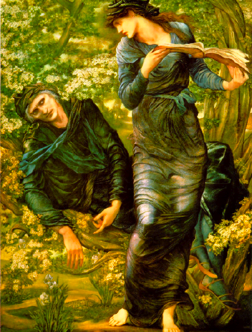
The Beguiling of Merlin
Edward Burne-Jone
http://commons.wikimedia.org/wiki/File:The_Beguiling_of_Merlin_by_Edward_Burne-Jones.jpg


In her book The Enchanted Hunters Maria Tatar tells us “Words have not just the astonishing capacity to banish boredom and create wonders. They also enable contact with the lives of others and the story worlds, arousing endless curiosity about ourselves and the places we inhabit. Such passion promises to keep us, at least intellectually, forever young.” In reading time often stops, or at least it seems to. But even if time does not actually stop, in reading well the mind retains its vigor and becomes more flexible. A story, to be enjoyed and understood requires the reader to enter its world and entertain its point of view. I must read Les Miserables with the heart of a revolutionary and The Man Who Was Thursday with a fondness for the established order (though as is true with most things Chestertonian, it must be a quirky fondness). I must be able to see and embrace the world from both sides of the fence.

This does not mean I stop being myself, or that my world view changes each time I open another book, but it does mean I have to give the point of view of the story a chance to have its say. For the sake of the story the world is seen through a revolutionaries eyes or the eyes of a gentleman with conventional views. I think it is easier for readers of stories to accept people with beliefs different from their own (not that they always will of course) because somewhere along the line there has been a story where those beliefs have been entertained and where they may not have been embraced necessarily by the reader, they have been understood and appreciated and for a fictional time the world was viewed through those lenses. Rosemary Hill in her review of a new edition of Wind and the Willows mentions another story by Kenneth Grahame, “The Roman Road.” The story, she tells us, is “a conversation between a child and an adult, its message that only the artist and the child are imaginatively free.” The reader lost in a book, I think, becomes like the child in the Kenneth Grahame story, “imaginatively free.”

The painting at the top is of Merlin, King Arthur’s magician and mentor. Like Benjamin Button in the Fitzgerald story Merlin, according to some versions of the tale, was born old and grew younger. He was a man who knew from the start what it meant to be old and came to understand what it meant to be young. He is beguiled as an old man, which would make him young and inexperienced in his reverse chronology. He knows what is coming, has foreseen it, but he has lost the wisdom of age and is experiencing the passions of his youth. Perhaps his mind has become that of an adolescent enchanted by a beautiful face. I enjoy the image of Merlin growing younger. Perhaps it is the longing of an aging man for the days of his youth or maybe it is the desire to preserve an enthusiasm for living that age and experience often quench.

“One More Step, Mr. Hands” Illustration for Treasure Island
N. C. Wyeth
http://en.wikipedia.org/wiki/File:One_More_Step,_Mr._Hands.jpg


C. S. Lewis once said, “In reading great literature, I become a thousand men and yet remain myself.” I think it is also true we become a thousand ages. The painting above is an illustration from Treasure Island. When I read this story I become Jack Hawkins, or at least like him in my imagination. When I read The Catcher in the Rye I see the world through the eyes of Holden Caulfield and become a bit like him. Though both these characters are the same age they come from different ages and therefore experience the world very differently and though as the reader I am experiencing the world of a teenager, they are very different teenagers living in very different worlds. So though the “age” I become in reading each of these stories is the same age in years it is not the same age in experience. This too, keeps the mind young and active.

Nor is youth always measured in years. I often tell people that the passage of time makes me grow older, but no power on earth can make me grow up. It can be said that Scrooge is a younger man at the end of A Christmas Carol than he was at the beginning. He is a younger man than he was when Old Marley died seven years before the story begins, if youth is measured in the way we think and behave. Unlike Merlin, Scrooge was not born old, but he lost his youth at an early age and recovers it many years later. Sometimes we need stories to remind us that being childlike is not being childish and that some aspects of age are more a state of mind than of being.

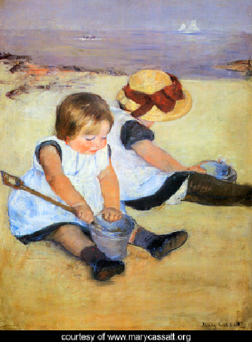
Children Playing on the Beach
Mary Cassatt
http://www.marycassatt.org/Children-Playing-On-The-Beach.html


The paintings above and below by Mary Cassatt capture certain aspects of the innocence of childhood, playing on a beach, listening to a story. It is the aspect of childhood captured in the two children on the beach that many want to recover when they get older. The children are engrossed in their “work” and nothing seems to distract their focus. Their work is their play and it is what many adults want their work to be. There is a great deal of what I do as a teacher that is like sitting on the beach filling my bucket with sand. It is pleasure and it is sunlight and it is the waves and the cry of gulls. Obviously my classroom is not a beach, there is much in my day that is like a day at the beach.

Auguste Reading To Her Daughter
Mary Cassatt
http://www.marycassatt.org/Auguste-Reading-To-Her-Daughter.html


The young girl listening to the story has a different look, a more mysterious look. Does she like the story she hears, is she listening, or is she somewhere else in her imagination? Adults often think that children want to hear a story, want to be read to, and often this is true. But I think sometimes children, like us, want to explore on their own, do not want others tagging along on the journey. In the reading of a story, whether we are reading on our own or being read to, the journey is always an individual journey, both the reader and the listener are “reading” the same story but they do not take the same journey. None of us can live in the imagination of another, though it is likely that our paths cross.

When I go to Treasure Island the island I visit resembles the island others visit, but it is unlike anyone else’s island. The journey is a personal one and that is important to remember. As a teacher I try to encroach upon the world that has been built in the minds of my students. I try to manipulate the story, to get them to see the palm tree as I see it, but of course this cannot happen. Those that see my palm probably see it only because they either did not read of the palm tree on their own or if they did, they did not see the palm tree, only the words on the page and were waiting for someone else to tell them how to draw the picture.

Baby Herman and Roger Rabbit “Tummy Trouble”
Walt Disney Studios

When we get to the end of this little film we see that the baby is not a baby (or at least we hear the voice of an old man when the baby speaks). If there is a child in this film it is Roger Rabbit, the baby is only masquerading as a child. The adventures these two have are the adventures of childhood, with all the exaggerated situations and expressions and the sense of powerlessness a child might feel in a large world that is out of control. The humor lies in the near misses and the indestructible nature of youth. Everything is dangerous and exciting but nothing, in fact, can do any harm. When the bombs burst Roger and Herman are scorched but unhurt. It is the world that some children crave that has all of the excitement that comes from living dangerously without the pain. After surviving the explosions and the flying objects both Roger and Herman leave the set to return to a safer, saner, and less exciting world.

Ursula K. Le Guin wrote a review in this weekend's edition of The Guardian of a book of stories by Italo Calvino. The book is called The Complete Cosmicomics. The stories, according to the review are very fanciful and were not taken seriously when published because they too closely resembled science fiction and science fiction, especially in the 1960’s, was not taken seriously as literature, it still isn’t by some. But they are the stories of a childlike mind, with characters with names that cannot be pronounced having experiences that cannot happen. But that is how the comic world works. That is also how the imagination often works. In the imagination we often do the impossible, say the unsay-able.

I remember as a child I had a recurring dream where I was riding a bomb to earth (this was the late 1950’s and bombs and bomb shelters were often in the news). The dream always began just after the bomb was dropped. I would wake up frightened just before the bomb hit the ground. Then one night as I was having this dream I told myself in the dream “this is just a dream and no harm can come to you”. From that moment on I enjoyed the sensation of free fall and when the bomb hit, it was like Roger Rabbit and Baby Herman, no one got hurt. Perhaps this too is part of the comic world, the world of a “mind forever young,” where there is pain there is also resilience and nothing is hopeless.

Sunday, June 7, 2009

Keeping It Simple

St. Matthew Passion "Choral: Erkenne mich, mein Huter"
J. S. Bach
American Tune
Paul Simon

Keeping It Simple

Cure for Oversleeping
Rube Goldberg
http://www.utexas.edu/features/archive/2003/rube.html


Beauty often lives in simplicity. Bach so appreciated the beauty of this simple melody that he used it again and again. Paul Simon also valued the simplicity and beauty of the tune and put it to work in his song American Tune. Whether it is a simple melody like that from Bach's St. Matthew Passion (and a half dozen others at least) or a simple explication of a poem or story, or the poem or story itself, simplicity lends a degree of elegance to the work. I like Occam's Razor ("Entities should not be multiplied unnecessarily") when it comes to most things, which simply suggests that the simplest explanation that accounts for all the facts is probably the truth. What made Rube Goldberg's cartoons so funny was that they demonstrated excessively complicated ways of solving extremely simple problems, like getting up in the morning. It is human nature, I believe, to prefer simplicity, even though we often live our lives as though our inclinations favored a different direction.

But it is important to remember that there is a difference between being simple and simple minded. The simplest explanation of a poem may be very complex and somewhat opaque. Being simple is not always the same as being easy. I think most of us equate a simple task with an easy one, when in fact it may only be simple because there are not many steps to carry out, though those few steps may place demands on our skill, abilities, and intellects. What simplifying a task often does is make it easier to focus on the work to be done, as there are not a lot of superfluous details that confuse or obfuscate. But that which demands our focus often requires all of our attention.

Double Portrait of Jean de Dinteville and Georges de Selve, called The Ambassadors
Hans Holbein the Younger
http://en.wikipedia.org/wiki/File:The_Ambassadors,_by_Hans_Holbein_the_Younger.jpg


The other side of the coin is being as simple as possible even though the work itself is very complicated. The painting above is very ornate. There are the designs in the curtains, the rug, the cloth on shelf, and in the robes of the ambassador in brown. There are many objects on the shelf as well. The detail found in the painting of the textiles is necessary to capture the reality of the scene but the objects placed in the painting have a symbolic value, many being associated with the various components of a liberal arts education of the time. Then there is that funny looking object on the floor between the two ambassadors. It is odd and appears, unlike everything else, very unreal.

It is a puzzle that Holbein placed in the painting and can only be seen for exactly what it is if the painting is viewed at the right angle, which is from the side and definitely not straight on. When viewed from the side, the strange object on the floor is seen to be a human skull. One of the stories told about the painting is that it was intended to be hung in a stairwell and that the skull would suddenly jump out at the person climbing up the stairs. One can imagine the effect this might have on a dark and stormy night. But whatever the intended effect this painting is not one that was done simply, though, it is hard to imagine it being done any more simply and still produce the effect that it does, it is as complicated as it needs to be, but not much more complicated, and that is, perhaps, a definition of simplicity.

Static-Dynamic Gradation, 1923
Paul Klee (German, 1879–1940)
Oil and gouache on paper, bordered with gouache, watercolor, and ink
15 x 10 1/4 in. (38.1 x 26.1 cm)
The Berggruen Klee Collection, 1987 (1987.455.12)
http://www.metmuseum.org/toah/hd/klee/ho_1987.455.12.htm

Some have questioned whether the work of modern artists like Paul Klee is really art at all. The painting above is a checkerboard pattern with each of the squares in a different color (in some cases the difference is very slight). But if you look at the photograph below of the Dome of the Rock you see an ancient place that takes a similar delight in geometric shapes in different shades of white, blue and brown. It is the same delight that many of us took as children in playing with a kaleidoscope, which was also play with shades and shapes.

Dome of the Rock
http://en.wikipedia.org/wiki/File:Dome_of_the_rock_close.jpg


Writing, when it is done well, evokes the simplicity or complexity of its subject but it always attempts to present its subject in as simple a light as possible. The skilled writer looks for the simplest path through the chosen subject. This is not easy and it is important to remember, simple is rarely easy. In fact what often makes poor writing poor is its unnecessary complexity that is usually an indication that the focus has been lost, that words are being used like shotgun pellets to hit everything in the hope that something might stick. I have assignments that I give where I require students to do something in a limited amount of space. They are used to getting assignments where they are told they must write at least a pre-determined number of pages, but they are rarely told they are to write no more than a page or two. I have seen students struggle more writing something that is short and to the point than with something that can be as long as they want to make it.

Simplicity, being concise and to the point, is often the most difficult thing we can be asked to do. When asked to compare writing short stories to writing novels, William Faulkner said, "You can be more careless, you can put more trash in it and be excused for it. In a short story that's next to the poem, almost every word has got to be almost exactly right, in the novel you can be careless but in the short story you can't." This is the struggle that all writers face. If they are to write well they must learn to identify what is necessary and what is not. Even in the novel where much will be forgiven, the reader's patience and tolerance is not endless and even that which is done badly must be done badly in an artful way.

Shaker Loops
John Adams


The music is called Shaker Loops. It was not initially called this, but after re-working the piece Adams thought the Shaker's ritual practice of ecstatically jumping about and their dedication to simplicity underscored what he was trying to achieve not just in this composition but in most of his work. He comes from, he helped to establish, the minimalist school of composition. The orchestrations are as bare boned as he can make them, they are very simple, but for those that are captured by the work of Adams, and others like him, there is a delight that the music provokes. For music that is as bare boned as this, melody, the most accessible quality of a musical score, plays a relatively minor role. Adams focuses instead on rhythms and harmony, a much more difficult path to ecstasy than melody.

Shaker Furniture
http://commons.wikimedia.org/wiki/File:Shaker_furniture7.jpg


The music is not unlike these pieces of Shaker furniture. There is not much more to these pieces than a graceful line combined with a skilled and sturdy craftsmanship, there is nothing "ornate" about this furniture. The simplicity of the furniture is meant to reflect the simplicity of the soul that crafted and uses it. It is somewhat ironic that one must be almost independently wealthy to afford a good piece of Shaker furniture.

In the world of school work and work itself, we are often drowning in unnecessary complexity. The philosopher Francis Fukuyama wrote a review of an interesting sounding book Shop Class as Soul Craft. The review is titled "Making Things Work" and Fukuyama delights in the idea that in shop class things have to work. He talks about how the author of the book, Matthew B. Crawford, spent his spare time while in college taking old Volkswagen engines apart and putting them back together. I took a bit of delight in this part of the review because I, as a young man in college, bought a book by John Muir (not the gentleman who introduced Teddy Roosevelt to Yosemite) that took you step by step through the dismantling and reassembling of the V. W. engine. I could not master this, having no aptitude for mechanics, myself, but I had friends who did. These friends could also attest to the importance of doing the job right. I had one friend who discovered he had not quite gotten it right when he arrived at college five or six hundred miles away from his tools, which were still at home.

It is easy when our work is done exclusively in the mind to overlook whether or not what we are thinking has any practical merit, if it will in fact work. As a professional I think I have only my instincts and judgment to rely upon. But I know from my classroom experience that often those things that I felt were working well, did not in fact accomplish the goal I had set for the exercise. On the other side of the coin, I have had the experience of feeling as though things are not working at all, that all is a dreadful failure, only to find out later that much, sometimes most, of what I set out to do had been accomplished.

This suggests to me that judgment and instinct are not always enough. My limitations as a mechanic become obvious as soon as the key is put in the ignition. The machine that is improperly assembled reveals everything, there are no secrets, there are no abstract theories, just an engine that will not take the spark and do what it does with gasoline and fire. In the end, in the classroom the educational machine must work and the only evidence that it is working is if the spark that lights the intellect and the imagination ignites and does its thing with fire.

Sunday, May 31, 2009

On Learning and Other Games of Chance

Dandelion River Run
Mimi and Richard Farina


On Learning and Other Games of Chance

Ad in the Boston Globe to Promote Reading


The dulcimer when played by Richard Farina is such an exuberant instrument. Art of all sorts for me is characterized by exuberance. Whether it be the exuberance the gentleman in the photograph brings to his reading or the exuberance dancers on prom night bring to the dance art is always an intense enterprise that demands a great deal of energy from those that would enjoy and understand it. Some think exuberance must always be cheerful, but I think it must always be energetic and enthusiastic and energy and enthusiasm are not always cheerful. The gentleman reading his book is absorbed, he is investing a great deal of mental energy in what he is doing and because he is doing what he is doing of his own free will there is, I like to believe, a great deal of enthusiasm involved in the process as well. An old philosopher said that art delights and instructs. This is probably true. But art also stimulates the mind and the emotions in ways that are not always instructive and perhaps not always delightful. The end of Twelfth Night, for example, is delightful, but I am not so certain that delight is what I feel at the end of King Lear or if it is, it is a very melancholy species of delight.

There is an autistic student I talk to with some regularity and she often asks me if there are any versions of Hamlet, or other tragedies, that have happy endings. I tell her that for Hamlet the ending is far from happy but for Elsinore and the state of Denmark things have been set right and for them the ending is happy and this is part of the point of tragedy. In the end good people suffer harm, but also a community has been redeemed and order has been restored. Scotland can be a just nation once again, Salem can recapture a truer righteousness. So in this sense all tragedy ends happily and perhaps it is here that the delight lives, though, it remains a delight wanting cheerfulness.

The Card Players
Paul Cezanne
http://en.wikipedia.org/wiki/File:Paul_Cézanne,_Les_joueurs_de_carte_(1892-95).jpg


There was an article in last weeks New York Times on taking chances. The article was actually an interview of sorts with the writer Leonard Mlodinow. It was called "What Are the Odds" and it was about speculating on the future. His basic point was that the farther we get from the present the less clear and the harder to predict the future becomes. This seems in some ways to be self-evident, but I wonder if we live our lives this way. We look at the present moment and make decisions about what will be important in the future. Some things we say are irrelevant and others we say are very relevant. But who can know the twists and turns the future will take. Mark Twain invested in a printing press that failed miserably because he did not believe anyone beside himself and his lawyer perhaps would buy a telephone.

The article suggests that what is important is preparation and gives examples of people with mediocre abilities who did extraordinary things because they were ready when opportunity presented itself. But what I found to be the most meaningful part of the article came at the end. He talks about learning to be comfortable with failure. He quotes Thomas Watson, the founder of I. B. M. “If you want to succeed, double your failure rate.” In our schools it seems that our preoccupation with grades discourages this. Failure is not seen as the first step on the road to success but the end of all hope. I believe that if I am not failing at things that I am not challenging myself, I am pursuing only those things I know I have the skills to accomplish. But to grow at anything I must attempt things that are beyond my grasp. And this means I must willingly flirt with failure and that as a teacher I must encourage my students to do likewise.

Students often do not like the books I teach in my classes. They do not believe they are relevant, but they say this without really having read the books. The problem often is that they are difficult and that students do not wish to wrestle with something so difficult. This may be because they have no interest in books or the stories of those books that I teach, or that they see no value in developing the skills that would enable them to understand these books. Who's to say they are wrong? I think these books have given comfort, joy, and wisdom to many people over many centuries and that they can continue to give comfort, joy, and wisdom. A book that has spoken to people over centuries has already demonstrated an ability to speak to times very different from those that gave it birth. This would suggest that it speaks to something that is not constrained by time but adapts with some ease to changing circumstances.

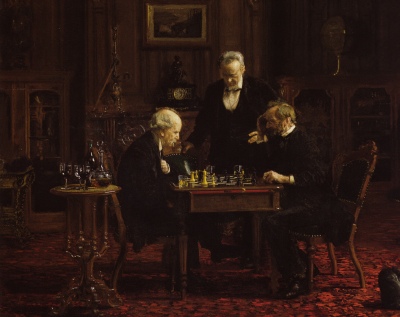
The Chess Players
Thomas Eakins
http://en.wikipedia.org/wiki/File:The_chess_players_thomas_eakins.jpeg

Perhaps education is less a game of chance and more a game of chess, a game in which luck plays a part but is not entirely a roll of the dice, there is skill and preparation involved as well. Chess is a game that, like many of the books we read in school, has survived many centuries, and if Star Trek is to be believed, will survive many more. It is a game that requires the beginning player to enjoy a bit of failure while learning to master the board. It often rewards thought and careful planning, but just as often it does not. In fact a good player must be able at each stage of the game to adapt and rework whatever plan or strategy guided the game's beginning. As the paintings above and below suggest, the game can be played by anyone, anywhere, any time; by the rich and by the poor, in a great house or in a public house, by sunlight or by moonlight.

The Chess Players
Honoré Daumier
http://en.wikipedia.org/wiki/File:Honoré_Daumier_032.jpg


This is also true of the development of the mind. All the money in the world cannot buy intelligence, though it can help those with modest intelligence develop their limited abilities to a far greater extent than those with greater intellectual gifts but fewer financial resources. It is important to wrestle with difficult things, whether it is becoming an accomplished chess player, an accomplished athlete, or an accomplished thinker. We wrestle with a difficult book for the same reason we wrestle with a difficult chess problem or a difficult equation, the wrestling grows the mind and the imagination, it reveals to us our capabilities. It is at the edge of failure that we truly learn our abilities and our limitations. The teacher must set the example. How do we teach students to test their limits if we will not find ways to reward failure? How can we understand what we are asking our students to do if we are unwilling to risk failure in our own practice?

Marieke
Jacque Brel


The song is about a man and a woman, one French and one Flemish. The French and the Flemish, at least at the time the song was written, did not get along. The love pursued by the two people in the song has to overcome cultural prejudices. This prejudice may not rise to the level of the Capulet's and the Montague's but it may feel that way to those involved. Love is one of those things that defies reason. It demands a long term commitment from people who often have not thought much or at all about the future and the nature of the commitment they are making. This is true not just of the love a person has for another person but it is also true of the love a person has for ideas, principles, and occupations. We choose our careers, for example, before we fully understand what it will be like to pursue those careers on a daily basis over many years. We embrace a faith before we fully understand how the pressures of daily living will challenge that faith and sow seeds of doubt.

As an educator I must care about those who care very little for that which nurtures me and is the focus of my work. And there is little comfort looking backwards. In the 16th century Robert Burton wrote of schoolteachers, "For what course shall he take (the learned man), being now capable and ready? The most parable and easy, and about which many are employed, is to teach a school, turn lecturer or curate, and for that he shall have falconer’s wages, ten pounds per annum, and his diet, or some small stipend, so long as he can please his patron or the parish; if they approve him not (for usually they do but a year or two), as inconstant as they that cried “Hosanna” one day and “Crucify him” the other; serving-man like, he must go look a new master; if they do what is his reward? At last thy snow-white age in suburb schools / Shall toil in teaching boys their grammar rules." Things have improved, I suppose, tenure means a bit more job security, though there are those that would seek to take tenure away. But at the end of the day there is the belief, against all odds, that most will learn, and that some will find a similar vocation, or if not a vocation, will find a similar ardor for a beautiful thing and a the subtleties of language.

According to the article the one aspect of success that is under our control is the number of chances we take. I think that many things that we think of as being difficult are only unfamiliar. That means the more chances we take the sooner the unfamiliar will become familiar and with familiarity comes a degree of success. For a teacher last year's success will not always guarantee success in the new year. Like the chess player the strategy and the plan must adapt to a different combination of moves and counter moves. Every year is new and unfamiliar. Each year must find its own road from failure to success or something resembling success. This process is difficult and it can be disheartening. But as Tom Hanks said in a movie about young women playing baseball "there is no crying in baseball" and "if it was easy, everyone would do it." The classroom is an exuberant place and it is a thing of beauty.

Sunday, May 24, 2009

Farming a Sandy Soil


Pipeline
Dick Dale
Dick Dale and Stevie Ray Vaughn
La Mer "#3 – Dialogue Du Vent Et De La Mer"
Claude Debussy
André Previn: London Symphony Orchestra

Farming a Sandy Soil

Ocean Park #129
Richard Diebenkorn
http://en.wikipedia.org/wiki/File:Richard_Diebenkorn%27s_painting_%27Ocean_Park_No.129%27.jpg


The painting and the music offer different impressions of the sea. The painting evokes the emotions associated with the color of the sea and its "wetness". The music evokes its power. Pipeline also evokes for me memories of growing up in Southern California overlooking the ocean. I sometimes tell people that I was there when the skateboard was invented. Not entirely true because there were skateboarders in my neighborhood the day I moved in, but it was when we split up one of a pair of clip on skates and nailed it to a board. I was told that surfers invented the skateboard as a way of practicing their balance on the board when they could not get to the ocean. I do not know if this is true but it seemed to make sense. By the time I graduated high school about seven years later in 1968 customized wheels and boards were on the market and friends were designing their own very fast skate boards that began to resemble those that are so ubiquitous today.

I remember while growing up there would be waves of extraordinary size that would visit the local beaches. There would inevitably be in the morning paper a photograph of a surfer who appeared as a small dot on the face of the wave riding the wave into the shore. It is in part this aspect of the ocean's power that Dick Dale, the king of the surf guitar, was evoking in his song. Debussy's impressions of the sea capture a bit more of the oceans "range of emotions" perhaps but the selection used in the musical opening captures the sea's more tempestuous nature. The sea is a force of nature whose power can overwhelm us and whose beauty can deeply move us.

For me stories have a similar kind of power. Often a story will grab me like the opening chords of Pipeline. They pull me into their depth and I remain lost there. But I also know that not everyone seems to be affected as I am by stories, or at least by the stories that move me. Many do not believe the stories of the past speak to people today. They speak to me, but that may only mean that I am an anomaly, the proverbial exception that proves the rule. But I wonder. Odysseus is a man trying desperately to get home, fighting against divine powers with a grudge. I think most of us know what it means to be lost, if only metaphorically. We are home safe in our rooms, but feel like Odysseus desperately trying to find his way home over an angry sea (he is involved in a grudge match with Poseidon, the god of the sea).

A Bigger Grand Canyon
David Hockney
http://en.wikipedia.org/wiki/File:Hockney,_A_Bigger_Grand_Canyon.jpg


Often in stories the first adversary is the natural environment, the setting of the story. In stories like The Last of the Mohicans that environment is in part the place, the wilderness in which the story takes place, but in others, like The Adventures of Huckleberry Finn the environment is the culture in which the characters are raised. The paintings by David Hockney and Georgia O'Keefe capture the stark beauty of a desert landscape but the ram's skull also suggests something of its dangers. In stories like McTeague and Death Comes for the Archbishop characters have to figure out how to survive in a hostile desert environment.

Ram's Head
Georgia O'Keefe
http://en.wikipedia.org/wiki/File:O%27Keeffe_Georgia_Ram%27s_Head.jpg


But often the hostile desert of story is found in the human heart, the heart incapable of compassion, the heart incapable of mercy or forgiveness. The Count of Monte Cristo has ample reason to seek revenge and to harbor an unforgiving heart. Heathcliff in Wuthering Heights feels more than justified in pursuing his revenge. But the strongest argument against giving sanctuary to such feelings is found in the manner in which these characters have been molded and changed by their dedication to vengeance. This is a great value of literature; it enables the reader to learn from the experience of others. This is something that we often do not do well, choosing instead to learn through our own suffering, but literature can provide an avenue for avoiding such suffering, or at least engaging some of life's snares with a little foreknowledge.

There is also something to be learned from a desert. My father owned some land in California's Anza Borrego desert. We would often go camping there. The roads into my father's parcel of land were not well maintained and in places were of dirt and sand. I think my father bought the land as a speculation. A new highway was going to be built and the parcel my father bought was on one of the proposed routes, but the state chose an alternative route. But he may not have been speculating. My father loved the desert and when he had to make a difficult decision he would often go into the desert and camp for a few days. The land was very remote and no one went there. During the day things were very quiet and the nights until moonrise were exceptionally dark. For one comfortable with solitude this was a place to plumb the depth of your thought. When the moon finally rose, the desert landscape would become nearly as bright as daylight and the sand would almost glow.

Woman Reading
Henri Matisse
http://en.wikipedia.org/wiki/File:Reading_henri_matisse.jpg


A book is a kind of wilderness in which I can lose myself as my father would lose himself in the moonrise over the desert. I am reading a book by Maria Tatar called Enchanted Hunters: The Power of Stories in Childhood. In the book she talks about how children read differently from adults. She quotes Adam Gopnik. He points out that when an adult reads to a child the adult and the child are in different worlds. He says, "In children's literature the grown-up wants a comforting image of childhood, or just a familiar name or story; the child want a boat, a way out, an example of the life beyond. The parent wants to get back, the child wants to get out."

I think this is also true of the books I teach and of the students to whom I teach the books. I want to on one level get back to the first experience I had with the book, to the pleasure and excitement the first reading afforded. I want to reawaken the perceptions I had and the understanding I had of what the author was trying to say. Now, of course, the reading I am trying to reawake may not have been my first reading of the book but the first reading of the book in which my mind was engaged and my intellect and my imagination took flight. I am looking to re-sample the literary meal the first reading offered up to me with all its emotional and intellectual intensity.

My students are trying to preserve the way they are used to reading stories; they are looking for a boat or a spaceship, a train, or a jalopy; anything that will get them into the open air. They are a bit like Mr. Toad after his first encounter with the motorcar. If the book does not provide this "magic carpet" (and provide it rather quickly in the reading process) they want to go on to something else. I am trying to teach students to begin reading as adults while they are trying to continue to read as children. I feel a bit torn when I enter this process because on one level I think I am taking away, in a sense, their belief in Santa Claus and the other myths of childhood, myths that I often want to reclaim when I go back to a book I read as a child or a more recent publication that affects children today the way the books I read as a child affected me. I understand this desire.

But I also understand the need to mature as readers and as people. This is something that books have done for me. Books that touch me deeply often bring with them an epiphany and instead of losing myself in a book I find myself. I think this is a kind of reading we all need to grow into, a kind of reading that teaches us, nourishes us, gives us a map of sorts to follow into the dusky night that is the future.

There was an article in this weekend's Los Angeles Times about reading and writing. It was written by Rich Cohen and is called "Will Facebook Kill Literature's 'Leave the Past Behind' Themes?" The main thesis of the article is that social networks like Facebook keep the past to close to us. We cannot get enough distance from our friends and the events of our youth to be able to shape them into stories. If we were to attempt what Hemingway attempted in writing about Michigan as he remembered it, or as Anderson wrote about Winesburg, Ohio we would get a message on Facebook pointing out everything we got wrong. The article is somewhat tongue-in-cheek but I think there is some truth to the writer's need for time alone with his characters and his settings so that he can shape them into the world he wishes to create, give them their own and separate reality.

I think it was E. B. White who said that not only must art not imitate life; it had better be a hell of a lot more interesting (or words to this effect). Part of the power of fiction is that it is imagined, that it is not biography or autobiography though it may contain elements of both. Fiction enables us to imagine the world as we would like it to be, or in the details we choose to emphasize clarify for the reader the world as it is. As someone has said, we experience life as a series of random events but we look back on life after it has been lived to find the purpose and the design.

Fantasia – "Night on Bald Mountain"
Walt Disney Studios


I enjoy this film in part because it is the first, and one of the few, films I saw that did not have a clear narrative structure. It is more a series of images than it is a story. The stories that are there, like the "Night on Bald Mountain" evoke a narrative structure; suggest a narrative that our imaginations can then create. There are devils and spirits and bones dancing about, there is hellfire and brimstone but why all this dancing and fire is happening is not made explicitly clear. It is a film that needs to be approached in much the same way we approach a poem, especially a poem by William Blake or Emily Dickinson that does not overtly state its purpose; that calls into question, perhaps, the need for a purpose in everything we do.

The film does what I want a story to do, it lights my imagination and lets me provide my own details. The writer of the story puts the words on the page, but my imagination puts the film into the can, so to speak. This is something else the adult reader does. The child follows the character through the looking glass or through the wardrobe or through whatever the magic door happens to be and than follows along. The child is looking for the vehicle that will take them away and the child imagines what the child must imagine in order for the story to live. But the adult paints, I think, a fuller canvas.

The adult sees the boat but also some of the invisible creatures that are swimming out of sight below the surface. The adult sees some of the pitfalls that are hidden from the child. The story may reveal these pitfalls in the course of the story or it may not, but the adult with the adult experience she or he brings to the reading sees them. I was a big fan of the Rocky and Bullwinkle show as a child. I saw the surface of the narrative and had a good time. But my parents had a good time as well and it was clear to me that they were seeing things that I was not. When I went back to some of these programs as an adult I saw some of the things my parents saw. That there were things happening that the children missed but that delighted the adult.

I think this is part of what I want to do as a teacher and a reader of stories. There is the immediate world of a story that does not require interpretation or analysis; its only demand upon us is that we enjoy it. But there is a less immediate world to the story; one that requires the reader to become a watchmaker of sorts; to disassemble the story and then to reassemble it so that the psychology of the characters can be understood, so that complexities that make the world tick can be seen, so that we can both tell the time and understand the times. It is this taking apart and putting back together that prepares us for the world in which we live; that teaches us to look beneath the surface of human events so that we can influence in our small way the course these events take. This is what I want my students to see and to embrace. But this is often farming in a sandy soil; it is working with a landscape that does not wish to nourish the seeds that have been planted. But the land must produce a harvest if those that live on it are to survive.

Monday, May 18, 2009

Things Change


Changes
David Bowie
"Una Nave da Guerra" From Madama Butterfly
Giacomo Puccini
"Que facevi Que dicevi" from La Boheme
Giacomo Puccini
"A Heart full of Love" From Les Miserables
Alain Boublil and Claude-Michel Schonberg

Things Change

"The Theft" and "The Restitution"
Max Beerbohm
http://en.wikipedia.org/wiki/File:Beerbohm_Theft_and_Restitution_(en).jpg


The David Bowie song is about changes and how we all change over time, sometimes in our own eyes, but more often, perhaps, in the eyes of others. The changes that take place between the songs and at the end of the music clip are much more jarring and a bit too noticeable, in large part due to my lack of skill with the tools used to merge the four songs. But there is a transformation within the second song that can almost go unnoticed. The aria is from the end of the opera Madama Butterfly and Madama, realizing she has been abandoned by the man she loved is preparing for the tragic ending of the story. The man who betrayed her was a United States Navy officer and if we are paying attention we notice a point in the aria where Puccini has seamlessly worked into the score "The Star Spangled Banner." It is woven into the song Madama sings. It only lasts a few seconds and then it is gone, but this musical metamorphosis reminds the listener of who the responsible party is.

The clip segues again into two other views of love that are on the one hand more positive, but in one case equally as tragic, La Boheme ends tragically for Mimi and Rodolfo while Les Miserables ends happily for Cosette and Marius. It may just be me but there seem to be echoes of La Boheme in Les Miserables. When I hear the two pieces of music separately the one evokes the other in my mind, but less so when I hear them together. Perhaps there are other similarities in the two stories that encourage this musical connection or perhaps it is just the mind's "rage for order".

Literature is about change. Stories involving characters that do not grow or learn from their actions are either dull stories or stories that are not true to life or stories about foolish people. The illustration at the top underscores a change in the artist, Max Beerbohm. I do not know if this illustration documents an actual event or if it is fictional but it does underscore a change either in Mr. Beerbohm or the character he has invented of the same name. He stole a book from a library as a young man and many years later, as an old man sees the error of his ways and attempts to put things right. Perhaps this act of restitution was the result of something he read in the book he stole, I do not know, but I know people are often transformed by what they read. St. Augustine in his Confessions tells of stealing some pears as a child and how as an adult after converting to Christianity he still carried the guilt for that action; it followed him throughout life. We can argue whether this change that came about as a result of his reading was for the better or for the worse, but it cannot be argued that the change was profound.

What we see, read, and hear changes us. This is true whether we are aware of this or not. I remember as a child watching Leave It to Beaver and shows of a similar ilk that presented the American family in a certain light, and this light colored the way I viewed the family ever after. When I started teaching the American family was represented on television by programs like The Simpson and Married with Children which presented a very different view of the family and where the view I grew up with was probably a bit too rosy, I wonder if the one my students grew up with is a bit too dark. It can be argued that there are families like those depicted The Simpsons, but the same might be said about the television families I grew up with as well.

My guess, and it is only a guess, is that the reality probably lies somewhere in between. But that is not the point. The point is to what extent is our view of family shaped by our actual experience of by the families we encounter in the media. Do we draw our own conclusions or have they been drawn for us. The issue for me is that our views are being shaped by the books we read, the movies we watch, and the music we listen to. Do we play a part in the changes that take place or are they happening without our knowledge. When the worldview of a nation or a culture changes, does it change as a result of reflections on the good and the bad in past behavior, or does it happen thoughtlessly through shifts in the stories we are told and the passivity with which we engage these stories? As an English teacher this is to me an important question, though I do not pretend to know the answer.

"Apollo and Daphne"
Piero Pollaiuolo
http://en.wikipedia.org/wiki/File:Apollo_and_Daphne.jpg

The paintings above and below capture scenes from a classical poem by Ovid, The Metamorphoses, which is entirely about change. Characters change into birds and trees and other objects from nature, stories merge into each other; the world is in a constant state of change and transformation. The poem contains in its pages most of the more important stories from the Greek and Roman myths but it also addresses character and what produces change in character. The young lady in the painting above is changing into a tree in order to avoid the unwanted advances of one of the gods, Apollo. This motif of a human character who is mobile and active changing into a tree that is rooted and bound to a single spot of land is found in other stories.

Spenser in his poem The Faerie Queen has a pair of lover so rooted. In the science fiction novel A Voyage to Arcturus a character whose will is being taken from him by another is being forced to root himself and is slowly changing into a tree. He is made to watch the roots slowly appear from his ankles and his feet. It is a rather terrifying moment in the story, for me at least. But it illustrates how things change, with or without our consent. In the story the man that is being rooted lacks the strength to fight back; his adversary is more powerful. This suggests to me how powerful forces in a culture can change those that are complacent and unreflective without their being aware of what is going on. The stories we read in school can only help us if we engage them actively; if we look at the worlds and the characters the stories offer up and question them and their reality and relevance to our own lives.

"The Spinners, or The fable of Arachne"
Diego Velázquez
http://en.wikipedia.org/wiki/File:Diego_Velázquez_014.jpg


This story of Arachne is a bit different. It is about pride and over-confidence. Arachne boasts that she is a more artful weaver than Minerva (the Roman name for Athena), one of the more prominent goddesses in the Greek and Roman mythology. Arachne losses the contest, of course and is transformed into one of nature's more capable weavers, the spider. What does this suggest about power, especially divine power. Are there forces that must be respected even though they can at times be malicious?

When I was younger I worked for a few months on a kibbutz in Israel. I left the kibbutz to see something of the country and I hitchhiked down to Elat, a small town on the Red Sea. At one point, after hours of trying, I could not get a ride. I decided it was only twenty miles to Elat and so I would walk the distance (I enjoy walking, but it is unwise to attempt a walk such as this in the desert in the middle of August). The forces of the desert are unremitting and were it not for the kindness of some Israeli soldiers with a jeep, I may not have had as happy a conclusion to my trip. Is the desert malicious or was I foolish? Does it matter in a world that can be hostile if its forces are not respected.

Still Life and Street
M. C. Escher
http://en.wikipedia.org/wiki/File:Escher,_Still_Life_and_Street.jpg


This etching by M. C. Escher plays with transformations and expectations. We see a table with a pipe, some cards, and a few books that unfolds into a busy city street. The image is discordant; this cannot be the real world. What does this suggest about the imagination? Is this just a clever piece of perspective drawing that plays with our expectations without really commenting on the nature of reality or does it suggest something about how the imagination works, perhaps how stories work? I enjoy the games that Escher plays with perspective (both in the artistic and the cognitive sense). I think about the articles on the table and what they suggest. The pipe suggests reflection, a person quietly smoking a pipe as he (or perhaps she) thinks things over, like Sherlock Holmes with a six pipe problem. The cards, to me, suggest magic and the magician's slight of hand (I was an amateur magician as a child and this may color my interpretation). The books suggest the imagination and the ability of the imagination to create new worlds, with their own city streets no doubt, as a magician might pull a world out of a hat.

I think of something G. K. Chesterton once said, “Art exists solely in order to create a miniature universe, a working model of the universe, a toy universe, which we can play with as a child plays with a toy theater.” I think there is some truth to this. We often tell stories and read stories to understand how the world works or how the world might work or be made to work differently. I wanted to say that the artist might seek to create a better world, but than one person's utopia is another's dystopia. I remember reading in Rabelais of the Academy of Theleme and thinking folks like me might find this an interesting place, but many of my students would probably feel like they had entered 1984. Most of us want to understand and to make things better, but there does not seem to be much consensus as to what constitutes a better world.

There was an article in this week's Los Angeles Times "A Room of Her Own" by Nahid Rachlin. It is about growing up in Iran and being a woman and desiring to be a writer. She eventually comes to the United States where she can get an education and where she can write. There were conflicts in her home that she had to reconcile. She was raised by a Muslim fundamentalist aunt who gave her the freedom to write and secular parents who were less tolerant, an interesting juxtaposition of stereotypes. She was drawn to reading and writing to find answers and to understand. The reading and writing did not answer the questions she had about the world in which she lived, but the reading and writing brought her peace and often happiness. I think for many this is a service that literature and the written word has provided. Reading and writing cannot change the world perhaps, but they can change us and help us to live with the things we cannot change and to work at changing those things we can change.

Frankenstein
Thomas Edison's Production

I like this film because it was one of the first films ever made and because it helped to start a genre, the Science Fiction film. The special effects by our standards are quite crude, but for 1910 I imagine they were something to write home about. I like science fiction in part because it reflects on reality and how the world might change and how in spite of all the changes that may take place, human beings often remain very much the same. One story I like a lot is A Canticle for Leibowitz. The book imagines a world that has been destroyed by human violence and then sets about rebuilding itself to the place where it can once again destroy itself. In some ways it is very pessimistic but in others it is hopeful. For though the human capacity for destruction remains so does the human capacity for kindness and compassion.

I think as we and the world grow older we have the opportunity to grow wiser, but this is an opportunity we each must accept as individuals, and it gets back to how we define a better world, Is it one with markets that do not crash and where everyone becomes prosperous, or is it one that recognizes the value of making sacrifices for the sake of others? I remember reading something about utopia by Theodore Adorno. He suggested that many of the writers that tried to imagine Utopia would think we are living in a utopia because of all the conveniences that we have. But Utopia is not about an electric blanket on a cold winter's night, but about the higher aspirations of the human heart. And to have aspirations at all we must reflect on where we are and where we might be.