Monday, August 15, 2011

Making Ourselves Uncomfortable


“Vorspiel” from Parsifal
Richard Wagner
James Levine and the Metropolitan Opera


Making Ourselves Uncomfortable

The Knights of the Round Table Summoned to the Quest by the Strange Damsel
Sir Edward Burne-Jones
http://en.wikipedia.org/wiki/File:Holy_Grail_tapestry_The_Summons.jpg


Most of the achievements we are proudest of are accomplished by making ourselves uncomfortable. They involve struggle, hardship, and a fair amount of failure before there is success. There was an article recently in the Times Literary Supplement, “The miraculous G. K. Chesterton?”, on the life and “cheerfulness” of G. K. Chesterton. Some described it as a “silly” cheerfulness because it seemed to require an unrealistic view of the world. But it is suggested that he learned to craft cheerfulness from the materials he was given. This is, or ought to be perhaps, a byproduct of making ourselves uncomfortable. The cheerfulness does not make the journey less difficult; it only makes the hardship a bit more bearable.

The music is from Richard Wagner’s opera Parsifal. The story the opera tells is of the quest for the Holy Grail. The grail has come to represent in western culture the pinnacle of excellence in any field. Bernard Malamud’s novel The Natural tells the story of a baseball player seeking the “grail” of baseball, winning the league title and the opportunity to compete in the World Series. John Feinstein, a sportswriter, wrote a book, The Majors, about the major tournaments in golf. He subtitled this book “The Holy Grail of Golf” because to win one of these tournaments is to rise to the top of the golf world.

What all grail quests have in common is the great demands they place on those involved with the quest. The quest is a trial and brings with it suffering and great discomfort. In some ways this is a metaphor for everyone’s life journey. In Le Mort d’Arthur Thomas Malory, begins his telling of the Holy Grail story with an invitation, depicted in the painting above, to the quest. The knights accept the invitation and begin set off to seek the grail. Malory says of these knights as they start their quest, “And so on the morn they were all accorded that they should depart everyone from the other; and on the morn they departed with weeping cheer, and every knight took the way that he liked best.” In other words each knight rode down the main road and when he (at this time all knights were “he’s”) saw a spot in the woods that looked inviting set off on his own personal quest, leaving the road and entering an uncharted wilderness.

This might suggest to some the line from Robert Frost’s poem, “Two roads diverged in a yellow wood, and I – / I took the one less traveled by / And that has made all the difference.” Except if we read this poem Frost also tells us that both paths were worn “really about the same.” In Frost’s poem there are two roads, not one road and a going off into the unknown, and both roads had received about the same amount of foot traffic. This is not the kind of path that Malory was talking about when he described the knights going into the woods. Joseph Campbell, in a conversation with Michael Toms, quotes from another version of the story, "They thought it would be a disgrace to go forth in a group. Each entered the forest at a point he had chosen where it was darkest and there was no way or path.” The path these knights took was untraveled and chosen because it involved risk.

The Arming and Departure of the Knights
Sir Edward Burne-Jones
http://en.wikipedia.org/wiki/File:Holy_Grail_Tapestry_-The_Arming_and_Departure_of_the_Kniights.jpg


This story of the knights setting out on their journey captures the journey each of us takes as we live out our lives. As children our parents select the paths we will take, where we will live (this may not always be the parents’ choice but it is certainly not the child’s), where we go to school, where or if we worship. Others, usually adults, play a significant role in teaching us the values we should embrace, the kind of people we should befriend, and the way we should view the world around us. At some point, though, we start to make our own decisions. At that point we leave the paths that have been chosen for us and enter the dark wood to pursue, . . . pursue what? Our own dreams and aspiration? That is part of it, but the real quest is to find ourselves, who we are as individuals, to establish our identities and we cannot really come to know ourselves without making ourselves uncomfortable.
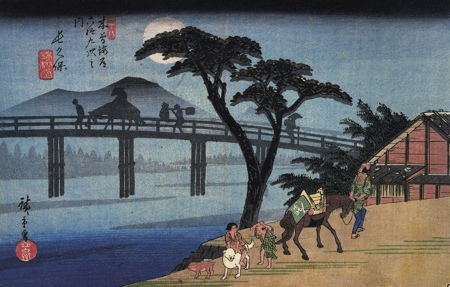

Man on Horseback Crossing a Bridge
Utagawa Hiroshige


But it goes beyond this. The paintings above and below depict people setting out on or in the midst of a journey. The painting above appears to be the beginning of a journey, it is peaceful, the moon is up and the sky is still dark. There are others on shore watching as the travelers set out over the bridge. Journeys, the easy ones and the most difficult, often begin with this kind of serenity that fosters hopefulness and optimism. There is a story in the painting, though we cannot know what it is. Though the man leading the horse and the man following the horse both seem alert and ready for the journey, the man on the horse seems slumped over and tired, weighed down by a burden of one kind or another. But in all other respects the landscape is peaceful and seems to provide an auspicious beginning to the journey.

The painting below is set in the midst of the journey after a catastrophe of one kind or another has struck. There are some people on a boat in high seas and what appears to be stormy weather. The sun shining behind the clouds may suggest hope for the future, but the present of the painting is of a small boat trying to make headway against high seas and a powerful current. There is a suggestion of landfall in the background far in the distance and tall waves yet to be encountered. We see the outlines of the people on the boat, but, unlike the picture above, not enough to draw any conclusions about how well they are enduring. When I look at the painting the first thing that comes to mind is the story of Odysseus fighting the waves Poseidon has thrown at him as he tries to reach the shore. He does eventually, after receiving a bit of help, but like the folks in the painting there were moments when the outcome did not look to be a happy one.


The Ninth Wave
Ivan Konstantinovich Aivazovsky
http://en.wikipedia.org/wiki/File:Aivazovsky,_Ivan_-_The_Ninth_Wave.jpg


There was a series of articles in The Guardian ("Yes, Teen fiction can be dark - but it shows teenagers they aren't alone" and “Teen fiction accused of being 'rife with depravity'”)responding to an article in The Wall Street Journal on youth fiction, "Darkness too Visible", that criticized the dark and violent nature of much of what is called Young Adult Literature (YAL). The concerns some parents might have that the Journal article points out are understandable, but then so are the points made by those writing in The Guardian. The problem with storytelling is that it is compelling because it captures the struggles, real and imagined, that people confront. The novelist Vladimir Nabokov did not care for happy endings and argued that stories that ended happily were not realistic. There may be truth to that but I suppose that largely depends on where one chooses to end the story.


Life is made up, for most of us, of a mix of happy and sad. And then of course, one must consider what is meant by a happy ending. Is a story that ends on a sad or melancholy note with a glimmer of hope a happy ending or a sad ending? When we finish a book like The Grapes of Wrath does the ending leave us feeling hope for the human race in general and the Joads in particular or does it leave feeling an overwhelming sadness. A lot depends on how we interpret the final moments of the novel. It is very difficult to connect with a story, to be captured by it, if we do not empathize with the characters and empathy is usually provoked by struggle and the hardships the characters encounter.

The fiction that many young adults read may be dark and violent, but than so is the fiction read by many adults who are not so young. Perhaps it helps us cope, perhaps it enables us to experience vicariously the adventures we cannot experience in reality. Which is worse, hardship or boredom? Most of the things in life that give us pleasure and make us happy only give us pleasure and make us happy because they are ephemeral, they do not last. The longer they last the more likely it is the pleasure will turn to ennui. This is not to say we should cut the good times short, enjoy them while they last, but appreciate the fact that they end before we are sated by them.


Arvind Gupta
TED Talk

The film is of a toy maker and his work. He uses simple everyday objects to make toys for children. These toys often teach principals of science and mathematics but they teach without interrupting the play. I think the film illustrates that our capacity for play is fed by imagination and I believe this to be true no matter how expensive the materials used to construct our toys. It also illustrates that learning is an act of the imagination; understanding often has its roots in our ability to imagine a principal at work. These toys were developed with poor children in mind but one need not be poor to get enjoyment from playing with them (one also need not be a child to play with them). Toys, like those Arvind Gupta makes, often ease the struggles of growing up and perhaps this takes us back to the stories young adults are reading.

Growing up is a struggle for most, no matter what advantages we are born with. The toys we play with often help us to shape our identities, they give us a chance to experiment with playing roles. Like stories where we imagine ourselves entering the wood where it appears to be the darkest and in our encounters with the darkness learn something about ourselves. It is in stories that we begin to explore who we are and question our ability to hold up under circumstances similar to those encountered by the characters in the stories. It is in play that we begin to act out some of the things we are coming to understand about ourselves. In any adventure, no matter how desirable it appears on the printed page or in the world of play, there is an element of danger that frightens us and fuels our self doubt. Those doubts can only be eased by the struggles and challenges we face and overcome in daily living.

The Forging of the Sampo
Akseli Gallen-Kallela
http://en.wikipedia.org/wiki/File:Gallen_Kallela_The_Forging_of_the_Sampo.jpg


The painting, The Forging of the Sampo, is from an event in Finnish mythology. No one really knows what the Sampo is; all that is clear is that it is a magical object that provides good luck and protection to whoever possesses it. The ambiguity that surrounds it makes it a useful metaphor for whatever it is that brings us good fortune because whatever it is, it is different for everyone. Most cultures have produced charms, talismans, amulets; objects of one kind or another that are usually worn that ward off evil of one kind or another and keep us safe and prosperous. Perhaps they work because we believe they will work, the way a placebo drug works on patients who believe they are being given a real cure. The stories we carry with us are often a talisman against the darkness we encounter, the troubles that life brings. If we never make ourselves uncomfortable we may have fewer encounters with the forces of fear and doubt. We may live more comfortable lives, but with this kind of comfort often comes a profound dissatisfaction and an emptiness that can only be filled by tribulations of one kind or another, and just as the talismans we each carry are unique to each of us, so are the troubles.

Pacific
Isaac Levitan
http://en.wikipedia.org/wiki/File:Isaak_Ilitsch_Lewitan_003.jpg


Sunday, May 15, 2011

On Writing Things Down


Telling Stories
Greg Brown


On Writing Things Down

Poster for Congress of Industrial Rights
Ben Shahn
http://en.wikipedia.org/wiki/File:Poster_RegtoVote.jpg


The old adage tells us that a picture paints a thousand words. The painting above is mostly a painting of words that is, I suppose, intended to suggest a thousand more words or more. Many things in life begin with writing something down. Revolutions often begin with declarations of one sort or another that have been written down in an attempt to explain what it is that makes revolt necessary. Often many things were written down before the declaration was issued that got things going. Thomas Paine, for example, wrote many things before Thomas Jefferson penned the declaration that initiated revolt.

The song that started things is called Telling Stories and it is often the stories that are told that interpret the events that provoke the anger that precipitate the revolt. After the revolt is finished there may not be agreement as to the veracity of the stories that got things going, but be that as it may, the revolutions themselves certainly speak to the power of telling and interpreting stories. Of course there must be a reality, even if it is a misperceived reality, that gives credibility to the stories that are told or else whatever power the stories have would never live outside the covers that contain them. As the song, and our own experience, suggests stories shape destiny, even those stories that live only inside the covers of the books that contain them.

Michael Chabon in an article written in the New York Review of Books, “‘The Phantom Tollbooth’ and the Wonder of Words”, writes about how his career as an author began with the reading of a book, not just the story the book told, but also the way in which that story used and played with language. Writing things down, at least for those that enjoy writing things down, is about playing with language. Someone, it may have been a student, once asked W. H. Auden what does one have to do to become a poet. Auden responded (and I do not remember the exact quote) that to be a poet you have to enjoy standing around and listening to words talk to each other. Perhaps this is true for anyone who does things with language.

I enjoy the Skaldic poets and one of the features of their poetry that is especially attractive to me (though it drove me nuts when I tried to translate it in college) is the way these poets mix up the words. Old Icelandic is an inflected language, which means the words’ endings reveal the place the words occupy in the sentence, not the order in which the words appear in the sentence as is the case in English. Icelandic prose, like most inflected languages, orders the words in sentences in ways that are easy to follow so that word order is much the same as it is in English prose, but the poets often abandon word order all together and this means that the listener or reader has to pay attention and put the sentences together as the poem unfolds. This is part of the fun and where a measure of the enjoyment lives for this poetry.

Study for Distortions; Isometric Systems in Isotropic Space—Map Projections: The Cube, 1978 Agnes Denes (American, born 1931)
Watercolor on graph paper, pen and ink on clear plastic overlay
17 x 14 in. (43.2 x 35.6 cm)
Gift of Sarah-Ann and Werner H. Kramarsky, 1983 (1983.501.3)
© Agnes Denes
Source: Agnes Denes: Study for Distortions; Isometric Systems in Isotropic Space—Map Projections: The Cube (1983.501.3) | Heilbrunn Timeline of Art History | The Metropolitan Museum of Art
http://www.metmuseum.org/toah/works-of-art/1983.501.3

The pictures above and below illustrate another aspect of where the pleasure of using language comes from, from expecting the unexpected. Using language too conventionally and too “properly” rarely provides much pleasure. The pleasure of language, for the reader as well as the writer, comes from living on the fringe of syntax and proper usage, not all the time but at the appropriate times, when doing the unorthodox draws attention to something or invigorates something. The drawing above is titled Cube. Everyone knows immediately what it is they are looking at, they are just surprised to see something so familiar look so unlike itself. This suggests that it is important to find ways to be unconventional without being incomprehensible.

The painting below suggests, perhaps, that while it is important not to be too obscure, there is a value to being not entirely transparent. The painting is calledConcord. It consists of two tan parallel lines on a blue background. There is concord in the colors, they do not clash but are comforting to look at and the lines being parallel also suggests concord. There is a peacefulness to the painting that underscores the message suggested by its title, but there is nothing concrete that speaks concord or peace to us. There is also a pun of sorts in the painting, the second syllable of “concord” is “cord” and the parallel lines suggest two cords side by side. The prefix “con” means “with” and the syllables taken together suggests how the painting is done, “with cords.” There are other games the viewer of this painting might play with the images; stringed instruments and the chords that are played on them come to mind. It is this kind of playfulness with language that might be found in the Skaldic poets and in many other poets and writers that enjoy the multi-dimensionality of words, syntax, and the architecture of meaning.

Concord, 1949
Barnett Newman (American, 1905–1970)
Oil and masking tape on canvas
89 3/4 x 53 5/8 in. (228 x 136.2 cm)
George A. Hearn Fund, 1968 (68.178)
© 2010 The Barnett Newman Foundation, New York / Artists Rights Society (ARS), New York
Source: Barnett Newman: Concord (68.178) | Heilbrunn Timeline of Art History | The Metropolitan Museum of Art
http://www.metmuseum.org/toah/works-of-art/68.178

There was a recent article on the discovery of “sacred trash.” The article, “Buried Treasure”, is a review of the book Sacred Trash: The Lost and Found World of the Cairo Geniza by Adina Hoffman and Peter Cole. The book is about the manuscripts that were found in the Cairo Geniza. The review informs us that a geniza is “a traditional storage place for worn or discarded Hebrew texts containing the Divine Name.” These texts included not only old Torah scrolls and prayer books, but also books and documents that were more literary or historical than sacred. Some were just documents that detailed aspects of daily life and recorded the activities of the community. There was also found a manuscript containing poems by a female poet. Hers are the only poems by a woman to be found in the geniza and prior to this discovery her work was completely unknown. It is ironic that she is only identified as “the wife of Dunash ben Labrat” and that though her work now survives her name does not.

One of the people the book focuses on was a scholar at Cambridge University who was visited by some folks asking him if he had an interest in some old documents. They gave him a few samples to look at and he recognized among them a manuscript of the Hebrew original for the Apocryphal book of Ben Sira, or in the Christian Bible, the Book of Ecclesiasticus. Prior to this the only exiting copies of the book were those from the Greek Septuagint translation of the Jewish Bible. It is difficult to imagine how exciting this must have been. For someone who loves language, stories, and history, to say nothing of the religious emotions that must have been felt by a student of rabbinic literature, probably nothing could equal the excitement generated by this unexpected visit.

The Marketplace, Vitebsk, 1917
Marc Chagall (French, born Russia, 1887–1985)
Oil on canvas
26 1/8 x 38 1/4 in. (66.4 x 97.2 cm)
Bequest of Scofield Thayer, 1982 (1984.433.6)
© 2010 Artists Rights Society (ARS), New York / ADAGP, Paris
Source: Marc Chagall: The Marketplace, Vitebsk (1984.433.6) | Heilbrunn Timeline of Art History | The Metropolitan Museum of Art
http://www.metmuseum.org/toah/works-of-art/1984.433.6

When things are written down it is impossible to know when or in what context the words will be rediscovered. There is a science fiction story called A Canticle for Leibowitz. In this story a similar excitement is generated by the discovery of a grocery list. You will have to read the story to find out what could cause something so simple as a grocery list to generate such excitement. The first explorers of the Cairo Geniza were interested in the literary and sacred texts but subsequent explorers brought their enthusiasm to the investigation of bills of lading, wills, and court records. These were exciting not because of the power of their language but because of what they revealed about the way life was lived in the Jewish community of medieval Cairo. The stories these documents tell have to be inferred from what all the bits taken together suggest. They revealed what things cost, identified their trading partners scattered throughout the world, and identified what was to them the known world. For those that are moved by the human experience and how it has changed and stayed the same over time these documents must be very exciting.

Handspring Puppet TheaterTED Talk

Theater is another medium in which what is written down is passed along to others. The written words on the page are often a mystery, how does the speaker feel who is saying the words, what is the environment in which the words are spoken like, what do the characters look like. When we pick up a play script we see only the dialogue, this is especially true of the script as it was first performed, as usually things like set descriptions and character movements and behaviors were added later by the stage manager of the first production of the play. There is little to inform us about what things look and sound like. The imagination must fill the gaps and this is not easy for everyone. The video is about the construction of puppets that were used by a puppet theater and describes how these “creatures” were brought to life. As I watch this video I am amazed at what the puppet masters can do and create and how so much larger than life the puppets become.

It is surprising how much can be done with puppets. I remember reading plays by the Japanese playwright Chikamatsu. Many of his most tragic plays were done originally as puppet theater. It is difficult for me with all the images of puppet theater that I bring from my childhood to imagine how a play as serious as a tragedy could be performed by puppets and not lose some of its seriousness. But puppets were a conventional part of the Japanese theater of Chikamatsu’s day. Of course, when I consider that Greek tragedy was often done with actors in masks and on stilts and the like I start to imagine actors who look almost like puppets and then the leap to the Japanese theater is not so great. Part of this is custom and imagining Chikamatsu’s plays is another way of expecting the unexpected.

Why do we write things down? Why do we tell stories, keep records, and document daily activities? What motivates us to do these things? Often writing things down helps us to understand and make sense of what we see as we watch the world as it is go by. But not all the horizons we overlook or seek are to be found on maps. The horizons of our imaginations can often only be approached through language and what has either been written down by us or by others. For those that enjoy it writing things down is often how the horizons of the imagination are preserved and the words become the maps of our different journeys.

Passenger, 1999
Doug Aitken (American, born 1968)
Chromogenic print mounted on Plexiglas
39 9/16 x 48 1/16 in. (100.5 x 122 cm)
Purchase, Alfred Stieglitz Society Gifts, 2004 (2004.223)
© Doug Aitken
Source: Doug Aitken: Passenger (2004.223) | Heilbrunn Timeline of Art History | The Metropolitan Museum of Art
http://www.metmuseum.org/toah/works-of-art/2004.223


Sunday, April 17, 2011

Whan That Aprill with His Verses Soote


Jerusalem
Hubert Parry
Royal Philharmonic Orchestra

Whan That Aprill with His Verses Soote

Preface to Milton
William Blake
http://en.wikipedia.org/wiki/File:Milton_preface.jpg

April is National Poetry Month. For students across America made to study poetry (or at least certain poems) against their will this might also make April the cruelest month. Of course for poetry to be properly appreciated it needs to be not so much studied as contemplated, reflected upon in the context of our lives and how they are lived. In studying poetry the focus often shifts from the passions that were aroused in the poet and which the poet is in turn trying to arouse in the reader to more academic concerns that, though they are important and should be considered, are beside the point. There was a recent article by Sven Birkerts in Lapham’s Quarterly on “idleness, “The Mother of Possibility”, in which he says,

“On a similar track, I wonder about childhood itself. I worry that in our zeal to plan out and fill up our children’s lives with lessons, play dates, CV-building activities we are stripping them of the chance to experience untrammeled idleness. The mind alert but not shunted along a set track, the impulses not pegged to any productivity. The motionless bobber, the hand trailing in the water, the shifting shapes of the clouds overhead. Idleness is the mother of possibility, which is as much as necessity the mother of inventiveness. Now that our technologies so adeptly bridge the old divide between industriousness and relaxation, work and play, either through oscillation or else a kind of merging, everything being merely digits put to different uses, we ought to ask if we aren’t selling off the site of our greatest possible happiness. ‘In wildness is the preservation of the world,’ wrote Thoreau. In idleness, the corollary maxim might run, is the salvaging of the inner life.”

There is a sense in which poetry was created to feed idleness. It will not be understood quickly and does not make many concessions to multi-tasking. It wants our undivided attention; it wants to force upon us a “Sabbath rest” that invigorates and nourishes our consciousness. What well written poetry does more often than it does anything else is change the way we see things; it enables us to see more clearly and deeply its object.

The song that began this is a poem by William Blake set to music. The illustration at the top of the page is Blake’s engraving designed as a visual accompaniment to the poem’s language. The song and the engraving underscore both the musicality of the poem’s language and vividness of its imagery and what is true of this poem is true of many, perhaps most poems; to be fully appreciated they should be heard and allowed to paint their pictures in the hearers imagination. Poems are more than words on a page. And where it is true that all written language is more than words on a page, poetry often becomes more incomprehensible the more it is reduced to the words that form the sum of its parts. Where a novel or an essay is using language to tell a story or communicate an idea, poetry is often using language to evoke, suggest, or point to something beyond itself and in this sense paying too much attention to the words themselves obscures what the words are trying to do.

Buttermere Lake, with Park of Cromackwater, Cumberland, a Shower
J. M. W. Turner
http://commons.wikimedia.org/wiki/File:Turner_Buttermere_Lake_with_Park_of_Cromackwater.jpg

In many ways poetry and painting are alike. The painting above is an impressionist landscape by J. M. W. Turner. It creates an image of water, mountains, rocks, vegetation, and sky. There is a boat in the water and one or two people in the boat. It provokes in the viewer an emotional response to the natural world and to its beauty and wildness. The images in the painting are not unlike those found in the opening lines of William Wordsworth’s poem “Tintern Abbey”

Five years have past; five summers, with the length
Of five long winters! and again I hear
These waters, rolling from their mountain-springs
With a sweet inland murmur
. — Once again
Do I behold these steep and lofty cliffs,
Which on a wild secluded scene impress
Thoughts of more deep seclusion; and connect
The landscape with the quiet of the sky
.
The day is come when I again repose
Here, under this dark sycamore, and view
These plots of cottage-ground, these orchard-tufts,
Which, at this season, with their unripe fruits,
Among the woods and copses lose themselves,
Nor, with their green and simple hue, disturb
The wild green landscape. Once again I see
These hedge-rows, hardly hedge-rows, little lines
Of sportive wood run wild; these pastoral farms,
Green to the very door; and wreathes of smoke
Sent up, in silence, from among the trees,
With some uncertain notice, as might seem,
Of vagrant dwellers in the houseless woods,
Or of some hermit's cave, where by his fire
The hermit sits alone.

There is not a one to one correlation; not everything in the painting is in the poem and not everything in the poem is in the painting but they both evoke a similar landscape and arouse similar emotions. The language of the poem is familiar and transparent; its meanings are not hidden.

The Magpie
Claude Monet
http://en.wikipedia.org/wiki/File:The_Magpie.jpg

Not all poetry, though, is as easy to follow. The painting evokes the winter landscape and the emotions winter often brings. The poem “the Snow Man” by Wallace Stevens evokes similar emotions, though the language is less transparent and not so easily understood.

One must have a mind of winter
To regard the frost and the boughs
Of the pine-trees crusted with snow;
And have been cold a long time
To behold the junipers shagged with ice,
The spruces rough in the distant glitter
Of the January sun; and not to think
Of any misery in the sound of the wind,
In the sound of a few leaves,
Which is the sound of the land
Full of the same wind
That is blowing in the same bare place
For the listener, who listens in the snow,
And, nothing himself, beholds
Nothing that is not there and the nothing that is.

There is found in both the painting and the poem frost and the boughs of trees and snow to surround the listener. But there are meanings to the poem beyond what the eye can see and the ear can hear. The language of the poem conceals meanings beneath the snow it captures that the painting does not. Or perhaps it does, perhaps it takes a mind of winter and an ear attuned to the sounds of winter to appreciate the painting as fully as Monet would wish.

Oscar Wilde said, "It is only shallow people who do not judge by appearances. The true mystery of the world is the visible, not the invisible." I am not sure what Wilde meant by this, but it suggests to me that first impressions, those impressions that attract us to something are taken in through the senses. There is something I can see in the poem and the painting that attracts my attention even though I do not fully understand what I see. There is a mystery to be unraveled but the mystery is suggested by what appears on the surface of the canvas and the surface of the language. The first impression is “superficial” but it need not be “shallow.” The depth of that impression is determined by how deeply I pursue the mysteries the surfaces of the canvas and the language evoke.

Rogier Van Der Heide
TED Talk


The video clip suggests another aspect of this mystery of first impressions, of the play of light upon surfaces to create beauty. Using terms like “light” and “darkness” often suggests to us metaphorically “good” and “evil.” But that is not necessarily what is being suggested so much as the need for contrast in order for any surface to be fully appreciated. Robert Browning suggests this in the closing lines of his poem “Home Thoughts from Abroad,” when he says, “And though the fields look rough with hoary dew, / All will be gay when noontide wakes anew / The buttercups, the little children's dower / - Far brighter than this gaudy melon-flower!” He is contrasting England’s less sunny landscape with the overly bright “gaudy” landscape of Italy. As is seen in the video when Van Der Heide compares brightly, uniformly lit spaces with those that are less uniformly lit. And even in his examples of cityscapes and of the planet viewed at night from space there is beauty, even though the light is not being used efficiently, in these images that contrast light and dark.

It might be argued that the beauty in a typical Ansel Adams photograph, or any black and white photograph, is created entirely by the contrasting of light colors with dark colors. But more importantly for me and what I am trying to say is what this suggests about poetry. The poems that often resonate the most, touch the reader the most are those that contrast effectively the expected with the unexpected; “the nothing that is not there” with “the nothing that is.” The line is a surprise and it delights us and it delights itself in keeping its secrets close.

The Tyger
William Blake
http://en.wikipedia.org/wiki/File:The_Tyger_BM_a_1794.jpg

This element of surprise is also seen in the poem “The Tyger” by William Blake. The surprise begins with the engraving Blake made to illustrate the poem, especially the engraving of the “tyger.” The tyger in the poem is a terrifying creature and though we may not be entirely sure what Blake means in this poem we are entirely sure we would not like to meet this tyger. The poem evokes something more akin to the tiger in the painting below than the “stuffed animal” suggested by Blake’s illustration. And that is part of the surprise. We see from the contrast of the tyger with the lamb a suggestion that this wilder beast is a being equated with the devil as it is contrasted with that tamer beast "the lamb of God.” Perhaps what Blake means to suggest is that evil resides only in our minds and that the world exists in contrasts of light and dark and that neither is “bad” and that both are necessary; that, as Pope suggests in his “Essay on Man” “whatever is, is right.” Or perhaps Blake is suggesting something far more subtle, that evil often appears to us in the guise of innocence and that because we expect the face of evil to terrify us, we do not recognize it when it makes us smile.

Tyger Tyger, burning bright,
In the forests of the night;
What immortal hand or eye,
Could frame thy fearful symmetry?

In what distant deeps or skies,
Burnt the fire of thine eyes?
On what wings dare he aspire?
What the hand, dare sieze the fire?

And what shoulder, & what art,
Could twist the sinews of thy heart?
And when thy heart began to beat,
What dread hand? & what dread feet?

What the hammer? what the chain,
In what furnace was thy brain?
What the anvil? what dread grasp,
Dare its deadly terrors clasp?

When the stars threw down their spears
And water'd heaven with their tears:
Did he smile his work to see?
Did he who made the Lamb make thee?

Tyger Tyger burning bright,
In the forests of the night:
What immortal hand or eye,
Dare frame thy fearful symmetry?

Tiger in a Tropical Storm (Surprised!)
Henri Rousseau
http://en.wikipedia.org/wiki/File:Surprised-Rousseau.jpg

How necessary is poetry to life? Can we get along without it? Plato seemed to think so and would have banished poets, he suggests that they lie, distort, and create discontent within a society. His pupil Aristotle felt otherwise. Many avoid poets, not for the reasons Plato suggests but because poetry has gotten a reputation for being difficult to understand requiring too much work to offer any real pleasure. But to those that read poetry and enjoy it the pleasure lies in working things out grappling with the meanings the poems often conceal. But this is often true with life in general. What is easy is often boring; what comes without effort rarely satisfies. There is something in the poem that enchants us and it is this sublime enchantment that the reader and the writer of poetry seek. I think it is this enchantment that we all seek.


Sunday, March 13, 2011

If Young Hearts Were Not So Clever


In My Room
The Beach Boys

If Young Hearts Were Not So Clever

Eton Library
Frederick Mackenzie
http://www.wikigallery.org/wiki/painting_255098/Frederick-Mackenzie/Eton-College-Library

The paintings above and below capture the images that many of us have of learning; the private space where the study is done and the overcrowded public space where that study is tested. The world of the library has an enchantment for some and is a desirable space, but the overcrowded hall gives pleasure to very few. For too many, perhaps, learning is characterized by this second space and it is a space that most want to escape. Even those that earn their living managing and directing this academic space do not feel entirely at home in it when it is given over to activities like the one depicted in The Writing School. It may be a necessary evil, but few are comfortable in the presence of evil, even those that are for one reason or another, necessary.

The title comes from a poem by A. E. Housman that suggests that too much thought can only bring us grief. But I think the poem ironic and maybe the real message is something different; that perhaps some do not think enough, and that those that do think do not think enough of others. There was an article in the Boston Globe recently, “The power of lonely”. It is about the importance of spending time alone with our thoughts and ourselves. The title is misleading, the essay is not about loneliness so much as solitude, which is not really the same thing, we may be lonely when in solitude, but we need not be and that really is the point of the essay. As in the song, a room is a place we can go to search ourselves and to escape what troubles us, including loneliness. The point of the article, and perhaps the song as well, is that without time spent alone in reflection we often do not fully comprehend what we have learned and experienced, in fact we often do not retain what we have learned and experienced without privacy and reflection.

Writing School
Frederick Mackenzie
http://www.wikigallery.org/wiki/painting_255082/Frederick-Mackenzie/Writing-School

One of the paradoxes of stories is that they are, usually, read in solitude, but they involve the reader in the world of others, sometimes the world at its most private and intimate and sometimes at its most rowdy and public. As readers we are drawn into a world filled with people and noise and activity. If we are good readers that world becomes as real in our imaginations and the people as much a part of our lives as the physical world that we inhabit and all the people in it. So when the ghost of Christmas Past shows to Scrooge his young self alone in the schoolhouse, because his friends have all gone home for the holidays, Scrooge sees not only himself, but the characters in the stories he read as a child. He says to the spirit, “'Why, it's Ali Baba!' Scrooge exclaimed in ecstasy. 'It's dear old honest Ali Baba!’” And in the story Dickens tells Ali Baba is as much a part of the scene as the boy Scrooge and the dark old schoolhouse.

Picture of Ali Baba
Maxfield Parrish
http://commons.wikimedia.org/wiki/File:Ali-Baba.jpg

So Scrooge alone need never be alone and we alone need never be alone, even if the “friends” that surround us are visible only to us, and live only in our thoughts (for no two readers bring a story’s characters to life in quite the same way, they are like fraternal twins with the same names). Stories move us in the reading of them; they come to life as we experience the words with which they are told coming to life in our imaginations. But just as it often takes time for us to absorb all we have seen on a visit to a place we have never seen before, it often takes time to fully experience the stories that we read. There is the mystery of the first impression, who fully understands what it is in a story that captures us, and there is the unraveling of parts of the mystery as we contemplate what we have read.

William Wordsworth wrote in the Introduction to The Lyrical Ballads, "I have said that poetry is the spontaneous overflow of powerful feelings: it takes its origin from emotion recollected in tranquility: the emotion is contemplated till, by a species of reaction, the tranquility gradually disappears, and an emotion, kindred to that which was before the subject of contemplation, is gradually produced, and does itself actually exist in the mind." Wordsworth was expressing his belief about how poetry is written, but there is something to be said perhaps about the imagination following a similar path in the act of reading as well.

The experience of reading is very subjective, we are all moved by different kinds of stories and though many readers like the same stories, I wonder if any two readers share an identical list of “important stories”, life changing stories. What we do with the stories we read after we have read them is often objective, the focus of study and analysis where we try to understand why we were moved as we were. This study in turn often reproduces some of the emotions the original reading produced. The initial emotion is subjective, the contemplation in tranquility is objective and this objective contemplation in turn produces a subjective experience. It is in working our way back from study to the recreation of the emotion that we often learn the important lessons that reading has to teach. If we stop after the first reading and never proceed to contemplation we may be left with a plot and the memory of a pleasant experience, but I wonder if this is enough to teach us much or to produce any kind of epiphany.

Solitude
Frederic Leighton
http://en.wikipedia.org/wiki/File:Frederick_Leighton_-_Solitude.jpg

The paintings above and below depict people in solitude and contemplation. In both pictures it appears that there is something melancholy about the depiction of solitude. In the painting of the Eton Library displayed earlier the most prominent colors are shades of blue a color often associated with melancholy. This is often the view of solitude and contemplation that comes most immediately to mind when these words are mentioned. I think it is in part this view of being alone that urges some of us to avoid spending time with ourselves and to make the mistake made by the author of the article who in the article’s title equated loneliness with solitude. Where it is true that too much time alone can produce a melancholy state of mind, too much time in the presence of others often produces a false contentment, a contentment not based on satisfaction with who we are or what we have done, but on keeping discontent at bay.

Portrait of Dr. Gachet
Vincent Van Gogh
http://en.wikipedia.org/wiki/File:Portrait_of_Dr._Gachet.jpg

There has to be a middle ground between thinking too much and thinking too little. There was an article in The Chronicle of Higher Education, “The Case for Play”, that offsets, perhaps, the article on solitude and balances it out a bit. Just as it is important to spend time alone in thought and contemplation, it is also important to play and perhaps to find ways to incorporate play into our learning. Children who do not learn how to make friends and to make time for leisure and fun, are not likely to grow up to be healthy adults. And this is not just fun in the sense of having a good time, though it is that, but the nurturing of the ability to create enjoyment from the materials we are given. Creation is at the heart of recreation, if we are to be truly carefree we need to learn how to find delight in what we have, to invent our games and pastimes from the commonplace. Even if we have the resources to buy whatever we want, there is often greater satisfaction gotten from making our fun from the simplest most attainable things. It is not the materials but the relationships that are important and it is often the inventing together of our pastimes that build these relationships.

There was also a recent article in Lapham’s Quarterly, “Vanishing Act”, about a young girl, Barbara Follett, who began her career as a novelist at the age of eight. Her father was a prominent writer, Wilson Follett. He wrote an influential book found in the libraries of many English teachers, American Usage, on grammar and such. He gave his daughter Barbara a typewriter and a room of her own. She spent serious time alone writing and with the guidance of her father produced a novel that was eventually published. The book received wonderful reviews, except for one that did not fault the writing but the wisdom of a parent encouraging a child to write this seriously at such a young age. Wilson Follett soon after divorced his wife, started a new family, and left Barbara to fend for herself. She did not do well and at 25 she disappeared and was never heard from again by anyone. The mystery is still unsolved. She depended overly much on a father who disappeared for guidance and did not learn enough of how to build relationships with others.


The Ahn trio
TED Talk

Of course there is another connotation to “play” that is suggested by this video clip, the making of music, the playing of an instrument. I think it is interesting that we refer to something as “play” that requires so much work and such intense concentration to do well. The playing of music also requires us to play well with others, at least most music does, even soloists need accompaniment, even the folksinger accompanying her or him self on an instrument depends on a crew of technicians to be heard. What is meaningful in this for me is the suggestion that those things we work hard at can also bring us intense pleasure and that work and play need not be two different things.

Sports, too, require this kind of teamwork if we are to play well. It is interesting I think that this kind of teamwork can often bring together people who would normally not be the best of friends. The picture below is of soldiers playing baseball during the Civil War. Soldiers on both sides loved this game and played this game. It is perhaps a healthier form of competition because everyone gets to play again tomorrow. The Housman poem ends, “'tis only thinking / Lays lads underground.” Perhaps there is truth to this, but I think if this is true it is because the wrong people are doing the thinking and that those doing the thinking have probably thought more of ends than of consequences.

Baseball Played During the Civil War
http://www.rpi.edu/~fiscap/history_files/hisproj1_files/civil.jpg


Sunday, February 13, 2011

A Storied Life


Scheherazade, symphonic suite for orchestra, Op. 35: III. “The Young Prince and the Young Princess. Andantino Quasi Allegretto”
Nikolai Rimsky-Korsako
Fanfare for the Common Man
Aaron Copeland


A Storied Life

Medieval Town by WaterAfter a painting by Karl Friedrich Schinkel (original painting destroyed by fire)
http://commons.wikimedia.org/wiki/File:Medieval_Town_By_Water.png


Ezra Pound in one of his saner moments said, “Man reading should be man intensely alive. The book should be a ball of light in one’s hand.” Books work magic, it is not clear how, not to me anyway, but that is the nature of magic, perhaps the definition of magic itself, something marvelous that defies definition. Reading, or appreciating art of any kind, does not make us better people; some of the worst people that have ever lived had very profound artistic sensibilities. They read the best books, listened to the best music, were moved by the best paintings and sculptures. This ability to appreciate the sublime added depth to their experience of life, but it did not make them good people. It enriched their experience; it did not impact on their humanity. Of course it can also be said that many of the most humane people that ever lived had this same experience of the sublime. It may be that those that brought virtue to their experience of the sublime experienced and understood more fully and more deeply, but that is something that cannot be known with any certainty.

When I look at the painting above I wonder what the original looked like. I am saddened that it has been destroyed because I find the copy so moving. Perhaps the painting that lives in my imagination is not only finer than the copy, but finer than the original as well (as far as that goes, the copy may be finer than the original for all that anyone can know). There was an article in the Boston Globe, “Well worth not reading,” about the books we imagine based on the blurbs on the back cover, or the cover illustration, or a sampling of the text. It is about the books we have encountered but have not read. I am not sure I like this article as much as I imagined I would when I began to understand its premise, though I do think there is truth to it. It is a bit unsettling perhaps for someone who teaches others to read books to contemplate the advantages of not reading them, but it must be owned that there are many books that I have read that did not live up to the expectations created by the first impressions they made. I am glad though that I gave them the opportunity to speak their piece.

The music suggests our first experience with stories, the fairy tale story of the princess and the prince, and the audience for stories, the common man. Though Scheherazade’s princesses and princes often behaved as princesses and princes should, those of the Brothers Grimm and other tellers of folk tales often behaved as though their origins were a bit more humble. When as children we read fairy tales that involved royalty we often looked at those “royals” as though they were just like us that there was not much difference between the pauper and the prince and at some level this is what lies at the heart of any good story, it is what makes the story attractive. It may not be a belief that we and they are the same but it is a belief that we and they share a common humanity and we have something to learn from how they encounter the world.

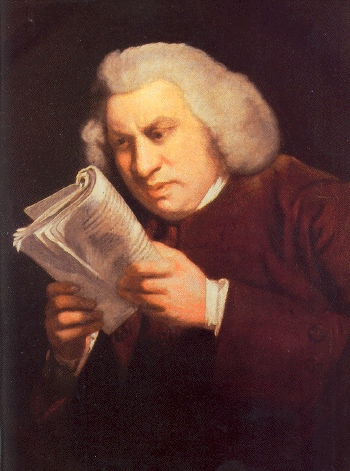
A portrait of Samuel Johnson
Joshua Reynolds
http://en.wikipedia.org/wiki/File:Samuel_Johnson_by_Joshua_Reynolds_2.png


The painting above is of Samuel Johnson, one of the English Language’s finest professional readers. In the painting he is reading intently, but according to the blurb accompanying the painting this was in part to dispel the image of “blinking Sam,” it was to offer a “counter-narrative” to one that was current at the time. But it makes one wonder, or at least it makes me wonder, why do we read? Because Samuel Johnson was who Samuel Johnson was it also makes me wonder why we analyze what we read? Is literary criticism something readers do to understand a text or does it superimpose the reader's vision on that of the writer? What makes some readers more “authoritative” readers than others, that is, why do we give more weight to the judgments drawn from the reading done by some than to that done by others?


There was a series of articles recently in the New York Times (I looked at these three, “The Will Not to Power, but to Self-Understanding,” “Translating the Code Into Everyday Language,” and “From the Critical Impulse, the Growth of Literature”) about literary criticism and its usefulness. The articles addressed meanings of literary texts and the like, but the main conclusion they all seemed to come to was that criticism contributes to a literate culture in that it provides a platform for discussing literature, its deeper meaning, and its impact on the culture at large. I enjoyed all of the articles but I was intrigued by Elif Batuman’s applying Freud’s method of interpreting dreams to the interpretation of literature or at least that aspect of Freud’s thinking that recognized the complexity of dreams and the multiplicity of possible meanings that they contain. According to Batuman this same dynamic is at work in our analysis of stories.

Farmer Sitting by the Fire, ReadingVincent Van Gogh
Watercolor, Charcoal, watercolour, heightened with white
Etten: October, 1881
Kröller-Müller Museum Otterlo, The Netherlands, Europe
F: 897, JH: 63
http://www.vangoghgallery.com/catalog/Watercolor/1816/Farmer-Sitting-at-the-Fireside,-Reading.html


The painting above is of a farmer sitting by his fire reading a book. This suggests that the printed word can work its magic not only on those that do not read for a living, but those who earn their living from occupations very different from those of “professional” readers. Farmers of course, at least good farmers, are always reading the literature of their trade so it shouldn’t surprise us that farmers read. But when they are reading the literature of their trade they are reading for information, not for enchantment. What are the respective values of each kind of reading, is one better than the other or do each provide their own unique kind of value? At the level at which each works they teach us how to profit from living, on the one hand how to earn a living and on the other how to spend a life in a way that is meaningful and not just productive.

Elderly Man at a WindowYves Trevedy
http://www.artinconnu.com/2008_04_01_archive.html


The paintings above and below are of an old man reading and of a young man reading. They are both engrossed and as one might expect the old man is farther along in his book than the young man, the old man is finishing his book while the young man is starting his. The old man is alone with a single book while the young man has an assortment of books propping up the book he is reading. There are perhaps some obvious metaphors that could be drawn but I’ll let others draw them. What I find attractive about these paintings is the intensity that each reader brings to the reading that he is doing. The young man is described as a student in the painting’s title and perhaps he is reading in the same fashion the farmer reads his agricultural journals, but perhaps not. The old man has his back to the window and to the beautiful landscape that is life as it truly is. Is the man turning his back on reality or is the reality he finds in his book more real than the one outside his window? In my experience all reading teaches and the books that capture my imagination the most intensely make the world outside my window more real and more understandable. As Pound suggests reading makes me and the world outside more intensely alive and more intensely real and comprehensible.

The Young Student
Ozias Leduc
http://cybermuse.gallery.ca/cybermuse/search/artwork_zoom_e.jsp?mkey=1361


John Connolly in his book The Book of Lost Things says, “The stories in books hate the stories contained in newspapers, David’s mother would say. Newspaper stories were like newly caught fish, worthy of attention only for as long as they remained fresh, which was not very long at all. They were like the street urchins hawking the evening editions all shouty and insistent, while stories – real stories, proper made-up stories – were like stern but helpful librarians in a well-stocked library. Newspaper stories were insubstantial as smoke, as long-lived as mayflies. They did not take root but were instead like weeds that crawled along the ground, stealing the sunlight from more deserving tales.” It might be that the books we read for information are short lived, they do not deliver anything magical, they are a pragmatic bunch that teach us what we need to know to keep the pantry stocked, but the truths they tell are only true for a short time, relatively, and will in all likelihood be soon replaced with other truths.

The truths contained in stories often help us unravel the mysteries that surround who we are; they help to teach ourselves to ourselves. There was a review by Sarah Bakewell in the New York Times about the lives of great philosophers, “Lives of the Philosophers, Warts and All”. The book points out that most philosophers led very muddled lives and that no matter how profound their insights, the art of living well and happily remained elusive. I am not sure that stories succeed any better at explaining life or simplifying day to day existence, but they do teach us that everyone has problems and that what really matters more than solving our problems is living with integrity while pursuing those solutions.

Elif Shafak
TED Talk


The film is about storytelling or more precisely perhaps being a storyteller. Ms. Shafak tells us that others try to tell her the kinds of stories she should tell, but she does not want to tell those stories. She suggests that as a writer she is pursuing in stories the same things I am as a reader of stories, she wants to explore what makes people from different backgrounds behave as they do. Modern storytelling has become a bit obsessed with the relationship between the characters in a story and the writers that create those characters; that J. D. Salinger, for example, must be a lot like Holden Caulfield, that novelists and storytellers of all stripes are actually engaged in a kind of autobiographical masquerade. When in fact most of the best storytellers from the past made little use of their personal lives. One reason some critics today do not believe Shakespeare could have written Shakespeare is because the stories Shakespeare told were so far removed from his life experience, that somehow because he had never been a nobleman he could not possibly comprehend what it was like to be one. Storytellers that cannot imagine the inner lives of characters different from themselves cannot amount to much as storytellers, their insights, like mine are all local. If I as a reader can enter the inner lives of characters different from myself as I read about them, why can’t storytellers do the same as they write about them?

The painting below is of an emperor of China who was also a literary critic. It is not unusual for a monarch to be engaged in literary pursuits, the first Queen Elizabeth wrote poetry and translated Latin texts, like Boethius’ Consolation of Philosophy. Alexander the great had Aristotle for a teacher. Some learned more from the literature they studied than did others, but it is difficult to imagine that even those who learned the least were not enriched by what they read. If stories do nothing else they take away our excuses. When we read we make judgments about the characters and the things the characters do. This suggests that we have an inner sense of what is just and recognize injustice when we see it; that we understand the need for compassion and recognize cruelty when we see it; that we understand the quality of mercy and recognize hardness of heart when we see it. Some of these conclusions we are led artfully to see due to the skill of the storyteller, but the fact that these virtues are so much more likely to be found in the stories we read than the vices suggests that there is something true about these virtues that resonates in all of us.

Cao Pi, Emperor of Wei (Emperor of China and Literary Critic)
Yan Li-pen
http://en.wikipedia.org/wiki/File:Cao_Pi_Tang.jpg