Sunday, September 18, 2011

How to Read a Map

Man in the Mirror

Michael Jackson

How to Read a Map

MediterraneanChartFourteenthCentury.jpg

Nautical Chart in Portolan Style Probably Drawn in Genoa

Anonymous

http://en.wikipedia.org/wiki/File:Mediterranean_chart_fourteenth_century2.jpg

There was an article recently in The Boston Globe, “Introducing Ray Bradbury, the Master of Fantasy,” that talks about introducing our kids to the books that were meaningful to us when we were children and reading the books that are important to our kids so that we can build a common heritage. Alice Hoffman, the author of the article, refers to these stories as road maps to our lives. The books become important not only for the stories they tell but for the ways in which they shape our lives and our imaginations and contribute to our growth as individuals. When we re-read these books we not only recapture the stories but those moments in our lives and personal growth when we first discovered the stories. By sharing these stories with our children, and in letting them share their stories with us, we help them to begin to chart the maps of their lives.

Alan Jacobs in his book The Pleasures of Reading in an Age of Distraction recalls being on a ferryboat and watching a father read one of the Harry Potter books to his child. Both the father and child were engrossed in the story and were creating the kind of moment that Hoffman talks about in her article. The moment Jacobs describes is a landmark in both the parent and child’s life together. When the people of Israel were wandering in the wilderness they would stack up stones to mark places where significant events took place. When their children asked them why those stones were there, their parents would retell the story the markers were built to commemorate. The stories we read are often stacks of stones, Cairns, of this kind. It is important to have these landmarks in our lives to which we can return when the need arises and which we can share with those that come after us.

Stories change us. The reading we do changes us, if we read well, even if we do not necessarily choose well the stories that we read. The song, Man in the Mirror, is about change beginning with us, if we are to change the world we need to change ourselves. The books we read can contribute to this change and as we age these books become maps of our development. I think maps are interesting things, even if we cannot figure them out. The drawing at the top of the page is of a map, a map I cannot easily read, of the Mediterranean Sea as it looked to a 14th century cartographer. Maps also say something about how we view the world. There is a scene in the Rogers and Hammerstein musical The King and I where the king and the governess of his children are looking at a map of Siam, or present day Thailand. Siam is the largest country on the map. This is not literally true of course, but for the king of Siam it was “psychologically” true, it was the center of his world and the most important place in his world and in that sense the largest country on his map.

And this is not a problem unique to the king of Siam. If we look at maps made throughout history, up to and including our own day, it is not unusual to find similar problems of scale and size, though with most of the planet having now been photographed from space, these geographic distortions are becoming less common. But what is the real truth, the psychological one or the physical one; is the size of a place determined by a scale of miles or by the scale of the places influence in an individual’s life? The smallest town on the planet plays a huge role in the lives of the people that live there.

TabulaRogerianaUpsideDown.jpg


Tabula Rogeriana, 1154 - upside-down with north oriented up

Mohammad Al-Idrisi

http://en.wikipedia.org/wiki/File:TabulaRogeriana_upside-down.jpg

The maps above and below are also very old though a bit easier to follow. The map above, we are told, is upside down, with the north at the top. Of course for us that makes the map right side up. But for the artist that rendered the map, south was at the top. Mohammad Al-Idrisi obviously looked at the world differently than we do. Did drawing the world differently change the way he looked at it; does someone who sees the South Pole at the top of the map view the world differently than someone who sees the North Pole at the top? The artist who drew the map of Africa below saw Africa as “beneath” his European home because he placed the northern hemisphere at the top of his map. For Al-Idrisi, on the other hand, the Middle East, Al-Idrisi’s part of the world, would be at the top of the map and Europe would be “beneath” him.

FernaoVazDourado.jpg

West Africa in a nautical chart

Fernão Vaz Dourado

http://en.wikipedia.org/wiki/File:Fernão_Vaz_Dourado_1571-1.jpg

Of course this begs the question of whether or not people see nations that are beneath them geographically as being beneath them in other ways as well. Does seeing the south on top of the map effect the stories that person reads or tells? Probably what touches us each as human beings is not greatly affected by which of the poles we place at the top of the map. But sometimes the way we organize the world, who is put on top and who on the bottom, suggests something about how we view the world and the people in it. Viewed from the cosmos up and down on our planet are very relative terms. But to us they are often loaded with significance.

SolarSystemUnmarked.jpg

Map of the Solar System

Anonymous (compiled from multiple images from the public domain, published by the Free Software Foundation)

http://en.wikipedia.org/wiki/File:SolarSystemUnmarked.png

But of course the kind of map Ms. Hoffman had in mind when she compared our reading to the making of maps are not the kinds of maps drawn by Al-Idrisi or Fernão Vaz Dourado. Her maps are more metaphorical, referring to the course of our development, to the steps in the journey that made us who we are. Stories often open us up to new ways of viewing the world, of viewing others, of viewing ourselves. We look at the actions of some characters and, though we may wish this were not so, we cannot see ourselves behaving in the same ways. We do not see in ourselves the courage, the honesty, or the selflessness we see in the characters in stories that we admire. Still we often try to emulate them to become more like them.

There were two articles in The Guardian recently about stories and their influence. One was about empathy, “Reading fiction 'improves empathy', study finds.” This article suggests that reading stories (and the article is clear about this, it asserts that non-fiction does not produce the same effect) develops the ability to empathize; stories help us to get out of ourselves and experience life a little bit from the point of view of the characters in the stories. The article is very short and leaves many questions unresolved but it does raise an interesting point. Faye Weldon in her book Letters to Alice on First Reading Jane Austen says, “You can practice the art of empathy very well on Pride and Prejudice, and on all the works of Jane Austen, and it is this daily practice that we all need, or we will never be good at living, as without practice we will never be good at playing the piano” For Weldon one of the reasons we read is so that we can become more effective empathizers. She also suggests the art of empathy is an essential part of good living. Again, this is an assertion that lacks evidence, but my experience as a teacher and as a reader reinforces for me the truth of this assertion. Until we care about the characters in the stories we read, especially in those stories where plot is of secondary importance, it is very difficult to be engaged by those stories, they will never capture us, worse than that, they are likely to become tedious and to bore us.

The second article was about a poll that asked readers to identify their favorite character from the Harry Potter stories, “Snape is voted favourite Harry Potter character”. The favorite of those taking the poll was Severus Snape. Snape is probably the most complicated, and I think the most human, of the characters in these stories. No matter what readers may have suspected to be the truth about Snape as the story unfolded, it was not until the end that we knew for sure whether he was one of the good guys or the bad guys. He is a character with many faults and many flaws, just like most of us. He is unlike either Potter or Dumbledore on the one hand and clearly good; or like Lord Voldemort or Bellatrix Lestrange on the other and clearly evil. He is either a basically good guy with serious flaws or a very bad guy with a few redeeming qualities. Most of us can identify with the problem of Snape.

Whatever we think of Snape, by about half way through the story we understand that Snape’s darker side is in part the product of how he was treated by characters we see as “good guys,” people like Harry’s father and Harry’s godfather Sirius Black. We also see that his redeeming qualities come from how other “good” people, like Harry’s mother and Dumbledore, have treated him. Snape is responsible for the person he becomes, for both what is good in him and what is not so good, but we understand his struggle. We want to be good and seen as good but if we are honest with ourselves we see our flaws and shortcomings and are aware of the distance between what we are and what we ought and, hopefully, want to be. I also think there is a deeper truth here and that is that often those we do not like or trust, like Snape, are actually acting on our behalf, while those we like and trust, like Professor Quirrell, perhaps, are acting to do us harm.


Marco Tempest The Magic of Truth and Lies

TED Talk

The video clips above and below suggest art’s dual nature. Does art lie to us or does it open our eyes to the truth. In the first clip we see that magic to be successful must succeed in lying to its audience and it helps if the audience, in turn, comes to the performance with a wish to be deceived (for we all know when we attend a magic show that nothing that we are seeing is happening as we are seeing it happen). In this sense art is a magic show. When we look at a painting we often see a two dimensional space appear to take on a third dimension. We know the surface is flat but the artist is able to suggest depth where there is none. Words on a page produce emotions and sensations in a reader that were not there before and the reader has not actually experienced what has elicited those emotions and sensations, she or he has been tricked into imagining those experiences, as the member from the audience who selected the three of clubs imagines that card was selected freely and at random. For art to function we cede control of our thoughts and imaginations, or at least a degree of control, to the artist. We may call this verisimilitude or the suspension of disbelief, but it amounts to much the same thing, we are allowing the artist to deceive us.


Raghava KK Shake Up Your Story

TED Talk

On the other hand, though, the second video also makes a valid point, that stories often reveal truth and reality to us. If we see the world one way, it is useful to “shake our stories” a bit so that we can gain some insight into how others see our world. Richard Rodriguez in an interview with Bill Moyers said that when he read William Saroyan for the first time he, Richard Rodriguez, discovered he was Armenian (Saroyan was Armenian and his stories often captured the experiences of Armenians in America). In allowing himself into Saroyan’s world Rodriguez recognized what it meant to be an Armenian and how aspects of being Armenian were not that different from aspects of being Mexican, that Armenians and Mexicans have a shared humanity. It is this ability of a book read well to bring us out of ourselves that Rodriguez valued. Is Rodriguez deceived in this view, is he only imagining what an author wants him to imagine, that we all share a common humanity? Or is it a “noble lie” that deceives us so that it can reveal to us a greater truth? Perhaps life is a briar patch of truth and deceit, of wisdom and foolishness and that these qualities are so comingled that we need to learn to negotiate the tension that this comingling produces.

The maps we make may be real maps to real places. They may be maps that guide us safely through a dangerous terrain. The stories that we read may take place in real or imagined worlds but the ones that become a part of us have helped us in some way, they have illuminated what was unclear to us, provided models of correct or incorrect behavior, or led us to places of safety within our psyche and our spirit. They me be like the map below, a map of Middle Earth in a language we cannot understand but a map of a terrain that is so familiar to us we do not need to understand the map’s language, we know nonetheless where we are and where we are going. We can find on this map both where the dragons live and the way home again.

HobbitMapSwedish.jpg

Map from The Hobbit (Swedish)
http://pblancho.free.fr/maps/html/image021.html

Monday, August 15, 2011

For What It’s Worth

Save the Country

Laura Nyro

For What It’s Worth


HarnettWilliamAStudyTable1882.jpg

A study table

William Harnett

http://en.wikipedia.org/wiki/File:Harnett_William_A_Study_Table_1882.jpg

There is a story by Alice Walker, “Everyday Use”, that revolves around a mother and her two daughters. At the heart of the story are some quilts. One daughter is well educated and prosperous and wants the quilts because they carry some status as folk art and in my imagination they are beautiful to look at, as are “The Quilts of Gees Bend,” for example, that recently made a tour of museums across the United States. The second daughter wanted them because she could use them; they filled a very practical need. This does not mean these quilts were not beautiful to look at in addition to being useful, only that their usefulness was where their true value lie.

The painting above is of musical instruments and books on a table. William Harnett did another painting similar to this that is also of musical instruments and books on a table. In the painting above these objects are sitting on a tablecloth, the other painting, Music and Literature, has them sitting on an unadorned black table. I chose the painting I did because I find the design on the tablecloth pleasant to look at and as enhancing the visual beauty of the painting. It is not clear from Alice Walker’s story if the sister who wanted the quilts because of their value as folk art really valued the quilts as folk art, but the story does invite us to consider art and its value and, perhaps more importantly, to consider whether art must be useful for it to have value.

To return to the painting it evokes three different art forms, painting (because that is what it is), music, and literature. To what extent are any of these art forms useful in the sense that the quilts in the story are useful? Paintings can be pretty, designed purely to accent a room with little if any artistic merit. There is in my doctor’s office a print of a piano in a living room next to a window overlooking a park. The print was selected because of the colors the artist used and the pleasant design of the room. But if one looks carefully at the piano it becomes clear that the piano keys have not been painted correctly, there are three sets of white and black keys between both the keys of “c” and “e” an between the keys of “f” and “b”. On a real piano there are two sets of white and black keys between “c” and “e” and three between “f” and “b”. Not an important detail but one that suggests the artist either did not look closely at the piano before painting it or did not expect the viewer to look closely at the piano. This, perhaps, illustrates a difference between art and decoration or art and entertainment. Art ought to both decorate and entertain, but, hopefully, it does something more.

There are books that we read solely for entertainment, that we are unlikely to revisit, or if we do revisit, it is to be entertained in much the same way we were the first time we read them. Much of the music we listen to on the radio demands little from us (though it might also be mentioned that some of it offers more than we are willing to receive). An important difference between the pretty and the beautiful is the difference between that which merely decorates and that which does something more. This is not to say that popular songs or popular novels do not have artistic depth, though many do not; nor is it to say we should spend more time reading “the classics” or attending the opera. But this is to say for those willing to invest, perhaps it would be better to say who desire to invest, the additional time and effort there are rewards that make the investment worthwhile. It is, though, like many things in life; we do not know what we are missing until we open ourselves up to what we are missing. The print in my doctors office not only does not stand up to close study, it loses much of its decorative value if it is studied too closely.


EustacheLeSueur.jpg


Clio, Euterpe and Thalie

Eustache Le Sueur

http://en.wikipedia.org/wiki/File:Eustache_Le_Sueur_002.jpg

The song, Save the Country, that played at the beginning is about peace and redemption. It is a song with a message and not a bad message. Some see in the study of art, music, and literature a kind of redemption or purification of the soul and spirit; that we read and study the arts because doing so somehow how makes us better people. The painting above is of three muses from Greek mythology, the muses of history, lyric poetry, and comedy. The suggestion is that art was art because it was divinely inspired, that it fulfilled in some fashion the will or purpose of the gods. But what if, as the “art for art’s sake” folks suggested, art serves no purpose, in the sense we usually think of the word, in the sense that the quilts in the story, though they may have been art, served a purpose.

ImageBookofCommonPrayer.jpg


Page from the Book of Common Prayer, 1583

http://sceti.library.upenn.edu/sceti/printedbooksNew/index.cfm?TextID=commonprayer&PagePosition=3

The pictures above and below are of a printed page, from the 1583 Book of Common Prayer and a painting of Mary Magdalen reading. Though the Book of Common Prayer serves a purpose, is designed to be used to as part of a religious practice, it also has beauty all its own. The book is printed using a typeface called “Blackletter” or Gothic script. It is not easily read by 21st century readers, but even if unreadable, it delights the eye and is pleasant to just look at, even if it cannot be understood. Perhaps the angels surrounding the letter “A” are enough to articulate its religious message. In the painting Mary seems to be “idly” reading while those around her are busy doing things. Of course we do not really see enough of the others in the scene to know if they are doing anything, but I think they are. If this is the case is Mary wasting time and letting others work while she idles the time away. Reading with purpose demands all of our attention and it cannot be done either quickly or while we are doing other things. If nothing else, reading, deep purposeful reading, provides a kind of “Sabbath Rest”, a time where all physical labor must cease.

Is reading another kind of work, is it a leisure activity, does it work it work on us and change us? I do not think that readers, or “appreciators” of any of the arts are better people, many terrible people have been appreciators of the arts, but I do think if we are paying attention we are changed and just as art demands we look more closely and carefully at the work of art, this practice carries over to other things and can make us a bit more reflective as people. Of course, the other side of the equation is probably also true, that we can experience the art, no matter how well and perfectly it is executed, solely as decoration, as entertainment.

TheMagdalenReadingRogier.jpg


The Magdalen Reading

Rogier van der Weyden

http://en.wikipedia.org/wiki/File:The_Magdalen_Reading_Rogier.jpg

There was an article recently in The Chronicle of Higher Education, “We Can't Teach Students to Love Reading”, that suggest most people will never develop into readers who will read deeply and well and that there is, perhaps, little value in trying to teach literature in schools, if our purpose in teaching literature is to make students deep and thoughtful readers. Of course, by this way of thinking there is probably not much point in teaching students geometry or algebra as most will not go on to use or value abstract mathematics. But in the book this essay was taken from, The Pleasures of Reading in an Age of Distraction, the author, Alan Jacobs, argues that this kind of reading is done best if it begins as a whim, with our being carried away by a “fancy” to read and discover. In the book Jacobs recounts Richard Rodriguez’s experience of reading difficult books as a young child where he kept a record of each book along with the book’s “big idea” or theme. In Rodriguez’s view (and Jacobs’) this diminished the books, if only because as literary art, but probably even as just entertainment, most books do not lend themselves to so easy a reduction.

To teach literature well the teacher must not only expose students to the books, but in some way pique their interest enough that they will explore on their own. I am dyslexic and when I was in high school I could not finish the books we were assigned in the time given to read them. So I had to rely on helps, helps familiar to most students. However, the effect of these helps on my imagination was to give me a hunger for these books and over the summer when no one was making demands on my time I read these books, Moby Dick, Great Expectations, Gulliver’s Travels, and others. My affection for these books did not come directly from studying them in school, but if I had never studied them in school I would never have gone on to read them. Even though I would be oblivious to how my life was diminished by not having read these books, I would not know what I was missing, my life would be diminished.


Paul Bloom

TED Talk

The video makes a couple of points about art and how we assess its value. My favorite story from this film clip is of the man who sold the Vermeer to the Nazis. The sale was treated as an act of treason for which there was no defense. He was Dutch and Vermeer contributed significantly to the Dutch culture. The art dealer, Han Van Megereen had a defense. He, not Vermeer, painted the painting he sold to the Nazis. He went from traitor to folk hero. Of course the painting lost all, or most, of its value. But this raises another question. Is an artwork’s value determined by its content or its history? The painting is what it is, regardless of who painted it. One of my favorite novels is a book by Robertson Davies What is Bred in the Bone. It is about the life, work, and education of an art forger, a very successful art forger. If the forgery contains all the elements of a great work of art, is it not still a great work of art even if it is not what it pretends to be? There is also the issue of how we define ourselves as a culture. For the Dutch Vermeer, Rembrandt, and Van Gogh are a part of their national identity, in the sense, perhaps, that Edward Hopper, John Singer Sargent, and, perhaps, John Steinbeck are part of our cultural identity. But what do these artists add to our cultural identity? How are we different as a people by the presence of this art in our midst, by these details of our cultural heritage?

The Museum of Fine Art in Boston has recently returned, or agreed to return, a part of a statue to the Turkish people and in the process reunite the two parts that make up the one statue. There has been talk about returning the Elgin Marbles, the Greek statuary that provoked poems by Lord Byron and John Keats that are now part of the British identity, to Greece, their proper home. It is now almost universally a crime to remove artifacts such as these from their native cultures, but it wasn’t a crime when the statues in question were removed from their homelands and now, because of their great beauty those that have them are reluctant to return them.

Amit Snood

TED Talk

This film clip raises another question about art and that is accessibility. Amit Snood is responsible for the Google “Art Project” and as can be seen from the film this project not only brings great art to anyone who wants to look at it, it enables those who wish to, to see the art in ways they could never see it even if they went to the museums in which these painting and statues live. The Art Project enables the viewer to see the paintings so closely and in such detail that aspects of the painting that are nearly invisible become clear. Also, unlike the print in my doctor’s office, these paintings reward the attention to detail. Things that no viewer could really be expected to notice become clear and reveal the importance of every detail to the painter. It will always be true that some works have more to offer than others, but if the work is well done it will always be true to the vision it tries to capture.

When I was starting college there was an issue of the magazine The Saturday Review that featured two articles, one on the public poet, Rod McKuen and one on the private poet, James Merrill. McKuen is for the most part forgotten and Merrill, outside of academic circles has not been that well known, though his poetry deservedly survives. Merrill’s poems are quite beautiful and some are very funny but he places demands on his readers and those that read because they enjoy the demands are richly rewarded. McKuen’s poems entertained for a time, but they did not offer much on rereading. Perhaps this is just me and that I do not have the proper sensibilities to see what lies beneath the surface of his poems, but every time I read a poem by Merrill I continue to be rewarded with new insights, and frustrated by that which remains unclear to me, that which must wait until another day to be revealed. That is in part why I go back to his poetry.

There is a book recently published by Marjorie Garber, The Use and Abuse of Literature. The book argues that literature is important for the questions it raises and not for the answers it gives and that a literary work reveals different things to different readers. What is important is not that we read and arrive at a preordained destination but that we read and consider and reflect. She makes a case for literature being “useless” in the utilitarian sense; that we do not read to accomplish anything; that in reading we will not change the world, though if we read deeply, perhaps carefully, and well we might change ourselves. But the importance of literature, the importance of any work of art, is in its ability to make us aware of the beautiful; of that which exists for no other purpose than to open our eyes to splendor and the sublime and asks nothing in return except that we take it seriously, that we enjoy it, and that we do not give it a job to do.

WeydenIvo.jpg


St Ivo

Roger van der Weyden

http://en.wikipedia.org/wiki/File:Weyden_Ivo.jpg

Making Ourselves Uncomfortable


“Vorspiel” from Parsifal
Richard Wagner
James Levine and the Metropolitan Opera


Making Ourselves Uncomfortable

The Knights of the Round Table Summoned to the Quest by the Strange Damsel
Sir Edward Burne-Jones
http://en.wikipedia.org/wiki/File:Holy_Grail_tapestry_The_Summons.jpg


Most of the achievements we are proudest of are accomplished by making ourselves uncomfortable. They involve struggle, hardship, and a fair amount of failure before there is success. There was an article recently in the Times Literary Supplement, “The miraculous G. K. Chesterton?”, on the life and “cheerfulness” of G. K. Chesterton. Some described it as a “silly” cheerfulness because it seemed to require an unrealistic view of the world. But it is suggested that he learned to craft cheerfulness from the materials he was given. This is, or ought to be perhaps, a byproduct of making ourselves uncomfortable. The cheerfulness does not make the journey less difficult; it only makes the hardship a bit more bearable.

The music is from Richard Wagner’s opera Parsifal. The story the opera tells is of the quest for the Holy Grail. The grail has come to represent in western culture the pinnacle of excellence in any field. Bernard Malamud’s novel The Natural tells the story of a baseball player seeking the “grail” of baseball, winning the league title and the opportunity to compete in the World Series. John Feinstein, a sportswriter, wrote a book, The Majors, about the major tournaments in golf. He subtitled this book “The Holy Grail of Golf” because to win one of these tournaments is to rise to the top of the golf world.

What all grail quests have in common is the great demands they place on those involved with the quest. The quest is a trial and brings with it suffering and great discomfort. In some ways this is a metaphor for everyone’s life journey. In Le Mort d’Arthur Thomas Malory, begins his telling of the Holy Grail story with an invitation, depicted in the painting above, to the quest. The knights accept the invitation and begin set off to seek the grail. Malory says of these knights as they start their quest, “And so on the morn they were all accorded that they should depart everyone from the other; and on the morn they departed with weeping cheer, and every knight took the way that he liked best.” In other words each knight rode down the main road and when he (at this time all knights were “he’s”) saw a spot in the woods that looked inviting set off on his own personal quest, leaving the road and entering an uncharted wilderness.

This might suggest to some the line from Robert Frost’s poem, “Two roads diverged in a yellow wood, and I – / I took the one less traveled by / And that has made all the difference.” Except if we read this poem Frost also tells us that both paths were worn “really about the same.” In Frost’s poem there are two roads, not one road and a going off into the unknown, and both roads had received about the same amount of foot traffic. This is not the kind of path that Malory was talking about when he described the knights going into the woods. Joseph Campbell, in a conversation with Michael Toms, quotes from another version of the story, "They thought it would be a disgrace to go forth in a group. Each entered the forest at a point he had chosen where it was darkest and there was no way or path.” The path these knights took was untraveled and chosen because it involved risk.

The Arming and Departure of the Knights
Sir Edward Burne-Jones
http://en.wikipedia.org/wiki/File:Holy_Grail_Tapestry_-The_Arming_and_Departure_of_the_Kniights.jpg


This story of the knights setting out on their journey captures the journey each of us takes as we live out our lives. As children our parents select the paths we will take, where we will live (this may not always be the parents’ choice but it is certainly not the child’s), where we go to school, where or if we worship. Others, usually adults, play a significant role in teaching us the values we should embrace, the kind of people we should befriend, and the way we should view the world around us. At some point, though, we start to make our own decisions. At that point we leave the paths that have been chosen for us and enter the dark wood to pursue, . . . pursue what? Our own dreams and aspiration? That is part of it, but the real quest is to find ourselves, who we are as individuals, to establish our identities and we cannot really come to know ourselves without making ourselves uncomfortable.


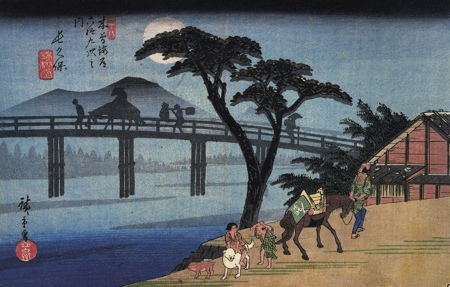
Man on Horseback Crossing a Bridge
Utagawa Hiroshige


But it goes beyond this. The paintings above and below depict people setting out on or in the midst of a journey. The painting above appears to be the beginning of a journey, it is peaceful, the moon is up and the sky is still dark. There are others on shore watching as the travelers set out over the bridge. Journeys, the easy ones and the most difficult, often begin with this kind of serenity that fosters hopefulness and optimism. There is a story in the painting, though we cannot know what it is. Though the man leading the horse and the man following the horse both seem alert and ready for the journey, the man on the horse seems slumped over and tired, weighed down by a burden of one kind or another. But in all other respects the landscape is peaceful and seems to provide an auspicious beginning to the journey.

The painting below is set in the midst of the journey after a catastrophe of one kind or another has struck. There are some people on a boat in high seas and what appears to be stormy weather. The sun shining behind the clouds may suggest hope for the future, but the present of the painting is of a small boat trying to make headway against high seas and a powerful current. There is a suggestion of landfall in the background far in the distance and tall waves yet to be encountered. We see the outlines of the people on the boat, but, unlike the picture above, not enough to draw any conclusions about how well they are enduring. When I look at the painting the first thing that comes to mind is the story of Odysseus fighting the waves Poseidon has thrown at him as he tries to reach the shore. He does eventually, after receiving a bit of help, but like the folks in the painting there were moments when the outcome did not look to be a happy one.


The Ninth Wave
Ivan Konstantinovich Aivazovsky
http://en.wikipedia.org/wiki/File:Aivazovsky,_Ivan_-_The_Ninth_Wave.jpg


There was a series of articles in The Guardian ("Yes, Teen fiction can be dark - but it shows teenagers they aren't alone" and “Teen fiction accused of being 'rife with depravity'”)responding to an article in The Wall Street Journal on youth fiction, "Darkness too Visible", that criticized the dark and violent nature of much of what is called Young Adult Literature (YAL). The concerns some parents might have that the Journal article points out are understandable, but then so are the points made by those writing in The Guardian. The problem with storytelling is that it is compelling because it captures the struggles, real and imagined, that people confront. The novelist Vladimir Nabokov did not care for happy endings and argued that stories that ended happily were not realistic. There may be truth to that but I suppose that largely depends on where one chooses to end the story.


Life is made up, for most of us, of a mix of happy and sad. And then of course, one must consider what is meant by a happy ending. Is a story that ends on a sad or melancholy note with a glimmer of hope a happy ending or a sad ending? When we finish a book like The Grapes of Wrath does the ending leave us feeling hope for the human race in general and the Joads in particular or does it leave feeling an overwhelming sadness. A lot depends on how we interpret the final moments of the novel. It is very difficult to connect with a story, to be captured by it, if we do not empathize with the characters and empathy is usually provoked by struggle and the hardships the characters encounter.

The fiction that many young adults read may be dark and violent, but than so is the fiction read by many adults who are not so young. Perhaps it helps us cope, perhaps it enables us to experience vicariously the adventures we cannot experience in reality. Which is worse, hardship or boredom? Most of the things in life that give us pleasure and make us happy only give us pleasure and make us happy because they are ephemeral, they do not last. The longer they last the more likely it is the pleasure will turn to ennui. This is not to say we should cut the good times short, enjoy them while they last, but appreciate the fact that they end before we are sated by them.


Arvind Gupta
TED Talk

The film is of a toy maker and his work. He uses simple everyday objects to make toys for children. These toys often teach principals of science and mathematics but they teach without interrupting the play. I think the film illustrates that our capacity for play is fed by imagination and I believe this to be true no matter how expensive the materials used to construct our toys. It also illustrates that learning is an act of the imagination; understanding often has its roots in our ability to imagine a principal at work. These toys were developed with poor children in mind but one need not be poor to get enjoyment from playing with them (one also need not be a child to play with them). Toys, like those Arvind Gupta makes, often ease the struggles of growing up and perhaps this takes us back to the stories young adults are reading.

Growing up is a struggle for most, no matter what advantages we are born with. The toys we play with often help us to shape our identities, they give us a chance to experiment with playing roles. Like stories where we imagine ourselves entering the wood where it appears to be the darkest and in our encounters with the darkness learn something about ourselves. It is in stories that we begin to explore who we are and question our ability to hold up under circumstances similar to those encountered by the characters in the stories. It is in play that we begin to act out some of the things we are coming to understand about ourselves. In any adventure, no matter how desirable it appears on the printed page or in the world of play, there is an element of danger that frightens us and fuels our self doubt. Those doubts can only be eased by the struggles and challenges we face and overcome in daily living.

The Forging of the Sampo
Akseli Gallen-Kallela
http://en.wikipedia.org/wiki/File:Gallen_Kallela_The_Forging_of_the_Sampo.jpg


The painting, The Forging of the Sampo, is from an event in Finnish mythology. No one really knows what the Sampo is; all that is clear is that it is a magical object that provides good luck and protection to whoever possesses it. The ambiguity that surrounds it makes it a useful metaphor for whatever it is that brings us good fortune because whatever it is, it is different for everyone. Most cultures have produced charms, talismans, amulets; objects of one kind or another that are usually worn that ward off evil of one kind or another and keep us safe and prosperous. Perhaps they work because we believe they will work, the way a placebo drug works on patients who believe they are being given a real cure. The stories we carry with us are often a talisman against the darkness we encounter, the troubles that life brings. If we never make ourselves uncomfortable we may have fewer encounters with the forces of fear and doubt. We may live more comfortable lives, but with this kind of comfort often comes a profound dissatisfaction and an emptiness that can only be filled by tribulations of one kind or another, and just as the talismans we each carry are unique to each of us, so are the troubles.

Pacific
Isaac Levitan
http://en.wikipedia.org/wiki/File:Isaak_Ilitsch_Lewitan_003.jpg


Sunday, May 15, 2011

On Writing Things Down


Telling Stories
Greg Brown


On Writing Things Down

Poster for Congress of Industrial Rights
Ben Shahn
http://en.wikipedia.org/wiki/File:Poster_RegtoVote.jpg


The old adage tells us that a picture paints a thousand words. The painting above is mostly a painting of words that is, I suppose, intended to suggest a thousand more words or more. Many things in life begin with writing something down. Revolutions often begin with declarations of one sort or another that have been written down in an attempt to explain what it is that makes revolt necessary. Often many things were written down before the declaration was issued that got things going. Thomas Paine, for example, wrote many things before Thomas Jefferson penned the declaration that initiated revolt.

The song that started things is called Telling Stories and it is often the stories that are told that interpret the events that provoke the anger that precipitate the revolt. After the revolt is finished there may not be agreement as to the veracity of the stories that got things going, but be that as it may, the revolutions themselves certainly speak to the power of telling and interpreting stories. Of course there must be a reality, even if it is a misperceived reality, that gives credibility to the stories that are told or else whatever power the stories have would never live outside the covers that contain them. As the song, and our own experience, suggests stories shape destiny, even those stories that live only inside the covers of the books that contain them.

Michael Chabon in an article written in the New York Review of Books, “‘The Phantom Tollbooth’ and the Wonder of Words”, writes about how his career as an author began with the reading of a book, not just the story the book told, but also the way in which that story used and played with language. Writing things down, at least for those that enjoy writing things down, is about playing with language. Someone, it may have been a student, once asked W. H. Auden what does one have to do to become a poet. Auden responded (and I do not remember the exact quote) that to be a poet you have to enjoy standing around and listening to words talk to each other. Perhaps this is true for anyone who does things with language.

I enjoy the Skaldic poets and one of the features of their poetry that is especially attractive to me (though it drove me nuts when I tried to translate it in college) is the way these poets mix up the words. Old Icelandic is an inflected language, which means the words’ endings reveal the place the words occupy in the sentence, not the order in which the words appear in the sentence as is the case in English. Icelandic prose, like most inflected languages, orders the words in sentences in ways that are easy to follow so that word order is much the same as it is in English prose, but the poets often abandon word order all together and this means that the listener or reader has to pay attention and put the sentences together as the poem unfolds. This is part of the fun and where a measure of the enjoyment lives for this poetry.

Study for Distortions; Isometric Systems in Isotropic Space—Map Projections: The Cube, 1978 Agnes Denes (American, born 1931)
Watercolor on graph paper, pen and ink on clear plastic overlay
17 x 14 in. (43.2 x 35.6 cm)
Gift of Sarah-Ann and Werner H. Kramarsky, 1983 (1983.501.3)
© Agnes Denes
Source: Agnes Denes: Study for Distortions; Isometric Systems in Isotropic Space—Map Projections: The Cube (1983.501.3) | Heilbrunn Timeline of Art History | The Metropolitan Museum of Art
http://www.metmuseum.org/toah/works-of-art/1983.501.3

The pictures above and below illustrate another aspect of where the pleasure of using language comes from, from expecting the unexpected. Using language too conventionally and too “properly” rarely provides much pleasure. The pleasure of language, for the reader as well as the writer, comes from living on the fringe of syntax and proper usage, not all the time but at the appropriate times, when doing the unorthodox draws attention to something or invigorates something. The drawing above is titled Cube. Everyone knows immediately what it is they are looking at, they are just surprised to see something so familiar look so unlike itself. This suggests that it is important to find ways to be unconventional without being incomprehensible.

The painting below suggests, perhaps, that while it is important not to be too obscure, there is a value to being not entirely transparent. The painting is calledConcord. It consists of two tan parallel lines on a blue background. There is concord in the colors, they do not clash but are comforting to look at and the lines being parallel also suggests concord. There is a peacefulness to the painting that underscores the message suggested by its title, but there is nothing concrete that speaks concord or peace to us. There is also a pun of sorts in the painting, the second syllable of “concord” is “cord” and the parallel lines suggest two cords side by side. The prefix “con” means “with” and the syllables taken together suggests how the painting is done, “with cords.” There are other games the viewer of this painting might play with the images; stringed instruments and the chords that are played on them come to mind. It is this kind of playfulness with language that might be found in the Skaldic poets and in many other poets and writers that enjoy the multi-dimensionality of words, syntax, and the architecture of meaning.

Concord, 1949
Barnett Newman (American, 1905–1970)
Oil and masking tape on canvas
89 3/4 x 53 5/8 in. (228 x 136.2 cm)
George A. Hearn Fund, 1968 (68.178)
© 2010 The Barnett Newman Foundation, New York / Artists Rights Society (ARS), New York
Source: Barnett Newman: Concord (68.178) | Heilbrunn Timeline of Art History | The Metropolitan Museum of Art
http://www.metmuseum.org/toah/works-of-art/68.178

There was a recent article on the discovery of “sacred trash.” The article, “Buried Treasure”, is a review of the book Sacred Trash: The Lost and Found World of the Cairo Geniza by Adina Hoffman and Peter Cole. The book is about the manuscripts that were found in the Cairo Geniza. The review informs us that a geniza is “a traditional storage place for worn or discarded Hebrew texts containing the Divine Name.” These texts included not only old Torah scrolls and prayer books, but also books and documents that were more literary or historical than sacred. Some were just documents that detailed aspects of daily life and recorded the activities of the community. There was also found a manuscript containing poems by a female poet. Hers are the only poems by a woman to be found in the geniza and prior to this discovery her work was completely unknown. It is ironic that she is only identified as “the wife of Dunash ben Labrat” and that though her work now survives her name does not.

One of the people the book focuses on was a scholar at Cambridge University who was visited by some folks asking him if he had an interest in some old documents. They gave him a few samples to look at and he recognized among them a manuscript of the Hebrew original for the Apocryphal book of Ben Sira, or in the Christian Bible, the Book of Ecclesiasticus. Prior to this the only exiting copies of the book were those from the Greek Septuagint translation of the Jewish Bible. It is difficult to imagine how exciting this must have been. For someone who loves language, stories, and history, to say nothing of the religious emotions that must have been felt by a student of rabbinic literature, probably nothing could equal the excitement generated by this unexpected visit.

The Marketplace, Vitebsk, 1917
Marc Chagall (French, born Russia, 1887–1985)
Oil on canvas
26 1/8 x 38 1/4 in. (66.4 x 97.2 cm)
Bequest of Scofield Thayer, 1982 (1984.433.6)
© 2010 Artists Rights Society (ARS), New York / ADAGP, Paris
Source: Marc Chagall: The Marketplace, Vitebsk (1984.433.6) | Heilbrunn Timeline of Art History | The Metropolitan Museum of Art
http://www.metmuseum.org/toah/works-of-art/1984.433.6

When things are written down it is impossible to know when or in what context the words will be rediscovered. There is a science fiction story called A Canticle for Leibowitz. In this story a similar excitement is generated by the discovery of a grocery list. You will have to read the story to find out what could cause something so simple as a grocery list to generate such excitement. The first explorers of the Cairo Geniza were interested in the literary and sacred texts but subsequent explorers brought their enthusiasm to the investigation of bills of lading, wills, and court records. These were exciting not because of the power of their language but because of what they revealed about the way life was lived in the Jewish community of medieval Cairo. The stories these documents tell have to be inferred from what all the bits taken together suggest. They revealed what things cost, identified their trading partners scattered throughout the world, and identified what was to them the known world. For those that are moved by the human experience and how it has changed and stayed the same over time these documents must be very exciting.

Handspring Puppet TheaterTED Talk

Theater is another medium in which what is written down is passed along to others. The written words on the page are often a mystery, how does the speaker feel who is saying the words, what is the environment in which the words are spoken like, what do the characters look like. When we pick up a play script we see only the dialogue, this is especially true of the script as it was first performed, as usually things like set descriptions and character movements and behaviors were added later by the stage manager of the first production of the play. There is little to inform us about what things look and sound like. The imagination must fill the gaps and this is not easy for everyone. The video is about the construction of puppets that were used by a puppet theater and describes how these “creatures” were brought to life. As I watch this video I am amazed at what the puppet masters can do and create and how so much larger than life the puppets become.

It is surprising how much can be done with puppets. I remember reading plays by the Japanese playwright Chikamatsu. Many of his most tragic plays were done originally as puppet theater. It is difficult for me with all the images of puppet theater that I bring from my childhood to imagine how a play as serious as a tragedy could be performed by puppets and not lose some of its seriousness. But puppets were a conventional part of the Japanese theater of Chikamatsu’s day. Of course, when I consider that Greek tragedy was often done with actors in masks and on stilts and the like I start to imagine actors who look almost like puppets and then the leap to the Japanese theater is not so great. Part of this is custom and imagining Chikamatsu’s plays is another way of expecting the unexpected.

Why do we write things down? Why do we tell stories, keep records, and document daily activities? What motivates us to do these things? Often writing things down helps us to understand and make sense of what we see as we watch the world as it is go by. But not all the horizons we overlook or seek are to be found on maps. The horizons of our imaginations can often only be approached through language and what has either been written down by us or by others. For those that enjoy it writing things down is often how the horizons of the imagination are preserved and the words become the maps of our different journeys.

Passenger, 1999
Doug Aitken (American, born 1968)
Chromogenic print mounted on Plexiglas
39 9/16 x 48 1/16 in. (100.5 x 122 cm)
Purchase, Alfred Stieglitz Society Gifts, 2004 (2004.223)
© Doug Aitken
Source: Doug Aitken: Passenger (2004.223) | Heilbrunn Timeline of Art History | The Metropolitan Museum of Art
http://www.metmuseum.org/toah/works-of-art/2004.223


Sunday, April 17, 2011

Whan That Aprill with His Verses Soote


Jerusalem
Hubert Parry
Royal Philharmonic Orchestra

Whan That Aprill with His Verses Soote

Preface to Milton
William Blake
http://en.wikipedia.org/wiki/File:Milton_preface.jpg

April is National Poetry Month. For students across America made to study poetry (or at least certain poems) against their will this might also make April the cruelest month. Of course for poetry to be properly appreciated it needs to be not so much studied as contemplated, reflected upon in the context of our lives and how they are lived. In studying poetry the focus often shifts from the passions that were aroused in the poet and which the poet is in turn trying to arouse in the reader to more academic concerns that, though they are important and should be considered, are beside the point. There was a recent article by Sven Birkerts in Lapham’s Quarterly on “idleness, “The Mother of Possibility”, in which he says,

“On a similar track, I wonder about childhood itself. I worry that in our zeal to plan out and fill up our children’s lives with lessons, play dates, CV-building activities we are stripping them of the chance to experience untrammeled idleness. The mind alert but not shunted along a set track, the impulses not pegged to any productivity. The motionless bobber, the hand trailing in the water, the shifting shapes of the clouds overhead. Idleness is the mother of possibility, which is as much as necessity the mother of inventiveness. Now that our technologies so adeptly bridge the old divide between industriousness and relaxation, work and play, either through oscillation or else a kind of merging, everything being merely digits put to different uses, we ought to ask if we aren’t selling off the site of our greatest possible happiness. ‘In wildness is the preservation of the world,’ wrote Thoreau. In idleness, the corollary maxim might run, is the salvaging of the inner life.”

There is a sense in which poetry was created to feed idleness. It will not be understood quickly and does not make many concessions to multi-tasking. It wants our undivided attention; it wants to force upon us a “Sabbath rest” that invigorates and nourishes our consciousness. What well written poetry does more often than it does anything else is change the way we see things; it enables us to see more clearly and deeply its object.

The song that began this is a poem by William Blake set to music. The illustration at the top of the page is Blake’s engraving designed as a visual accompaniment to the poem’s language. The song and the engraving underscore both the musicality of the poem’s language and vividness of its imagery and what is true of this poem is true of many, perhaps most poems; to be fully appreciated they should be heard and allowed to paint their pictures in the hearers imagination. Poems are more than words on a page. And where it is true that all written language is more than words on a page, poetry often becomes more incomprehensible the more it is reduced to the words that form the sum of its parts. Where a novel or an essay is using language to tell a story or communicate an idea, poetry is often using language to evoke, suggest, or point to something beyond itself and in this sense paying too much attention to the words themselves obscures what the words are trying to do.

Buttermere Lake, with Park of Cromackwater, Cumberland, a Shower
J. M. W. Turner
http://commons.wikimedia.org/wiki/File:Turner_Buttermere_Lake_with_Park_of_Cromackwater.jpg

In many ways poetry and painting are alike. The painting above is an impressionist landscape by J. M. W. Turner. It creates an image of water, mountains, rocks, vegetation, and sky. There is a boat in the water and one or two people in the boat. It provokes in the viewer an emotional response to the natural world and to its beauty and wildness. The images in the painting are not unlike those found in the opening lines of William Wordsworth’s poem “Tintern Abbey”

Five years have past; five summers, with the length
Of five long winters! and again I hear
These waters, rolling from their mountain-springs
With a sweet inland murmur
. — Once again
Do I behold these steep and lofty cliffs,
Which on a wild secluded scene impress
Thoughts of more deep seclusion; and connect
The landscape with the quiet of the sky
.
The day is come when I again repose
Here, under this dark sycamore, and view
These plots of cottage-ground, these orchard-tufts,
Which, at this season, with their unripe fruits,
Among the woods and copses lose themselves,
Nor, with their green and simple hue, disturb
The wild green landscape. Once again I see
These hedge-rows, hardly hedge-rows, little lines
Of sportive wood run wild; these pastoral farms,
Green to the very door; and wreathes of smoke
Sent up, in silence, from among the trees,
With some uncertain notice, as might seem,
Of vagrant dwellers in the houseless woods,
Or of some hermit's cave, where by his fire
The hermit sits alone.

There is not a one to one correlation; not everything in the painting is in the poem and not everything in the poem is in the painting but they both evoke a similar landscape and arouse similar emotions. The language of the poem is familiar and transparent; its meanings are not hidden.

The Magpie
Claude Monet
http://en.wikipedia.org/wiki/File:The_Magpie.jpg

Not all poetry, though, is as easy to follow. The painting evokes the winter landscape and the emotions winter often brings. The poem “the Snow Man” by Wallace Stevens evokes similar emotions, though the language is less transparent and not so easily understood.

One must have a mind of winter
To regard the frost and the boughs
Of the pine-trees crusted with snow;
And have been cold a long time
To behold the junipers shagged with ice,
The spruces rough in the distant glitter
Of the January sun; and not to think
Of any misery in the sound of the wind,
In the sound of a few leaves,
Which is the sound of the land
Full of the same wind
That is blowing in the same bare place
For the listener, who listens in the snow,
And, nothing himself, beholds
Nothing that is not there and the nothing that is.

There is found in both the painting and the poem frost and the boughs of trees and snow to surround the listener. But there are meanings to the poem beyond what the eye can see and the ear can hear. The language of the poem conceals meanings beneath the snow it captures that the painting does not. Or perhaps it does, perhaps it takes a mind of winter and an ear attuned to the sounds of winter to appreciate the painting as fully as Monet would wish.

Oscar Wilde said, "It is only shallow people who do not judge by appearances. The true mystery of the world is the visible, not the invisible." I am not sure what Wilde meant by this, but it suggests to me that first impressions, those impressions that attract us to something are taken in through the senses. There is something I can see in the poem and the painting that attracts my attention even though I do not fully understand what I see. There is a mystery to be unraveled but the mystery is suggested by what appears on the surface of the canvas and the surface of the language. The first impression is “superficial” but it need not be “shallow.” The depth of that impression is determined by how deeply I pursue the mysteries the surfaces of the canvas and the language evoke.

Rogier Van Der Heide
TED Talk


The video clip suggests another aspect of this mystery of first impressions, of the play of light upon surfaces to create beauty. Using terms like “light” and “darkness” often suggests to us metaphorically “good” and “evil.” But that is not necessarily what is being suggested so much as the need for contrast in order for any surface to be fully appreciated. Robert Browning suggests this in the closing lines of his poem “Home Thoughts from Abroad,” when he says, “And though the fields look rough with hoary dew, / All will be gay when noontide wakes anew / The buttercups, the little children's dower / - Far brighter than this gaudy melon-flower!” He is contrasting England’s less sunny landscape with the overly bright “gaudy” landscape of Italy. As is seen in the video when Van Der Heide compares brightly, uniformly lit spaces with those that are less uniformly lit. And even in his examples of cityscapes and of the planet viewed at night from space there is beauty, even though the light is not being used efficiently, in these images that contrast light and dark.

It might be argued that the beauty in a typical Ansel Adams photograph, or any black and white photograph, is created entirely by the contrasting of light colors with dark colors. But more importantly for me and what I am trying to say is what this suggests about poetry. The poems that often resonate the most, touch the reader the most are those that contrast effectively the expected with the unexpected; “the nothing that is not there” with “the nothing that is.” The line is a surprise and it delights us and it delights itself in keeping its secrets close.

The Tyger
William Blake
http://en.wikipedia.org/wiki/File:The_Tyger_BM_a_1794.jpg

This element of surprise is also seen in the poem “The Tyger” by William Blake. The surprise begins with the engraving Blake made to illustrate the poem, especially the engraving of the “tyger.” The tyger in the poem is a terrifying creature and though we may not be entirely sure what Blake means in this poem we are entirely sure we would not like to meet this tyger. The poem evokes something more akin to the tiger in the painting below than the “stuffed animal” suggested by Blake’s illustration. And that is part of the surprise. We see from the contrast of the tyger with the lamb a suggestion that this wilder beast is a being equated with the devil as it is contrasted with that tamer beast "the lamb of God.” Perhaps what Blake means to suggest is that evil resides only in our minds and that the world exists in contrasts of light and dark and that neither is “bad” and that both are necessary; that, as Pope suggests in his “Essay on Man” “whatever is, is right.” Or perhaps Blake is suggesting something far more subtle, that evil often appears to us in the guise of innocence and that because we expect the face of evil to terrify us, we do not recognize it when it makes us smile.

Tyger Tyger, burning bright,
In the forests of the night;
What immortal hand or eye,
Could frame thy fearful symmetry?

In what distant deeps or skies,
Burnt the fire of thine eyes?
On what wings dare he aspire?
What the hand, dare sieze the fire?

And what shoulder, & what art,
Could twist the sinews of thy heart?
And when thy heart began to beat,
What dread hand? & what dread feet?

What the hammer? what the chain,
In what furnace was thy brain?
What the anvil? what dread grasp,
Dare its deadly terrors clasp?

When the stars threw down their spears
And water'd heaven with their tears:
Did he smile his work to see?
Did he who made the Lamb make thee?

Tyger Tyger burning bright,
In the forests of the night:
What immortal hand or eye,
Dare frame thy fearful symmetry?

Tiger in a Tropical Storm (Surprised!)
Henri Rousseau
http://en.wikipedia.org/wiki/File:Surprised-Rousseau.jpg

How necessary is poetry to life? Can we get along without it? Plato seemed to think so and would have banished poets, he suggests that they lie, distort, and create discontent within a society. His pupil Aristotle felt otherwise. Many avoid poets, not for the reasons Plato suggests but because poetry has gotten a reputation for being difficult to understand requiring too much work to offer any real pleasure. But to those that read poetry and enjoy it the pleasure lies in working things out grappling with the meanings the poems often conceal. But this is often true with life in general. What is easy is often boring; what comes without effort rarely satisfies. There is something in the poem that enchants us and it is this sublime enchantment that the reader and the writer of poetry seek. I think it is this enchantment that we all seek.