Sunday, January 24, 2010

Making Copies


Just Like Me
Sarah McLachlan and DMC
Written by Harry Chapin, Sandy Campbell Chapin and Darryl McDaniels

Making Copies

Title Page
First Folio, William Shakespeare
http://en.wikipedia.org/wiki/File:First_Folio.jpg


There was an article in the Guardian, “Plagiarism: in the words of someone else… there's little new in literature,” a few weeks ago about plagiarism. The article tries to identify the difference between copying and plagiarizing. On the surface it would not seem there is a difference and perhaps there isn’t. Robert McCrum, who wrote the article, mentions an article written by Robert Greene, a contemporary of Shakespeare. Greene wrote the article on his deathbed and he called Shakespeare, "an upstart crow, beautified with our feathers," or in more contemporary terms, a plagiarist. The charge is undoubtedly true in a literal sense, Shakespeare told very few original stories, but most agree that many of the stories he stole would likely have been forgotten a long time ago if he had not stolen them.

The song is an example of a more contemporary form of borrowing. The rap artist Darryl McDaniels (DMC) has taken some liberties with a song originally written and performed by Harry Chapin. Each listener’s taste in music may determine which is the better song or if both songs are not equally impressive in their own right. But is McDaniels a plagiarist for taking Chapin’s song, even if Chapin is listed first in the songwriting credits. Nor is McDaniels alone in borrowing bits from other artists. T. S. Eliot once remarked that many of his best lines were written by other people. A reading of The Waste Land, one of his best known poems, will reveal that many of the best passages are not original with Eliot. That said, though, most agree that Eliot has crafted a remarkable poem and even those that do not admire the poem recognize that the lines Eliot has taken from others serve Eliot’s purposes in the poem and not those of the original authors.

But what is plagiarism? J. D. Salinger is quick to take legal action against any work by another author that, in his view, too overtly borrows from his stories or intrudes into his private life. Just last year he brought suit in New York to prevent the American publication of a new book, 60 Years Later: Coming Through the Rye by J. D. California (the name of the author on the title page is a pseudonym for Fredrik Colting). The central character of the new novel is a “Mr. C”, but the title all but tells most readers Mr. C’s full name. Has Holden Caulfield become so iconic a figure in the culture that his name is no longer the private property of Mr. Salinger? Or is Mr. Salinger within his rights to try to block publication of a work of fiction that so overtly borrows from his fiction?

J. K. Rowling not too long ago successfully blocked publication of a Harry Potter reference book that, in her opinion, borrowed too heavily from her books; that did little more than quote passages she had written. If she was within her rights to stop publication of this book are the makers of the 1986 film Troll within their rights to sue Rowling for using the name of one of their characters, Harry Potter, in her novels? Ursula Le Guin said of Rowling, “She has many virtues, but originality isn't one of them." Is this just one author sniping at another who has had a bit more success writing about wizards and their school days? How original is any author, to what extent is any story truly new? Most stories resemble other stories that came before them, but for the new story to succeed it has to find some way of setting itself apart. For example, how like Harry Potter in the film Troll is Harry Potter in the series of books that bear his name? Whether or not the borrowing of the character’s name is coincidental depends on how closely the Harry Potter of the books resembles the Harry Potter of the film. In the case of the novel featuring Mr. C. the author is hoping readers will recognize Mr. C as Holden Caulfield and not take it as a coincidental resemblance. But than Shakespeare expected his audience to know something about a story featuring a Danish prince named Hamlet.

The Courtesan or Oiran (after Eisen)
Vincent van Gogh
http://en.wikipedia.org/wiki/File:Van_Gogh_-_la_courtisane.jpg


The paintings above and below by Vincent Van Gogh suggest other aspects of borrowing. In the first painting Van Gogh was clearly copying another painting by the Japanese painter Eisen. Van Gogh did this a lot; he felt that just as a musician could play music she or he did not writer so could painters borrow images from other artists. But what he did was not at all like what young art students sometimes do when they go to a museum and copy the paintings that are hanging there. Where young artists are trying to master technique and craft, Van Gogh, like Eliot, is using other images created by other artists to make his own unique statements.

In the painting of his bedroom at Arles he has placed some of his other paintings on the walls. He did three versions of this painting and each version has different paintings hanging on the walls. Gauguin lived with Van Gogh for a while and I wonder, what if the paintings hanging on the walls were Gauguin’s paintings. Would Van Gogh be plagiarizing if he painted the paintings of his friend on the walls of the room? What if the paintings of his friend were in fact hanging on the walls when he painted the painting, would painting what he saw be an act of plagiarism?

Bedroom in Arles
Vincent Van Gogh
http://en.wikipedia.org/wiki/File:VanGogh_Bedroom_Arles1.jpg


There are obvious problems with students passing off the work of others as their own, but are writers always plagiarizing when they make use of the work of other writers? When an author adapts the work of others to her or his own purposes, does this not make the work new? There is a difference between cutting an image out of one painting (or photograph) and pasting it into another and painting into a canvas an image from another painter’s work, especially if the image that is borrowed is iconic. I remember an old series from the Doonesbury comic strip in which Zonker wins the lottery and uses his winnings to buy a title; he becomes Lord Zonker, or some such thing. In one of the episodes Zonker buys a Monet and the Monet is hung in his apartment by the water cooler. The painting by the water cooler is clearly a Monet but I do not think of this image as plagiarized.

My Sweet Lord
George Harrison
(He’s So Fine by the Chiffons)


Most borrowing like that done by Shakespeare, Eliot, and Gary Trudeau depends on audience recognition of the borrowing to work its full effect. The borrowing is conscious and done with the expectation that the borrowing will be seen for what it is. However, what about borrowing that is unconscious. George Harrison was taken to court for stealing the melody of his song My Sweet Lord from an earlier song, He’s So Fine by the Chiffons. The judge in ruling against Harrison admitted that she preferred his song to the original but upheld the copyright of the composer of the original tune. Harrison had to share royalties both from the song and from the record on which the song appeared. Harrison had his revenge though. He had earned enough money from work he had done earlier in his career to buy the rights to the original song. Harrison maintained, though, that if he had borrowed the melody he did not do it consciously. Does this really make a difference? It may be a mitigating factor that the pirating of another’s work was not done intentionally, but the lack of intent does not alter the fact that the work itself is the property of another.

Campbell’s Soup Can 1
Andy Warhol
http://en.wikipedia.org/wiki/File:Warhol-Campbell_Soup-1-screenprint-1968.jpg


I grew up with Andy Warhol and his soup cans. Some took these paintings seriously and some saw them as silly or contrived. Growing up in the 1950’s and 60’s I saw these soup cans on television with great regularity and looked on the paintings the way some look at bad puns. The paintings were, to me, like those plays on words that elicited groans of pleasure from those that heard them. It may be that Warhol’s soup cans were an obvious and artificial representation of American consumerism and the advertising that promoted it, but the obviousness of the statement was only recognized after the statement was made.

A few years ago I developed an online course in which I used artwork to make points about the literature I was teaching. The paintings I used were painted many years ago and I took it for granted that the images were in the public domain and that I was free to use them. I learned in the process of assembling the materials for the class I was creating that though the original images, the paintings the painters created, were in the public domain, the photographs of them were not. So though the Mona Lisa has outlived its copyright, the photograph made of it may not have, in fact probably has not, outlived its copyright. The law was changed a year or two after I developed the course and I could now claim fair use of the images for educational purposes. Still, for the images I now use I rely on creative commons like that provided by Wikipedia as my sources. I do not want to infringe upon anyone’s right to earn an honest living from her or his work, even if that work involves capturing as accurately as possible something that someone else has created.

La Gioconda (Monna Lisa)
Leonardo da Vinci
http://en.wikipedia.org/wiki/File:Mona_Lisa.jpeg


Monday, January 11, 2010

Leaving Home


Child’s Song
Tom Rush

Leaving Home

"Brunnhilde lies asleep, surrounded by magical fire"
Arthur Rackham
http://en.wikipedia.org/wiki/File:Ring34.jpg


The song is about leaving home and the emotions it evokes as well as the concerns. The painting is in a sense about a father throwing his daughter out of the house. Brunnhilde has disobeyed her father and her father, Odin, the chief of the Norse pantheon of gods, punishes her by putting her to sleep and surrounding her resting place with a ring of fire. The story is a “sleeping beauty” story in that she is ultimately awakened by a kiss from Siegfried who braves the fire to rescue her.

For some leaving home involves leaving the house and for others it involves being thrown out of the house. Either way it is difficult. But starting out on one’s own is always about facing the future. There was an article in the Guardian, “Arthur C Clarke and the end of upbeat futurology,” about the futurists of the mid to late 20th century, especially the futurist Arthur C. Clarke. The gist of the article is that for Clarke and others like him and all that followed him the future was full of promise and optimism. There were amazing things that were going to be accomplished by the century’s end, most of which did not come to pass. What is especially disturbing about this is that I grew up in a world where anything was possible and the world that is being given to the next generation seems to be one in which little of consequence is possible. I wonder if children growing up today are as excited about the world they are moving into as I was about the world I was moving into when I was a child.

The Flying Carpet (Ivan Tsarevich with the Firebird on a magic carpet)
Viktor Vasnetsov
http://en.wikipedia.org/wiki/File:Vasnetsov_samolet.jpg


Part of the optimism and excitement I felt about the world came from the stories I read. I read a lot of H. G. Wells and Jules Verne and other writers of science fiction. Of course Wells’ view of the world was not always a positive view, his most famous novels were about things going wrong, an island with a mad scientist playing games with genetics, alien invasions, and an invisible man who was not motivated by kindness. One story I remember especially well was called “The Magic Shop” about a child with magical powers controlling mom and dad. The child was a malevolent child who was not making the world into a happy place, For children who often feel powerless there may be a delicious irony in the way tables are turned in the story, but the story was not really a happy one and its ending, even to a child enjoying the tables being turned, is disturbing.

But other writers presented a magical world like that of the paintings of the flying carpet. As the article points out, Arthur Clarke believed that “advanced technology (would be) indistinguishable from magic.” Our stories today still have magic but it is unrelated to technology, magic has been put back into the realm of fantasy and taken out of the real world. I enjoyed the stories of flying carpets and exotic places that could only be visited in the imagination, but I was also excited about a world in which some of that magic would be realized. Perhaps it is important to not only teach our children to dream but to give them a realistic hope that dreams can be realized, not just the dreams of a happy and successful life and the ability to set and realize goals, but the ability to believe in dreams of a wiser world with a more active imagination.

Flying Carpet
Viktor Vasnetsov
http://commons.wikimedia.org/wiki/File:Ковёр-самолет._1919-1926.jpg


Of course these new worlds that we dreamed of when I was child were often a bit “Utopic” in that they imagined a world in which science made life more just, less painful, and more pleasant for all. Of course these are not things science can deliver and one person’s Utopia is another person’s prison. Much of life is about giving up things we would like so that others can have things they need, whether that is in a marriage where one does what the other desires from time to time, or in a nation where each part gives up something to the greater good of the whole. Part of learning to live well is learning to live with a certain amount of sacrifice and suffering. Stories, even those with magic carpets, often teach us that. Often the most important lesson the stories we read as children teach us is that life can be difficult and that suffering is often followed by rewards of one kind or another.

There was an article in the New York Times, “New Envoy’s Old Advice for Children: Read More,” about Katherine Paterson being made the new “national ambassador for young people’s literature.” She talks about writing the stories she does not for her children but for her own “inner child,” suggesting that the stories we tell should be stories that we would first want told to us. In the article she talks about growing up in China at the start of the Second World War and witnessing some of the things done by the Japanese in China during that war. As a result she came to hate the Japanese. Upon graduating college she was given the opportunity to go to Japan as a missionary. Her hatred was such she did not want to go. She did go. She said, “It was one of the greatest gifts of my life to be able to be in a situation and find yourself loved by people that you thought you had hated.” Her first book also came out of this experience and there is probably a lesson in that as well, it is a lesson stories often tell us, it is a lesson found, for example, in the Harry Potter stories, that those we thought were our enemies are often our friends.

Sleeping Beauty
Walt Disney Studios


Another theme often found in children’s stories is that though we are surrounded by forces that mean us harm there are other forces present that watch out for us and protect us. In the film clip Maleficent intends great harm, but there are three other spirits, Flora, Fauna, and Merryweather, that guard the sleeping princess. As I have grown older the stories I now read have fewer of these protective spirits and the message is that if we are to be saved we must save ourselves. It is perhaps unrealistic to expect others to come to our aid or to expect divine forces to watch over us, but often it seems that aid and comfort is to be found outside of our own resources. In the classical literature it is not unusual to find characters protected by divine forces, Odysseus is protected by Athena and Aeneas receives help from different gods and goddesses at different points in his journey. But ours is a skeptical age and we tend to believe only in those forces we can see and touch. In this sense, perhaps, the stories we tell our children instill a false sense of security.

Leaving home often begins with solitude, with finding ourselves alone and perhaps friendless. Our beliefs teach us to what extent we can depend on forces outside ourselves. For many God and the teachings of their religion are real. For others religious beliefs and practices are an intrusion that takes our focus off of the problems at hand that we alone must solve. I have my beliefs about this but that is not really the point.

I think we depend on stories to show us something of the way and to help us figure out how to live well. We all need comfort and we all need to feel cared for. That we have these needs does not mean that there are forces out there that will see to it these needs are met, but it does suggest that others have these same needs and that we have an obligation to care for our neighbor. It suggests in part that our need is met by giving what we need to others, that there is a beauty sleeping in all of us that needs to be awakened.

Sleeping Beauty
Sir Edward Burne-Jones
http://en.wikipedia.org/wiki/File:Sleeping_beauty_by_Edward_Burne-Jones.jpg


Sunday, January 3, 2010

The Mind and the Maker


Variations On an Original Theme, Op. 36 Enigma Theme (Andante)
Edward Elgar

The Mind and the Maker

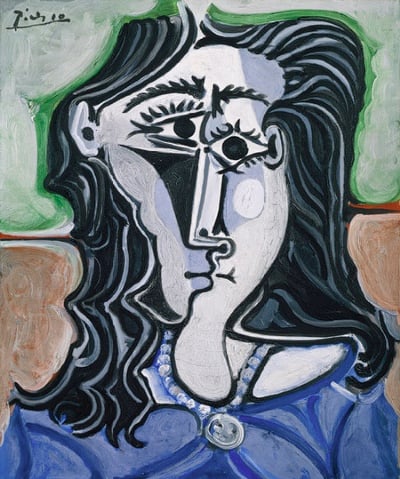
Head, 1960
Pablo Picasso (Spanish, 1881–1973)
Oil on canvas
Gift of Mr. and Mrs. Leonard S. Field, 1990 (1990.192)
http://www.metmuseum.org/toah/hd/pica/ho_1990.192.htm

There were a couple of articles published this week on the mind and how it works, actually they were both reviews of recently published books. One in the Guardian, “The Master and His Emissary: The Divided Brain and the Making of the Western World by Iain McGilchrist”, and one in the New York Times Review of Books, “Mind Reading.” The first article is about how the left and right hand sides of the brain work and the second about how we evolved into readers. They do not have much in common in that they address two very different functions of the brain, but they raise issues about how the mind works and how we learn that are interesting to anyone who works in, or appreciates, the humanities.

The Guardian article reviews a book about how the different sides of the brain are responsible for two very different and somewhat contradictory operations of the brain. The left hand side focusing on the immediate and the concrete and the right hand side focusing on the future, the bigger, long term picture, and the abstract. The music by Edward Elgar is from The Enigma Variations and suggests that music, like language can take us in a number of different directions at once. The title, Enigma, suggests there is a mystery behind the music, which Elgar never explained other than to suggest the actual theme at the heart of the variations is never played. But the variations also suggest the different ways a melody can be heard and performed and, by extension, the different ways the mind can “understand” a piece of music.

The painting by Picasso gives us two views of a human face at the same time, the full face and the face in profile, again suggesting that how we see something depends on our perspective or point of view. The book reviewed in the article argues that for the mind to do what we need it to do each side must perform its part of the job and then hand the task back to the other part of the brain to do its part of the task. The left hand side of the brain does what it needs to do to address immediate problems than hands the task back to the right hand side to make plans for the future. If one side monopolizes the task and refuses to turn it over to the other side problems can arise. In practice it is the left hand side, that is more focused and less abstract, that is more likely to try to dominate.

Ocean Park No.129
Richard Diebenkorn
http://en.wikipedia.org/wiki/File:Richard_Diebenkorn%27s_painting_%27Ocean_Park_No.129%27.jpg


It is the two sides of the brain that allow us to see more than one side of a thing, as in Picasso’s painting, at a time. The painting by Diebenkorn is from a series of paintings called Ocean Park. Each painting is different and offers a different view of the same landscape. Ocean Park is a real place in Santa Monica, a suburb of Los Angeles. As with the music, that same view may change depending on how we see it at any given moment, seasons change, different aspects of a landscape may capture our attention at different times. A more left side of the brain painting of the landscape may be more identifiable as a Southern California beach city, but does that make it more “real”?

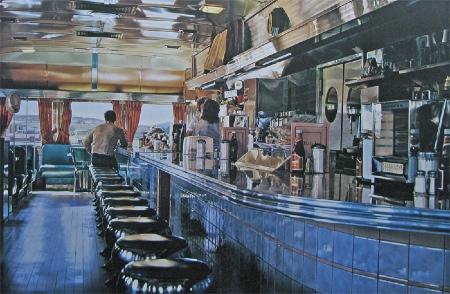
Ralph's Diner
Ralph Goings
http://en.wikipedia.org/wiki/File:Ralph_Goings.jpg


A more left brain way of looking at a landscape might be suggested by Ralph Going’s painting Ralph’s Diner. The painting attempts to capture a photograph with paint and canvas and to make that painting to the extent possible an exact duplicate of the photograph. It is an impressive demonstration of what can be done with paint, canvas, and an artist’s skill. But if all it does is duplicate the photograph what makes it more than just a demonstration of an artist’s skill, what makes it a work of art in its own right, what is the contribution of the right hand side of the brain?

I suppose it is the same thing that makes a Renaissance painting of a landscape, that captures that landscape as realistically, as photographically, as possible, a work of art. In any painting there are at least two components, the artist’s choice of a subject and the manner in which that subject is captured. The Renaissance painter tried to capture what was seen as a photograph might if the camera had existed. The photorealist painter is trying to capture the photograph as though it were a Renaissance landscape, sort of.

Becket
Paramount Picture


In this film clip Henry II makes Thomas Becket his Lord Chancellor. He is trying to use the brilliance of his friend and advisor to achieve certain ends with the church. Henry is a very concrete, left brain, kind of thinker. He knows what the immediate problem is and he knows the most effective way of achieving an immediate solution to that problem. Becket on the other hand is more imaginative, a more right brain kind of thinker, better at using abstract thought and abstract language to achieve the ends Henry desires.

Later in the film Henry will put Becket in charge of the English Church by making him Archbishop of Canterbury. Because it is the church that is giving him trouble he, thinking very concretely, will put his friend who will do what he asks in charge of the church. He misunderstands Becket who is immensely loyal in his service to Henry. By making Thomas head of the church his loyalty must be to the Church and not to Henry. Becket tries to warn Henry, but Henry is not able to make that abstract leap and imagine his friend as anything but loyal to the king.

Wallace Stevens in the first part of his poem “The Man with the Blue Guitar” captures the relationship between the concrete and the abstract sides of the brain, or perhaps lack of a relationship would be more to the point.

The Man with the Blue Guitar

I

The man bent over his guitar,
A shearsman of sorts. The day was green.

They said, "You have a blue guitar,
You do not play things as they are."

The man replied, "Things as they are
Are changed upon the blue guitar."

And they said then, "But play, you must,
A tune beyond us, yet ourselves,

A tune upon the blue guitar
Of things exactly as they are."


The audience wants “things as they are” they want what is “real” but the guitar captures it own reality, it changes what “it sees” and makes it into something else, as Diebenkorn does with his seascape. The artist, even the photorealist artist, captures the world in her or his imagination and makes that world into a piece of music, into a story, into a painting or a sculpture, the world is changed, after a fashion, by the imagination.

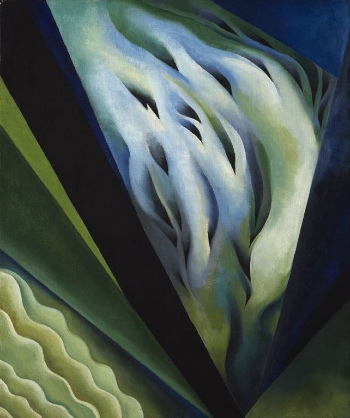
Blue and Green Music
Georgia O'Keeffe
http://en.wikipedia.org/wiki/File:Blue-green.jpg


The painting claims to represent music, blue music and green music, it is a visual representation of what O’Keeffe imagines music to “look” like. But it is not just any music; it is green music and blue music. What are the colors intended to suggest about the music? Did she have a specific piece of music in mind when she painted it? I wonder what the story is that O’Keeffe is trying to tell. There is a suggestion of sound waves and of flowers in the painting but I do not know what they are meant to suggest about music (perhaps I am too concrete in my thinking). There is also a sense in the painting that music is a force that is penetrating, perhaps the furrows that might suggest sound waves are not waves at all but furrows and it is the earth the music is penetrating. In that sense you might have the “blue” sky and the “green” earth.

The New York Times article is about reading and writing and how they evolved. It is a review of a book that tries to understand how the black (usually) marks on a white (usually) surface (that is not always a paper surface anymore) can produce such profound emotions in the human psyche. It wonders why the letters we use to make words are shaped the way they are and why do we use letters, like “b” and “d” that are so easily confused. The article also points out that the shapes of some letters, the “t” for example, have primal associations that might have made them attractive to those who invented the first letters, though it does not go on to say how these associations relate to the letters they have become. At its heart the written word seems to be a very right brain kind of function but it is often used to achieve very left brain kinds of things.

But for me it is the coming together of the imagination with language to tell stories that I find most attractive. It is the right brain ability to think abstractly and to imagine that causes me to wonder how we have evolved into storytellers who shape meanings through sounds and images and words. I also wonder why it is that reading Jonathan Swift excites me and makes me laugh but seems to put many of my students to sleep. Is it just an inadequate vocabulary or are there significant ways in which we all process what we read differently? Obviously we all see different things in what we read, but why is it that some of us can develop a “literary” imagination that can take complex texts and shape them into meaning and merriment while others not only cannot but do not have an interest in developing the skill?

It is not that those that are not attracted to the written word lack imagination, though it might be that some do, because many that are not captivated by the written word have very rich imaginations, they may be dancers, musicians, or painters. Maybe it is just a case of finding the right story to bewitch the imagination and that until that story is found the “literary” imagination pursues other things. Maybe it is just that it is difficult to understand how what is gold to one person is brass to another. We do not all value the same things; we are not all touched by the same things. It is probably enough that the imagination lives even if it is sustained by a different kind of nourishment.


Tuesday, December 29, 2009

The Look of the Moment


L. A. Freeway
Jerry Jeff Walker

The Look of the Moment

Self Portrait
Leonardo da Vinci
http://en.wikipedia.org/wiki/File:Leonardo_self.jpg


The freeway system of Los Angeles (and perhaps the smog it helps to generate) is in many ways the “face” of Los Angeles, its icon on the cultural desktop. There is of course much more to Los Angeles and much of that “much more” paints the city in much more favorable colors. Those aspects of a landscape that become iconic are not always the aspects that best represent that landscape, just the aspects that get the most attention. Still, it is something we do; we do not just name things but characterize them as well. We give them an identity that may or may not be true to their nature.

But we do not just do this with places; we do this movements, with cultures, with moments in time. How dark were the “Dark Ages”, what were the “Middle Ages” in the middle of? As freeways for some define Los Angeles, Leonardo da Vinci is, for many, the face of the Renaissance. When we think of the “Renaissance Man” the face that comes most readily to mind for many is Leonardo’s and when we call someone a Renaissance man or woman the comparison is for many to Leonardo. His face is iconic with an age and a concept.

Set of Harry Potter books, UK edition
Bloomsbury Publishing
http://en.wikipedia.org/wiki/File:Harry_Potter_Books.png


There was an article in the Guardian last week, “Harry Potter: Icons of the decade,” that identified Harry Potter as the icon of the last ten years, the first decade of the third millennium. There have been a number of articles over the past month that pointed out that Rowling’s wizard dominated book and movie ticket sales over the years since he first appeared. Some of these articles were positive, most of them were negative, in that many critics do not think these books have literary merit. But last week’s article pointed out that the Harry Potter books appealed to readers of many generations and asserts that they made reading “children’s books” an acceptable adult practice. Many of the images of an age are literary; they come from the stories that people tell that capture the spirit of the time. And because they capture so effectively the moment that produced them they come to represent that time.

Classical Greece is personified in Homer’s epic heroes and Plato’s representation of Socrates and classical Rome in Virgil’s epic hero with bits of Ovid and Petronius thrown in as well. For Renaissance poets Virgil became the iconic epic poet that everyone else tried to imitate. Milton begins Paradise Lost with an appeal to his heavenly muse that suggests Virgil’s invocation of his muse. Virgil tells the story of The Aeneid over twelve books, Milton tells his story over twelve books. There is an irony in that both The Aeneid and Paradise Lost focus on a character that was on the losing end of a war who ventures off to a new land to start a new kingdom. Perhaps it is this similarity between Aeneas and Satan that cause some to see Satan as the hero of Paradise Lost.

King Arthur as one of the Nine Worthies, detail from the "Christian Heroes Tapestry"
Anonymous
http://en.wikipedia.org/wiki/File:Arth_tapestry2.jpg


King Arthur has come to represent Great Britain and its destiny. He is called, after all, the “Once and Future King” and it is part of his myth that he will one day return and restore Britain to greatness. The illustrations above and below capture aspects of Arthurian iconography. Arthur was one of the “Nine Worthies” and was at the time of Malory’s retelling of the stories already a revered character who had found his way into the storytelling of many European countries. It is interesting to me that Malory relied more on the French versions of the stories than he did on the more indigenous Welsh versions of the tales. The image below is of the Holy Grail that has become synonymous with excellence and achievement at the highest levels. And as the exclamation from Harry Potter “Merlin’s Beard” reminds us, Arthur’s wizard Merlin has become an icon of wizardry and he makes frequent reappearances in literature.

Apparition of Saint Graal
Anonymous
http://en.wikipedia.org/wiki/File:Apparition_saint_graal.jpg


Where we find the icons of an age suggests to us what was important to that age. The icons of the 1960’s, for example, were rock bands, most notably The Beatles, though there were many others. Victoria and the first Elizabeth have become icons of their age not because of what they produced but what was produced in literature and the arts during their reigns. What does this suggest about how the people of each age saw themselves or, perhaps, how they were seen by those that did the labeling. Did Victorians, for example, see themselves as “Victorians”?

To what extent do our icons actually capture those we are trying to label? If Harry Potter is the icon of the present decade what does he, as a character, say about us? Is he important because of his economic contributions to the book trade or is he important because of the ideals he represents? People read these books because they are captured by the stories they tell. We want, perhaps, to see ourselves as heroic and these books offer an avenue for “experiencing” a bit of heroism. King Arthur represents an ideal of might on the side of justice and that probably contributes to his popularity through the ages and to the extent that Arthur’s vision was planted in his mind by Merlin might suggest Merlin’s rise to an iconic status. Perhaps stories are as much about what we aspire to as they are about who we are.

Don Quixote. From Chapter I
Gustave Dore
http://en.wikipedia.org/wiki/File:Gustave_Doré_-_Miguel_de_Cervantes_-_Don_Quixote_-_Part_1_-_Chapter_1_-_Plate_1_%22A_world_of_disorderly_notions,_picked_out_of_his_books,_crowded_into_his_imagination%22.jpg en.wikipedia.org/wiki/File:Gustave_Doré_-_Miguel_de_Cervantes_-_Don_Quixote_-_Part_1_-_Chapter_1_-_Plate_1_%22A_world_of_disorderly_notions,_picked_out_of_his_books,_crowded_into_his_imagination%22.jpg


On the other side of the coin Don Quixote is iconic not just for the ideals he pursued and the manner in which he pursued them but because of his obsession for living in stories, for giving stories too much power over his sense of himself. There is value to the stories we tell, they help us to give life to our ideals, but there is also a danger. Quixote first lived vicariously through his stories than tried to put his vicarious living into practice. He goes beyond emulating the characters in his stories to trying to become the characters in his stories. I think stories can help us to give definitions to concepts and values but we have to make these concepts and values true to the people we are, to our own psychology. There is a difference between learning from stories to live more effectively and using stories to escape from living altogether. There is a place for the Quixotic quest, but only if we pursue the quest in our own name and not that of the hero of some story, that we become Quixotic and not Quixote.

Raiders of the Lost Arc Trailer
Paramount Pictures


Many of our modern icons come not from books but from films. For many the stories that help give definition to their lives and define their values come from the cinema. In the film clip we are introduced to a character who is a scholar with a worldwide reputation for scholarship, Army Intelligence, after all, seeks him out because of his scholarship. But he is also an adept field archeologist, a quick and insightful thinker, and a “super hero” of sorts; he is, in fact, a kind of “Renaissance Man.” He is part Sherlock Holmes and part James Bond with, perhaps, a bit of Errol Flynn thrown into the bargain. The film also draws upon iconic images from films of the past. There is a suggestion of Humphrey Bogart in The Treasure of Sierra Madre and of John Wayne in Stagecoach.

How important are these icons to our lives and our understanding of our place in the real and the cultural worlds? Do we need these icons; do they provide a kind of shorthand that makes communication easier? If they do, how accurate are they and do they really do what we think they do? It is important to tell stories and to communicate these stories effectively.

But we cannot communicate with others unless we all mean the same thing, or nearly the same thing, by our common iconic vocabulary. Were the Victorians, for example, remarkable because of their real cultural achievements or were they something much less exemplary, a closed minded intolerant people? They gave us the novels of Dickens, Eliot, and Hardy but were also possessed of a prudish set of values that has become an icon of a different color and the term Victorian is positive or negative depending on the context in which it is used.

The great Victorian detective often found the solution to a problem to be “elementary” but the writer of detective fiction often begins with the solution and writes backwards. If we know the end from the beginning much does become elementary, but those who live their lives going forward from beginning to end often depend on others to find the narrative thread that defines their lives. For Sherlock Holmes the story ends with the solution to the problem. But an age, like any individual, is rarely around to define itself by the ending that it makes and depends on those that remain to make an honest assessment.

Sherlock Holmes
Sidney Paget
http://en.wikipedia.org/wiki/File:Sherlock_Holmes_Portrait_Paget.jpg


Friday, December 25, 2009

Reading all the Signs


Long Way Home
Tom Waits

Reading all the Signs

Portrait of the Merchant Georg Gisze
Hans Holbein
http://en.wikipedia.org/wiki/File:Portrait_of_Georg_Gisze,_by_Hans_Holbein_the_Younger.jpg


The song talks about taking “the long way home.” Often the shortest, and the quickest, distance between two points is not the most interesting journey. Just as a quick look at the painting will not reveal all the painting has to offer. When I was younger I rode a bicycle through England, Scotland, and Wales, Holland, Germany, and France. When I started my trip my plan was to hitchhike everywhere. When I left London I hitchhiked down the motorway to Salisbury. While I was there I walked to Stonehenge, about a ten mile walk from where I was camping just outside the town. It was a beautiful walk that made me aware of what I would be missing if I traveled the motorways. When I got back to town I went to the Salisbury Cycle Works and bought a ten-speed bicycle. They put a rack on the bike so that I could more easily carry my backpack. The second day out I went down a quiet country road in a valley beneath one of the houses in which Jane Austen lived. There was a woman by the side of the road selling strawberries and cream. I, of course, bought some and enjoyed the whole “Jane Austen” aura of the moment, a moment I would have not enjoyed on the motorway. I imagine the strawberry vendor was there for the benefit of tourists visiting Austen’s house, but I arrived early and was the only other person on the road at the time so I did not feel so much like a tourist.

The point is that it often profits us to take the long way and to not rush so much from place to place. I could have seen much more of Europe than I did if I had stuck to the motorway, but in another sense, though I would have covered more miles and visited more places I would not have seen as much. I also think that people responded to me differently riding a bicycle than they would have if I were rushing by car from place to place. I was a tourist and folks looked at me as such, but the bicycle initiated conversations that probably would not have been initiated otherwise. When the rack that carried my pack broke (because of the books I brought with me it weighed close to sixty pounds) a couple in a large black Bentley invited me to join them for tea by the side of the road. They could not give me a ride to town but they did give me a pleasant break from pushing my bike.

I made the journey that Chaucer’s pilgrims made from Canterbury to London (their return journey) in one day. I am not certain how long a trip it was for Chaucer, but my sense is that it took a couple of days. I went faster than a fifteenth century traveler, but not nearly as fast or as far as most twentieth century travelers. But it is not just that travel by bicycle is slower than travel by car, but that travel by bicycle puts you closer to the ground and to the rest of the landscape and because you are traveling more slowly many more of the small details are noticeable. In a car you may see the lichen on a stone wall, but you would miss the rabbit lunching behind it.

There was an article in the Guardian last week, “You can't speed read literature,” about the way we read (or ought to read) literature differently from the newspaper or a textbook. When we read the paper or a textbook we are generally reading for specific information and are less concerned with the subtleties of language or the sound of the words in combination with one another. Our goal is to just get through the material and do whatever we need to do with the facts we have gleaned. But when we read literature, the way the words interact with one another and the phrasing and the figurative language that are used are the source of much of the pleasure we get from the experience. Literature cannot be read quickly, not if we are to enjoy all it has to offer.

A novel can be read quickly for the plot line, to get the gist of the story, but for those that read literature as literature that is not the point. May Sarton once said, “I used to tell my students situation and character are life to a short story and plot kills. Plot kills something, there is no doubt, and in the kind of writer that Katherine Mansfield was, plot is not the point. It is something else. The same thing with Virginia Woolf. You might say that in To the Lighthouse very little happens except inwardly, in the characters, but people go back to reread books where not much may be happening but a great deal of life is being created.” We speed read for plot, we read carefully for character, situation, and to find the other interesting things a great writer can do with language. Those who travel the motorway from Canterbury to London in a few hours have made the same journey as those that make the same trip by bicycle in the course of a day or at least they cover the same ground. But is it really the same journey?

Children’s Games
Pieter Breughel the Elder
http://commons.wikimedia.org/wiki/File:Pieter_Bruegel_d._Ä._041.jpg


As with the painting at the top of the page, in this painting by Breughel there is a lot to see and though a quick glance may be enough for us to enjoy the use of color and the superficial construction of the scene there is much too much happening in the painting for us to get much of its real value from a momentary glance. Every one of the little groups that fills the painting depicts or suggests a different children’s game. To fully enjoy the painting attention needs to be paid to each of the games and the way each game is suggested by what the characters in the painting are doing. It is necessary to spend time with things of value if their full value is to be appreciated.

"The Dirigible"
Alfred Stieglitz
http://en.wikipedia.org/wiki/File:Stieglitz-Dirigible.jpg


The photographs above and below suggest other reasons to linger over things. The dirigible in the Stieglitz photo, to me anyway, is kind of mysterious. It evokes the wonder of flight. The sun gilding the edge of the clouds suggests the rising or the setting sun, we cannot really tell if it is dawn or dusk or if the clouds are just hiding the sunlight. But the dirigible itself is captivating. The way the gondola hangs beneath the sausage shaped balloon is intriguing to me. It suggests a sailing ship in flight. For me there is also an eeriness to the photograph, something mysterious that I do not fully understand that reminds me of something from a Jules Verne story.

The Adams photograph provokes, or at least it does in some, a meditation on the natural environment and its wild and sublime beauty. It invites us to linger over it, to pursue its details and enjoy the landscape that it captures. There is a similar play between light and shadow, between the ominous and the comforting, that is found in the Stieglitz photograph. Both the storm in the mountains and the currents in the river suggest the power of nature and its potential dangers.

The Tetons and the Snake River
Ansel Adams
http://en.wikipedia.org/wiki/File:Adams_The_Tetons_and_the_Snake_River.jpg


There were two reviews in the Washington Post of modern translations of stories from fifteenth century England and Italy. One was of Peter Ackroyd’s prose translation of Chaucer’s Canterbury Tales, “Book review: 'The Canterbury Tales: A Retelling' by Peter Ackroyd,” and the other of Ludovico Ariosto’s epic poem Orlando Furioso, “Michael Dirda reviews 'Orlando Furioso' by Ludovico Ariosto.” Both of these stories have been personal favorites and that they still generate enough interest to warrant a new translation is encouraging to me, though I am much more surprised about the Ariosto than the Chaucer, who has always been popular in the English speaking world. I think Ariosto repays the time that is spent with him and it is a pleasant thought that many more will perhaps spend some time with him. For me he is like a cross between J. R. R. Tolkien and Jonathan Swift in that it marries the heroics of the one to the comedy of the other. Enjoyment can be gotten by speed reading each of these books but there is so much in each to be savored and lingered over that is sad to think that some could be satisfied with such a meager offering, sort of like taking a single bite from an ice ream cone and throwing the rest away.

Traffic
Jacques Tati


A film is experienced differently than a book or a painting. One cannot take more time over a film than the film takes to run, well one could, but that would defeat the purpose of the film and probably do some harm to its enjoyment. But careful attention needs to be paid to what happens on screen. In the film clip from Jacques Tati’s Traffic much of the humor can be missed if the viewer does not pay attention to details, like the movements of the individual drivers after the accident or to the debris and the way it moves through the scene. The film is a French film but it is not necessary to understand the language (though I think it is has been dubbed in English) to enjoy the comedy, so much of the humor is visual.

It is not just the spending of time, though, but how the time is spent. One person may read a book slowly because they do not understand the words and have to read and re-read to figure out what is happening while another may take the same amount of time reading because she or he is paying careful attention to the details of the story and the manner in which those details are conveyed. I think the increasing speed at which we move through life makes us less willing to spend time wresting with the written word when we do not understand and can leave us satisfied with a superficial reading when we do understand. Because of the numerous distractions that are available in the modern world, many students do not want to build the language skills necessary to fully understand and enjoy a work of literature.

Thoreau felt, when life went quite a bit more slowly, that we spent too little time with ourselves and the world around us. We probably spend even less time with ourselves and our environment today. I suppose reading and reflection are a kind of mental exercise that many want to avoid in the same way they avoid calisthenics and other forms of physical exercise. In the same way we struggle with delayed gratification in the manner we run our finances we often struggle with delayed gratification in the manner we develop our intellect. As our enjoyment of a thing we desire is often more perfect when we take the time to save up for its purchase, as opposed to using credit of one form or another, so is the object of our study, whether of a text, a concept, or a science, more perfect when we take the time to fully understand that study. There is a difference between knowing and understanding and that difference is often the product of time.


Thursday, December 17, 2009

Mindful of the Cost


Bach: Cello Suite #1 In G, BWV 1007 - 1. Prelude
Mstislav Rostropovich


Mindful of the Cost

Scholar and His Books
Gerbrand van den Eeckhout
http://en.wikipedia.org/wiki/File:Gerbrand_van_den_Eeckhout_003.jpg


The music of Bach has always seemed very contemplative to me, often there is to it a kind of joyousness as well that captures both the introspective nature of scholarship and the pleasure that scholarly pursuits can give. Perhaps I am just superimposing onto Bach my own feelings and interests, who’s to say. Aristotle believed that the desire to learn and develop intellectually is built into every human being and is part of what makes us all human. I think there is truth to this. The painting also captures the contentment the scholarly gentleman it features experiences as well. He looks very at home with his books and his thoughts.

There was an article in this weekend’s Boston Globe, “FreeHarvardEducation.com,” about a web site that makes student notes (and the many of the professors’ lecture notes) available free online where anyone who wishes can read and learn from them. The specific students and professors being discussed in the article are from Harvard University but the underlying issue addressed by the article is “who owns academic work” and the knowledge that is created by study and scholarship.

This is in part why students are required to document the sources of the information that appears in their essays. They are acknowledging that the ideas and information that appears in their papers do not originate with them. But is all that is cited equally original with the source that is being cited in the paper? Is an encyclopedia article that gives information on the French Revolution as entitled to the ownership of the information presented as Darwin is of the Theory of Evolution or Einstein is of the Theory of Relativity? If the student does not quote the article word for word is that student really stealing from the encyclopedia or are they only stating facts that belong to all that have an interest in history.

There is another issue here of course and that relates to preserving the sources of one’s research so that those that come after can duplicate that research. R. C. Bald in his biography of John Donne points out that an earlier biographer, Edmund Gosse, wrote an excellent biography of Donne. But Bald points out that Gosse published at a time when citing sources and printing bibliographies was not as big a concern as it is today. Gosse did the research and prepared the bibliography of that research, but his publisher did not see the importance of printing the bibliography. As a result most of Gosse’s research had to be done over. I think this is an important concern, but the issue is not so much one of who owns the information so much as leaving a trail that those that come after can follow. Even though it is unlikely that the research done by students in a high school English class will be studied by future scholars, the principle is worth learning and the habits of good scholarship are worth developing.

Bangalore Central Library
Mouleesha
http://en.wikipedia.org/wiki/File:BangaloreCentralLibrary.JPG


There was an article recently in the New York Times, “Despite Ray Bradbury’s Efforts, a California Library Closes,” about how a library that Ray Bradbury had tried to help save last summer was forced to close due to budget cuts and the inability to raise the necessary funding from alternative sources. In the article Bradbury is quoted as saying, “Libraries raised me. I don’t believe in colleges and universities. I believe in libraries, because most students don’t have any money. When I graduated from high school, it was during the Depression and we had no money. I couldn’t go to college, so I went to the library three days a week for 10 years.” Most of what is worth knowing can be learned at a library. Obviously the bigger the library the more one can learn, but most well stocked and well maintained libraries make a great deal of valuable information available to anyone who wants to learn it. As more books become digitized it is becoming easier to access a good library even if one lives many miles away from the library itself.

National Central Library of Florence
http://en.wikipedia.org/wiki/File:BNCF_7.JPG


Of course this raises other issues about the ownership of ideas and intellectual property. But as Harry Lewis says in the Harvard article mentioned earlier, “Harvard and MIT and Stanford and Princeton, we’re not Decca records. Our job in life is to provide enlightenment to the world,” says Lewis, an outspoken critic of the way content providers have used copyright law online. “We have to make a living doing it and all the professors have to be paid for their labors, but the notion that universities would inherit the oppressive picture of the way intellectual property is treated by the music industry is really a fundamentally warped view of what the ultimate purpose of universities are.” Lewis believes that professors need to be paid and that universities cannot keep their doors open if they cannot charge for what is taught in their classrooms, but the fundamental mission of a school is radically different from that of a business and that mission should guide the decisions, including the financial decisions, that a school makes. If online libraries and study groups can give more people access to knowledge and scholarship ways ought to be found to accommodate that enterprise.

Portrait of Jean Miélot, secretary, copyist and translator to Duke Philip the Good of Burgundy
http://en.wikipedia.org/wiki/File:Escribano.jpg


The medieval monk in his scriptorium worked daily at preserving the accumulated knowledge he had inherited. Most of what was preserved was religious in nature, but not all of it. Classical works of poetry and philosophy were preserved as well. The Beowulf manuscript was probably preserved by a monk. Snorri Sturluson, a Scandinavian monk, preserved a hefty chunk of Skaldic poetry and Norse storytelling. Those who have read Umberto Eco’s The Name of the Rose can appreciate the irony of a manuscript that was lost when the library that provides the setting for his story burns down. This manuscript also lies at the heart of the mystery the story’s protagonist investigates. The novel at the very least suggests who is the owner of the knowledge, of the scholarship, that is housed in the monastery’s library? Is it the property of the monastery and its leadership and are they free to do with it what they will?

Paper Chase
CBS

The film clip comes from the television program Paper Chase. The program, like the film, focuses on a law professor, Professor Kingsfield, who teaches contract law at Harvard (or at least a very Harvard-like institution). He is an exacting legal scholar who expects his students to be equally as exacting, and equally as brilliant. In the film there is a moment when Hart comes to class unprepared and cannot answer a question that is put to him by Kingsfield. Kingsfield attack Hart and Hart, eventually attacks back. Kingsfield praises Hart, after a fashion, for fighting back, suggesting that what is important to Kingsfield is not being always right or preserving his ego but in teaching his students to defend their point of view and to make that defense intelligently based on the law as it is written. As for many teachers worthy of the name, what is important is honing the students’ skills by whatever means necessary.

So, who owns scholarship; who owns learning? Why do we go to school, why do we send our children to school? Is the purpose of school merely to teach the next generation a trade by which they can earn their bread, or is there a greater purpose? Some derive great pleasure from being able to reason out a difficult problem. Isaac Newton used to calculate logarithms in his head for fun (anyone who has ever had any experience with logarithms can appreciate the mental effort involved in this exercise). Many go to college to make contacts with others that may be important for the advancement of their careers, some want a degree from a prestigious university because of the doors the degree will open when they enter to job market. There is nothing wrong with this way of thinking about education, it is probably what motivates the majority of students, but for the university itself and for the student who wants more from an education than just the degree that comes with it this is not (or ought not to be) what is important. It is not just the preservation of a culture, but a frame of mind that sees the development of a mind as an important and beautiful thing. The bank note pictured below is of a Turkish twenty million lira note, the world’s largest currency denomination. I think it is fitting that the image that graces this bank note is of a library, the ancient library at Celsus. Of course it should not be overlooked that the library on the bank note is a ruin, which should remind us that libraries cannot survive if those that value them fail to preserve them.

Twenty Million Turkish Lira banknote featuring the Library at Celsus
http://en.wikipedia.org/wiki/File:20million.JPG


Thursday, December 10, 2009

Where the World Can’t Find Me


Down on the Corner
Creedence Clearwater Revival

Where the World Can’t Find Me

From "Miscellany on the life of St. Edmund"
Pierpont Morgan Library, New York
http://en.wikipedia.org/wiki/File:Wikinger.jpg


The song celebrates a group of folks, Willie and the Poor Boys, who live in a poor neighborhood but manage to carve out a space for themselves every night where the world behaves more to their liking, and the liking of those that take the time to listen to the music that they make. There is something in human nature that wants its own private space where there is no one to answer to. For some it is their home at the end of the day, that place where there is no doing as they are told, though with the advent of the cell phone and other technologies the idea of a fine and private place is becoming a thing of the past.

The paintings above and below are of Vikings. They produced an impressive literary tradition of Skaldic verse and prose sagas that are among the finest adventure stories in any language. But they were an independent people. When Harold made himself king of Norway they pulled up stakes and moved to Iceland where they set up their own little world with its own somewhat democratic form of government. At the time a land that was a sea voyage away from any other land was an isolated place. Vikings were the best and the most daring navigators of their day. They sailed most of the known world and a bit of the unknown world. And though they were a pain and a terror to much of the world, they had their own corner of it that they could call home where outside forces could not, or at least did not, intrude.

Guests from Overseas
Nicholas Roerich
http://en.wikipedia.org/wiki/File:Nicholas_Roerich,_Guests_from_Overseas.jpg


There was an article in this week’s Boston Globe, “The mystery of Zomia,” about various peoples that live in the mountain regions of Southeast Asia. According to the article groups of people, the Hmong and the Wa for example, migrated into the mountains in order to escape the tyranny of the lowland governments of the Mughals and the Han among others. These mountain folks not only left these oppressive governments behind, but all of the cultural accoutrements that came with them. As a result these mountain people did not develop a written language or a literary or cultural tradition. For these people literature and art were associated with oppression. On the other side of the coin, theirs is a very “survival of the fittest” kind of existence with a very rough justice that can be bit oppressive in its own way to certain groups within the culture.

But this raises an interesting question, is culture a liberating force within society? The Vikings isolated themselves after a fashion and created rich cultural traditions, while other groups have taken themselves into isolation and eschewed the cultural trappings they might have inherited and did not adopt a formal culture of their own. I find it difficult to believe, though, that a people can survive without stories, even if they are the stories told around a campfire that are never written down. Part of what makes a culture and a people, a culture and a people are the ways they go about doing things and the way they look at the world. Even if a formal “Culture” is abandoned there are still ways of doing things, the way a camp is set up for example, the distribution of labor, and the like that become traditions that are handed down from one generation to the next. They are perhaps, the little rituals that Hemingway captures in his stories and novels. When the Old Man, in The Old Man and the Sea, goes fishing, for example, there are proper ways to trim a sail and to set a hook and limits to how far out to sea one takes their little boat.

But are agreed upon ways of living and doing things the same thing as a culture? For Hemingway’s Old Man there is “baseball” which is inessential to daily survival on top of all the little rituals he has learned that are essential to daily survival. There are lessons to be learned from baseball about how we should live, about tenacity, and about giving our best effort to all that we do. These are lessons that our cultural traditions often teach us. And though these traditions may not be set down in writing or preserved in paintings or sculptures they are surely present somewhere in the heritage of a people. The Hmong may not have a print copy of their Iliad or Odyssey but it is very likely there are stories they tell one another that perform for them the office of The Iliad and The Odyssey.

Book of Kells, Folio 32v, Christ Enthroned.
http://en.wikipedia.org/wiki/File:KellsFol032vChristEnthroned.jpg


There was an article in the Chronicle of Higher Education, “A Monk Saves Threatened Manuscripts Using Ultramodern Means,” about a monk who is digitizing early Christian manuscripts in order to preserve them, he is performing a “transcriptional” service not unlike that performed by the medieval monks that copied and recopied the manuscripts that are now being digitized. (There was an article of a similar nature in the New York Times a few weeks ago about a woman transcribing the Torah, “A Torah Scribe Pushes the Parchment Ceiling,“ a book of great importance to the Jewish culture.) Both the modern and the ancient monks preserved their cultural artifacts using the best technology available to them. The monasteries, especially in the Middle Ages, that preserve these documents are often remote and isolated places. They were removed, often, from worldly influences in order to pursue religious traditions that, for those that practiced them, were liberating.

There is a paradox, I suppose, to a tradition that imposes rules and restrictions on the practitioners of that tradition that most would find constraining and restrictive but the practitioners themselves find freeing. Perhaps an aspect of liberty is the willingness to place limitations on the exercise of that liberty to insure that it is exercised responsibly. Of course the restrictions monks placed upon themselves go beyond this and suggest that self-denial is perhaps an essential aspect of the liberty they enjoyed, that true liberty lives not just in doing but in choosing freely not to do certain things. Liberties, like those found in the Bill of Rights free us to live as we choose in our free society, it liberates us from the tyranny of government. Self-denial on the other hand liberates us from the tyranny of ourselves and the desires, compulsions, and impulses that often dictate our actions and behaviors.

Swiss Family Robinson
Buena Vista


The film clip suggests another aspect of isolation, though in this instance it is not a self-imposed isolation. In the film (and the book) a family is shipwrecked on an uninhabited island and must find a way to survive with what little is left them and with what they can “harvest” from their surroundings. But as with those groups that have isolated themselves there is a freedom that comes with being marooned. The family can make their own rules; shape a lifestyle that is pleasing to them, within the limitations imposed by the island. They are a bit different from other castaways, like Tom Hanks in the film Castaway or Robinson Crusoe in the book that bears his name, in that they have each other, they have company and can make the beginnings of a small society. Of course it is a very small society and over time they are likely to feel the need for a larger community. But for the moment they are shaping an idyllic paradise. But there are no guarantees, I suppose, that the life of a company of castaways will turn out so well. William Golding’s book The Lord of the Flies suggests other, less desirable, possibilities.

Still, mountains and other natural barriers provide a means for cultural discontents to separate themselves from a way of life, a social order they find distasteful or oppressive. The Scottish Highlands offered such a refuge to the more independent and iconoclastic clans of the region, as did the western frontier for many American malcontents. Perhaps the region of America most like the Zomia region of Southeast Asia is Appalachia. The people that settled these mountains were also looking for a way to separate themselves from a culture they found disagreeable. They resisted public education, at least as it was practiced in the lowlands, and were distrustful of any cultural baggage that they associated with the lowlands. The stereotype of the region is often of a people that are ignorant, illiterate, and unsophisticated. However, as the Foxfire series of books, bluegrass music, and other cultural contributions of this region of the United States attest, this is a community with a deep, rich and vibrant heritage, and the culture of the nation is enriched by it.

It is the culture we choose to preserve that identifies us as a people. We may enjoy the cultures of other parts of the world, read their books, enjoy their paintings and music, but it is the literature, art, music, and traditions that we as a people preserve and value because of what they reveal about us as a people that define who we are as a people. We are the curmudgeonly anger of talk radio; we are the brash in-you-face iconoclasm of rock and roll music and graffiti art; we are the kitschy “camp” culture of vampires and young wizards. But we are also the epic, literary individualism of Walt Whitman and Henry David Thoreau, the stark loneliness of an Edward Hopper painting, and the urban lyricism of George and Ira Gershwin. There is a “high brow” and a “low brow” culture that say much the same things about who we are as a people and there is a place, I suppose, where the high and the low meet and put a face on the character of the nation.

Detail of Diego Gutiérrez's 1562 map of the Western Hemisphere, showing the first known use of a variation of the place name "Appalachia" ("Apalchen")
Diego Gutiérrez
http://en.wikipedia.org/wiki/File:Gutierrez-1562-detail-app1.jpg