Sunday, October 17, 2010

For Love of the Game


Playing Right Field
Prairie Orchid

For Love of the Game

Comenius on a 20 KCS bill
http://wapedia.mobi/en/File:Comenius20.jpg


The picture is of old Soviet era currency from Czechoslovakia. The man depicted on the bill is John Comenius. He was a 17th century philosopher/theologian who is responsible for developing the form that public education takes to this day. He developed a structure for schooling of kindergarten, elementary school, secondary school, college, and university that is the basic structure of public education in America today. He also articulated a philosophy of education centered on thought and investigation, an application of the scientific method to the classroom, that is also practiced in many classrooms to this day. Lastly, his influence on the curriculum and the course of study is also still felt; a belief that getting an education should be enjoyable and that it should be universal both in its scope and in its availability; that it should cover the breadth of human knowledge and that it should be available to all. He was a product of his time and there are things he believed were important that may not be seen as important today, but nonetheless his influence on education is a profound one.

At the heart of modern education is testing. In America in any given year students spend many weeks taking tests. They may be the conventional tests associated with midterms and finals or the completion of a unit of study or the ever more ubiquitous state and federal tests that are being imposed on schools across the land. Most of the time spent testing probably runs counter to Comenius’ belief that getting an education should be pleasant, though if the stress that is placed on grades were less onerous it might be easier to see a test as a pleasant challenge than as a threat to future prospects. There was an article in The Guardian a few weeks ago, “'You may now turn over your papers',” about four English writers who were given “the most difficult test in the world” just for the fun of it. Will Self was given the question “Is there something inherently coarsening about sport?” The song at the beginning, Playing Right Field underscores one area in which it coarsens, that of choosing up sides. The last to be chosen have been marked and that mark often never leaves. Though the song is humorous, the issue at its heart can be devastating to the individual experiencing it.

But it is not really this aspect of the coarseness of sport that Self’s essay addressed. Self’s concern is that sport dulls the mind’s capacity to think; that in taking games too seriously we do not take life seriously enough; we become more engrossed in earned run averages than in the maintenance of our democracy. This to an extent can be seen when riot police are sent to secure the streets after a local team wins a championship. This does not always happen and it does not happen everywhere, but it does happen. It is also too often true that too many can draw intelligent conclusions from the statistics surrounding their favorite sport, but cannot do the same with the statistics that surround a mortgage or the choices that life often calls upon all of us to make.
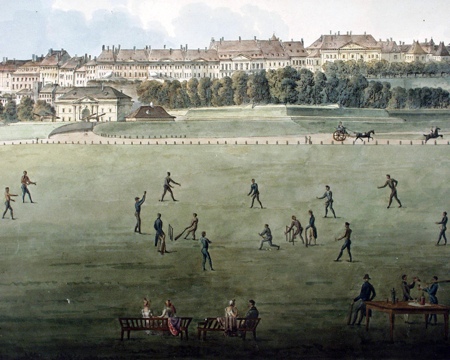
Plaine de Plainpalais with cricket's players, 1817
http://en.wikipedia.org/wiki/File:Plainpalais-1817.jpg


The painting above and the woodcut below are of two “elegant" sports, cricket and archery. It is difficult to see cricket as a sport that coarsens. It is structured around the daily life of the typical Englishman, a match begins after breakfast with a break for lunch and tea and ends at suppertime. It is played over a weekend, or so I was told by the man in Salisbury, England who sold me the bicycle I rode throughout Britain and the Continent. He may have been teasing me a bit, I do not know. Wikipedia, though, says a typical match lasts five hours and a test match can take five days to play, so maybe he was not deceiving me, or at least not much. But it is a sport where everyone wears white and is civil to one another, at least in theory.
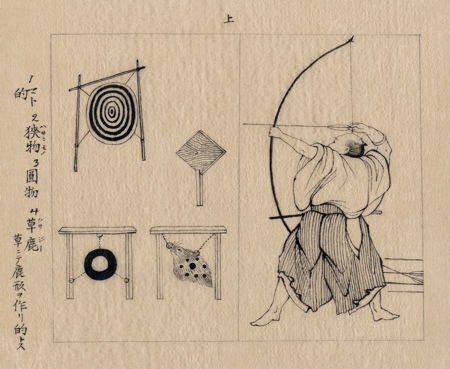
Japanese Archer
http://en.wikipedia.org/wiki/File:Japanese_archer_1878b.jpg


Archery is also an elegant sport. Though the bow and arrow is an effective weapon the sport involves shooting at targets and there is no physical contact between competitors and both winners and losers go home in one piece. When Robin Hood competed for a prize he was a sportsman not a soldier and everyone could enjoy his prowess. There is, of course the less civilized use of the bow that created a greater tension between Robin Hood and the civil authorities of his day. There is, I suppose an aspect of all sport where everyone can enjoy and appreciate the skill and focus of the athlete. To play any sport well requires a great deal of intelligence, discipline, focus, and dedication; qualities that serve anyone well in the long term and have an important place in modern education.

A view from inside the mob taken at the 2006 Royal Shrovetide Football Match (Mob Football)
Gary Austin
http://en.wikipedia.org/wiki/File:Japanese_archer_1878b.jpg


The photograph above was taken at a “Mob Football” match from the midst of the festivities. It is said of mob football that there is one rule, you cannot commit manslaughter or murder, but evidently, everything else is fair play. It is also a very democratic sport in that anyone who wishes and who plays by the rule, can compete. It is a game that can accommodate an unlimited number of players. Shakespeare includes in his play Comedy of Errors a football joke, “Am I so round with you, as you with me, That like a foot-ball you do spurn me thus: You spurn me hence, and he will spurn me hither, If I last in this service, you must case me in leather.” Of course for Shakespeare, as for most in the world to this day, football is soccer, though the football being played in the photograph is a medieval antecedent to rugby.

Truro hurling ball
http://en.wikipedia.org/wiki/File:Truroball2.JPG


Mob football is another name for Cornish Hurling, which was adapted from the Celtic game of hurling or shinty. It is interesting, perhaps, that hurling was an antecedent of the modern sport of ice hockey, it was played with a ball on a field of grass with what look like field hockey sticks and Cornish hurling was an antecedent of the modern American sport of football, as well as of rugby; perhaps three of the most aggressive sports being played today and perhaps what Mr. Self had in mind when he wrote of the coarsening influence of sport. A sixteenth century gentleman said of Cornish hurling, “The Cornish-men they are strong, hardy and nimble, so are their exercises violent, two especially, Wrestling and Hurling, sharp and severe activities; and in neither of these doth any Country exceed or equal them. The first is violent, but the second is dangerous.” The photograph above is of the ball that is used in Cornish hurling. It is made of silver and weighs about a pound. It reminds me of the golden snitch that Harry Potter pursues in his games of quidditch, a sport that shares some of hurling’s physicality.

The game was a competition between those who lived in town and those who lived in the country and reflects the tension that has always seemed to exist between those that live in town and those that live in the country. I think the rules of Cornish Hurling amusing and you might also find them so and here, according to Wikipedia, are a few of them:

  • Field of play. The game takes place mainly in streets still open to traffic. The game can also extend onto private property including gardens and fields and sometimes through houses or pubs. The game can stop at any time so that members of the watching crowd can handle the ball. Touching the ball is said to be lucky and can bring good health and fertility. The parish of St. Columb Major is the world's largest pitch for any ball game, with an area of about 20 square miles.
  • Goals and winning. There are two goals but no goal-keepers. The goals are made of granite. The town goal is the base of an old Celtic cross and the country goal is a shallow stone trough. To win the team must carry the ball to its own goal. Another way to win is to carry the ball out of the parish, which can be up to 3 miles. As soon as the ball is goaled or carried out of the parish, the game finishes.
  • Rules. There is no referee, no official written rules and no organizing committee. The two teams have unequal numbers. The Town team has the larger team since the town has grown larger in size. Before the 1940s the Country team was stronger in numbers due to the number of people who were employed in agriculture.
  • Serious injuries are very rare. The game attracts visitors from miles away but most watchers are local to the area.
  • Time of games. There are only two games a year. The first game is held on Shrove Tuesday. The second game is on the Saturday of a following week. The game is always started at 4:30 pm. The game can last anything up to two hours. After the game the ball is always returned to the start point.


Though the influence of sport may be coarsening, it also teaches collaboration and the importance of teamwork to the achieving of a goal and this has a place not only in sport and education, but also in the fruitful and happy living of a life.

Steven Johnson Where Ideas Come From
TED Talk


This film clip illustrates the importance of inspiration, collaboration, and of thought conducted over time. The image of the coffee house as a space where ideas could be exchanged and developed is a fruitful one. It is not just that the consumption of coffee replaced the consumption of alcohol (or at least moderated its consumption) but that the coffee house provided a space for sober conversation. But I think the most moving part of the clip concerned the incubators sent to impoverished corners of the world where infant mortality rates were high. As long as the machines worked the babies survived, but when after a year or two of use they broke down, there was no one who could fix them. This part of presentation suggests the importance of design and that design be adapted to the circumstances of those the design is intended to serve. Where these machines went there were few skilled in the maintenance of high tech machines, but many skilled in the maintenance of automobiles and an incubator made of car parts could accomplish more than its high tech cousin. Most innovation begins with someone thinking differently about something. But the end product usually takes time and often requires some help and input from others; that without collaboration innovation may be much slower in coming if it comes at all.

Perhaps sport illustrates this, and perhaps this is a way in which its influence does not coarsen. Though every team has its star players, the team is at the end of the day a team and if they all do not work together the stars cannot make the team successful. When I was a boy there was a new team in Los Angele, The Los Angeles Clippers (I think they have moved since to San Diego). I remember one sports writer saying that this team had some very talented players on it but that they were all playing for themselves; too many aspired to be team’s “star player” to the extent that they were incapable of playing like a team. Skill by itself is often not enough to make us successful in life, it helps if we also know how to play well with others, to collaborate and allow our ideas to be nurtured and nourished by the ideas of others. It also helps to have a place, like the coffee shop perhaps, where ideas can be shared. Ideas and innovation need both the den and the conference room to achieve their potential.

I like Rabelais description of the Abbey of Theleme. His is a Renaissance idea of the perfect space and it is idealistic (though it may not be agreeable to the ideals of all). But what I like about Rabelais is his enthusiasm for life and thought and his belief that a happy life cannot be a “thoughtless” life, that thought is essential to happiness. If Comenius was correct in his belief that learning should give pleasure than Rabelais must also be, at least in part, correct. I think the problem with sport is that it is often given too much space in our lives; we equate “happiness” and “fulfillment” with fun. Not that there is no place for fun, but that it is necessary to recognize, perhaps, its limitations; though often I think the problem is much more profound. Many have forgotten how to have fun at anything other than play, or perhaps more precisely they have lost the ability to find the play and the fun in the work that they do.


Tuesday, September 28, 2010

The Beginning of Things


High Hopes
Frank Sinatra

The Beginning of Things

Norns
Arthur Rackham
http://en.wikipedia.org/wiki/File:Norns1.jpg

The song talks about having “high hopes” and that with those high hopes a great deal can be accomplished that does not, from appearances, seem to be possible. Much of life revolves around confronting the impossible and often what is labeled impossible has as much to do with lack of confidence as it does with lack of ability. Of course there are probably many things we do not have the skills or abilities to accomplish, but why begin by assuming that a beguiling challenge is beyond us; why do we not first try to prove to ourselves we cannot do a thing rather than assume we cannot?

The Norns in the painting above represent fate or destiny. These are familiar figures in the myth and folklore of many parts of the world. In the German myths the Norns were, as were the Fates in the myths of Greece and Rome, weavers who wove the tapestries of individual lives and when a life was done, they cut the thread and the tapestry that was that individual life was finished. But how was the tapestry created. Did the Norns weave into the tapestry what an individual accomplished or did the tapestry come first, preordaining what that individual would accomplish? It probably does not make much difference which came first, the tapestry or the acts that were woven into it, what is important is that the action is done, that the attempt is made. We will find out soon enough if it is our “destiny” or not and if it is not there are other “destinies” to pursue.

The Seven Virtues – “Hope”
Giotto Di Bondone
http://www.giottodibondone.org/No.-46-The-Seven-Virtues--Hope-1306-large.html

Succeeding at most things involves taking something we hope for or dream of and making it real, bringing it to pass. Often the difference between something hoped for and a goal is planning, figuring out how to get to where we want to go, or at least planning out the first few steps on the journey, perhaps its just figuring out where to start. Hope often has more to do with yearning than with planning, but perhaps often hope is where goal setting begins. It is after all one of the “Seven Virtues.” There was an article in The Boston Globe a few weeks ago, “The bright side of wrong” about the importance of making mistakes, of being willing to get it wrong. The article suggests that a great deal of success is the product of intuition, of insight into a problem or a project that is instantaneous and does not appear to be the product of careful thought. Sometimes decisions have to be made quickly and there is no time to “think things through.” We know many things and our minds can process the many things we know quickly and often what seems the product of intuition is the result of a kind of sorting process our minds can complete with speed and efficiency.

The article gives the following example to demonstrate this:

"To change how we think about wrongness, we must start by understanding how we get things right.

"Try filling in the following blank: “The giraffe had a very long ____.”

"You can answer that question in a flash, and so can my 4-year-old neighbor. Yet a computer — a machine that can calculate pi out to a thousand digits while you sneeze — would be completely stymied by it. Long after you’ve moved on from the giraffe and finished the sports section and gone for a walk, the computer would still be frantically spitting out ideas to fill in that blank. Maybe the giraffe had a very long...tongue? Flight from Kenya? History of drug abuse? Paralyzed by so many potentially right answers, the computer would struggle to generate any answer at all."

This reasoning process, even when it is applied to much more complicated problems than the neck of a giraffe, is a reliable one more often than not for most of us. The more one has learned the more this is probably true. We have to be willing to live with the embarrassment that comes from getting it wrong from time to time if we are to enjoy the success that comes from getting it right at some crucial moment. It also means running the risk of getting it wrong in one of those crucial moments.

The Garden of EdenThomas Cole

The paintings above and below depict The Garden of Eden, the one above of Adam and Eve enjoying the garden and the one below of them being sent out of the garden, after getting it wrong in what was for them a crucial moment. Cole’s vision of paradise may not be your vision of paradise but most of us know what it is to have attained and lost something beautiful, something secure and life sustaining. There is a sense that every major disappointment is a lose of paradise, something we have hung our hopes on has been denied, maybe it is losing an important game, getting a poor grade on a test we thought we were ready for. Maybe it is losing a job or failing to achieve a goal. Unlike Adam and Eve’s loss, though, most of our disappointments lose a bit of their significance with time and reflection. If we are wise we realize we must reassess if we are to be happy, it is important to feel the disappointment as a part of the healing process, but it is also important to grow beyond it.

Fyodor Dostoyevsky was celebrated as Russia’s greatest author upon the publication of his first novel. His second novel was published two weeks later and he was labeled among one of Russia’s worst writers, the praise had turned to scorn. He became insufferably cocky after his first book was published and well received. After his fall from grace fifteen days later he never recovered his confidence, though he did indeed go on to become one of Russia’s greatest novelists. His first book wasn’t as good as everyone said it was and his second book may not have been as bad, but the work of his maturity is recognized by most as truly great and part of what made it great probably lies somewhere in that earlier success and failure.

Expulsion from the Garden of Eden
Thomas Cole
http://en.wikipedia.org/wiki/File:Cole_Thomas_Expulsion_from_the_Garden_of_Eden_1828.jpg

When Adam and Eve lost paradise it was for them truly lost. For us, though, it is often a bit different. It is not unusual for people to set their sights too low, to settle for something less because it appears to be easily achievable. We, often, must lose an inadequate conception of paradise, through disappointment perhaps, to wake up to a truer more worthy view of paradise. Of course it could as easily happen that the fruit of our disappointment is to give up on paradise altogether. Still, I think there is a place for looking at failure as a kind of gift that puts us on a more rewarding path; a path more in keeping with our gifts and temperament.

Caroline Phillips: Hurdy-gurdy for beginners
TED Talks


The video is a TED Talk about the Hurdy-gurdy. As the clip suggests it is an odd instrument. My first exposure to the hurdy-gurdy was in the film Captains Courageous. Manuel, a Portugese fisherman played by Spencer Tracy in the film, plays the hurdy-gurdy to pass the long times of inactivity at sea. When I saw the instrument being played in the film I thought it could only play one tune; that it worked like a music box playing a pre-programmed song. From the video I learned that it is in fact an instrument that can play any tune, though its inner workings are odd and unlike any other instrument I know of. Learning is often like this, it surprises us, it draws us out of preconceptions and introduces us to new ways the world, or those things in it, work. Learning often opens the mind by teaching us something new about those things we believed we already knew, if not all there was to be known, at least all that was worth knowing. This is another way that hope is kept alive and “high hopes” are reawakened. The closer we get to learning all that is worth learning, the less interesting life becomes. It is often the surprises in life that keep it from becoming mundane and when we reach a place where we think we know all that is worth knowing we begin to believe there are no more surprises and this can be disheartening.

The painting below is of Ra setting forth on his nightly cruise of the underworld. This journey takes Ra through night and the land of the dead to the next morning and the world’s recreation. Each day the world is made anew and brings with it new possibilities. There is a sense that the failures of the previous day have been put behind us and we start the new day with not just renewed energy, but perhaps with new abilities or beliefs in existing abilities we did not possess the day before.

Book of Gates Barque of Ra
http://en.wikipedia.org/wiki/File:Book_of_Gates_Barque_of_Ra_cropped.jpg

There was a review recently in The Guardian, “On Evil by Terry Eagleton,” of a book on evil by Terry Eagleton. The book is something of a paradox. Eagleton a Marxist, and one would assume, perhaps incorrectly, an atheist, has written a book on preserving the idea of evil as it is understood from, if not a Christian, at least a religions perspective. But the issue here is not evil, but a reminder that we can never quite know who all of our friends are and that sometimes discovering a friend can come as something of a surprise. Insights of this sort, too, recreate the world for us, because they make it a bit less hostile. Of course these insights can also go in the other direction and expose enemies we once believed were friends.

Still, the knowledge does us good and is probably worth having. It is a good thing to learn stuff, the good stuff and the bad. Learning can renew hope, and it can make us wiser if we use that learning to pursue wisdom. In the drawing below St. Anthony is reading a book. Reading is one of the conventional means by which learning is attained, though it is certainly not the only means. Still, if we are to read well when we open a book, it helps to open our minds first.

St. Anthony
Albrecht Durer
http://www.albrecht-durer.org/St--Anthony-large.html


Monday, May 24, 2010

What We Put Away


The Janitor’s Boy

Natalie Merchant/Nathalia Crane


What We Put Away

A Children's Puppet Show Liu Songnian http://en.wikipedia.org/wiki/File:A_Children%27s_Puppet_Show.jpg

St. Paul in the thirteenth chapter of his first letter to the Corinthians says, “When I was a child, I spake as a child, I understood as a child, I thought as a child: but when I became a man, I put away childish things.” What are those things we put away when we pass from childhood to adulthood? In the painting above some children are putting on a puppet show. These might be considered childish things, though there are those that manipulate puppets to entertain adults. The Japanese playwright Chikamatsu Monzaemon wrote some of his most famous plays to be performed by puppets. Granted Chikamatsu’s plays probably dealt with more serious subjects than those found in the children’s puppet plays, still the play of children often imitates the behavior of the adults that surround them and the same may be true of the plays their puppets perform.

The song is from a collection of songs by Natalie Merchant that puts mostly children’s poetry to music. The song The Janitor’s Boy revolves around children seeking to find a place for themselves in an adult world, even if it is an uninhabited corner of the adult world. Perhaps the putting away of childish things revolves around working at being an adult as opposed to playing at being an adult, though I am not entirely sure if it is the child or the adult that is doing the playing much of the time. But for children it is a game of “let’s pretend” while for adults it is making ends meet and fulfilling very real obligations and responsibilities.

There was an article recently in the Guardian about the 70th anniversary of the children’s book label, Puffin Books; “Puffin marks 70 years by celebrating best ever books.” The article identifies what Puffin Books regards as their seventy best titles in a number of different categories. Many of these books are also adult books, The Adventures of Huckleberry Finn, for example, and Dracula. I remember reading when I just got out of high school that in England Moby Dick was regarded as a book for children, yet it is studied very seriously by adults who seem to be of the opinion the book was written with an adult audience in mind. Of course this line of thought might seem to suggest that the things we do and read as children are all childish, which is probably not the case. We do not put away everything we had as children, nor change all the behaviors we had as children, only the “childish” things and the “childish” behaviors. Perhaps an essential ingredient of maturity is the ability to recognize those qualities of our youth that should be preserved and brought with us into adulthood.


Three Laughing Men by the Tiger Stream Song painting in the Litang style http://en.wikipedia.org/wiki/File:Huxisanxiaotu.jpg

The three men in the painting are a Taoist, a Confucian, and a Buddhist. They were so engrossed in a conversation that they did not realize they were passing through a bit of land infested by tigers and as a result were unafraid. After crossing the bridge and realizing what has happened they laugh together. The painting is meant to suggest that the three religions practiced by the three men were truly one religion, I guess because the intensity of their beliefs as they discussed them actually protected them from harm. It might also be because that each in his own worldview saw the same event as funny and they all laughed in unison, and this laughter is what unifies them. The Bible mentions on one occasion that Jesus wept, but it does not explicitly say that he laughed. I like to believe this is because laughter was such a regular part of his life that it did not need mentioning. Perhaps the reason why Aristotle’s treatise on comedy was lost while his treatise on tragedy survives is because we need less help understanding the comic side of life and enter into it with greater relish, though there are those that see laughter as a superficial thing that lacks seriousness, who regard it as one of the childish things, though I would like to believe this view is less prevalent today than it was once upon a time.


Baby at Play Thomas Eakins http://commons.wikimedia.org/wiki/File:Eakins,_Baby_at_Play_1876.jpg

Perhaps one of the childish things we leave behind is the seriousness of play. In the paintings above and below we see children playing. The adults watch the children play at the beach but seem a bit restrained in their play, they certainly are not dressed to enjoy the water as zealously as the children. There are those in modern education that tell us we must prepare children for the world of work and behind that exhortation there seems to be a suggestion that the world of play must give way to the world of work, that work is real and play is frivolous. As a teacher I am one of the ones this exhortation is aimed at and I feel a bit conflicted about how to embrace this exhortation. For me, my work is a kind of play, not all the time, but much of the time and I would feel a bit of a fraud if I were to suggest the world of work and play cannot intersect. I think the most successful adults are those that have managed to convince others to pay them for what they would do for free.


At the Beach Edward Henry Potthast http://www.edwardhenrypotthast.org/At-the-Beach.html

It is difficult to know at what point we go from being children to being adults. In many religions there is a ritual that is supposed to inaugurate our passage from one state to the other, but it is doubtful that maturity is a byproduct of ritual; it is more likely that the ritual serves to remind us that society’s attitude towards us and expectations of us have changed. But the passage of time by itself does not make us more mature, more “adult.” It is one of the goals of a teacher to help students not only gain a set of skills and abilities but to put them on a path towards wisdom and responsible adulthood. But what are the childish things that get put away? What is it that I, as a teacher, am trying to help my students leave behind?

Many of the behaviors we label as childish are behaviors we do not want to loose entirely. I want to approach the world as an adult with a sense of wonder, but “too much wonder” might border on naiveté and foolishness. I do not want to loose my playfulness but being “too playful” might be another sign of immaturity. I think that coming of age does not necessarily mean leaving certain behaviors behind so much as establishing boundaries and limits for those behaviors. It is, perhaps, recognizing the difference between a leader and a bully, between good cheer and flippancy, perhaps between a Mr. Micawber or Mr. Skimpole and a Joe Gargery. I often tell people that the passage of time makes me grow older but no power on earth can make me grow up and I think there is some truth to this. We have no say in the passage of time, but we do play a part in the shaping of our own characters.


Pinocchio

Walt Disney Pictures

The film is about a puppet that wants to be a boy and it chronicles his passage from being an animated toy to becoming a mature young child. The film is basically about the quality of the choices he makes and how he learns from experience. Pinocchio as he grows wiser does not give up play, he does not stop doing things that give him pleasure and enjoyment, he succeeds where many “real boys” fail because he learns from his mistakes, he becomes less foolish as the story progresses and wiser in the ways he plays. Perhaps this is what we all aspire to, to hold on to our capacity to have fun and to enjoy life; that though we may never become wise we, like Pinocchio, may succeed at becoming less foolish.

Playing Children Su Han Ch'en http://en.wikipedia.org/wiki/File:Su_Han_Ch%27en_001.jpg

Saturday, May 8, 2010

Staying Well


Ain’t Misbehavin’
Keith Jarrett

Staying Well

Galen and Hippokrates from Anagni Italy
Photo: Nina Aldin Thune
http://en.wikipedia.org/wiki/File:Galenoghippokrates.jpg


The illustration is of two great physicians of the ancient world, Galen and Hippocrates. They both made early attempts at understanding the human body and what keeps the body in good health. This being National Mental Health month I have placed below a photograph of the “Father of Psychoanalysis” though some might contend that psychoanalysis is much older than Sigmund Freud. There was a review in the Guardian, “A Reader on Reading by Alberto Manguel,” of a new book, a collection of essays, by Alberto Manguel. The review quotes a passage from the book that summarizes Manguel’s thoughts on reading and why it is so important, "For a reader, this may be the essential, perhaps the only justification for literature: that the madness of the world will not take us over completely though it invades our cellars . . . and then softly takes over the dining room, the living room, the whole house." In a nutshell reading keeps us sane and has been keeping us sane for many millennia, even if our only sane moments are those spent reading. It might also be said, in the spirit of Galen and Hippocrates, that in quieting the mind, the time spent reading also quiets the body and brings to the body a degree of healing and comfort; that reading is a kind of “Sabbath” for the mind, the soul, and the body.

Sigmund Freud
Max Halberstadt, 1921
http://en.wikipedia.org/wiki/File:Sigmund_Freud_LIFE.jpg


The lyric to Fats Waller’s song “Ain’t Misbehavin’” begins, “No one to talk with / All by myself / No one to walk with / But I'm happy on the shelf / Ain't Misbehavin' / I'm savin' my love for you.” The song evokes the loneliness of waiting for someone that is important to us while being true to that person. This is also a way in which reading can keep us sane; it can provide the company that we need. Of course when one is in love there is little that can adequately fill this time of waiting, probably not books, films, or music, though each does provide a kind of solace and sometimes each can remind us that we are not the first to experience this kind of anguish. Books and such can provide the company that misery often enjoys.

On the other side of the coin, though, it seems sometimes that we talk about reading like it were something mysterious and magical, that it is something separate and apart from the real world. To a certain degree it is a world unto itself that is incomprehensible to those that have not experienced its transformational power. Many read newspapers, magazines, and the like mainly for information or to keep up with things, much of this information is gotten from online venues that do not easily lend themselves to reading deeply. But these kinds of reading, whether read on paper or on a computer screen, are often done quickly, the material is skimmed through for the important facts and set aside, the reader of these rarely enters an alternative universe, is rarely “captured” by what has been read. In fact readers of this sort are often looking for ways to keep their footing in this world, to stay up to date, they are not interested in being introduced to new worlds, let alone spending any time living in them. Sometimes this would suggest that those that read deeply in fiction, poetry, essays, and such are looking to escape, are trying to avoid facing the world as it is by seeking refuge in a non-existent world crafted from some writer’s imagination; that it is just one more form of escapism.

My experience is that works of imagination (and not just literary works of imagination) deepen my appreciation and understanding of the world as it is, puts me more in touch with myself and those around me. But I also know that I am incapable of explaining clearly how this works to those that have not been touched by the power of language and the imagination, at least not in an active sense. I think there is a difference between those who actively engage a book or a film or a piece of music, those who interact with what they are hearing or seeing or reading, and those that just let the movie, or song, or book “happen” to them, who receive something from the work but do not give back to it anything of themselves, who do not dig deeply into themselves in response to the work I think there is a difference between those who actively engage a book or a film or a piece of music, those who interact with what they are hearing or seeing or reading, and those that just let the movie, or song, or book “happen” to them, who receive something from the work but do not give back to it anything of themselves, who do not dig deeply into themselves in response to the work. In this sense it is true that it is “more blessed to give than to receive” though unless you have had the experience you will probably remain unconvinced.

Monty Python’s Philosopher’s Football Match
BBC


The clip is of a famous soccer match. There was an article in the Guardian last week, “Who's the thinker in the white?”, about a celebration commemorating this important match, a rematch of sorts with other philosophers taking part. I think there is something apropos in this match if one remembers that Plato argued for the training of both the mind and the body. It may seem that sports and the more sedentary work of reading and scholarship would be somewhat at odds with one another, but it is difficult for the mind to work well if the whole body is not well, and in that sense exercise and athletics are important. To study well it is important to know how to play well. I enjoy this Monty Python sketch because it is only after 89 minutes of play, or wandering, that one of the philosophers finally realizes what the point of the game is, to score goals. The field is full of German and Classical Greek philosophers trying to figure out what it is they are supposed to do, while Confucius, Augustine, and Aquinas officiate the match with some amusement. Sometimes I think when philosophy looses its narrative, its story, it forgets its purpose, like those philosophers playing soccer they know how to think and reflect on life, but have forgotten how to live it.

Psyche
William Adolphe Bouguereau
http://en.wikipedia.org/wiki/File:Bouguereau-Psyche.jpg

One of the more famous love stories is that of “Cupid and Psyche.” It is not just a story from Classical mythology but one that has been incorporated into the folklore of different cultures. The painting above is of Psyche while the one below comes from a Norwegian retelling of the story called “East of the Sun, West of the Moon.” Psyche in the classical world represented the soul, the self, and the mind, that which defines us as individuals. Cupid, on the other hand, represents love, specifically physical love, that aspect of human experience that requires us to sacrifice a bit of ourselves in order to the meet needs of another, at least when practiced within a relationship. The Norwegian story focuses on the more mysterious qualities of the Cupid and Psyche story, the identity of the unknown lover. This suggests that what lies behind any successful marriage, perhaps any kind of successful relationship, is the realization that the other, no matter how well we know them, will always be a bit of a mystery, we will never know and understand everything about this other person, as the other will never fully know and understand us. The problem for the characters in these stories is to learn to live with and accept this unknown quality of the other.

This illustration came from:
Asbjornsen, Peter Christen and Moe, Jorgen. East of the Sun and West of the Moon: Old Tales from the North. Kay Nielsen, illustrator. New York: George H. Doran, n.d. [1914].
http://www.surlalunefairytales.com/illustrations/eastsunwestmoon/nielseneast1.htm


The allegorical quality of Psyche that I find most interesting, though, is her connection to the mind. From this perspective the relationship between Cupid and Psyche suggests the relationship between the intellect and the emotions. Being fully human means giving both our mind and our emotions equal opportunities to grow and develop and be fully realized. Suppression of either is not healthy. Reading often provides an opportunity to exercise both the intellect and the emotions. Stories, poems, and essays make me think and feel and encourage me to recognize when each (thinking or feeling) is the more appropriate response or, as is often the case, when a bit of both is required. But again this is probably a subjective response based on my experience and practice.

I first saw the painting below when it was used as the cover illustration for my edition of Benet's Reader's Encyclopedia. It evokes the world of the bibliophile. Books like Benet’s encyclopedia give thumb nail sketches of many different works; provide a brief introduction to writers and their books. They are travelogues of a sort, where the books themselves are the journeys. But they come with a caution, or ought to. The painting suggests that the reader, like the philosophers in the soccer match, needs to engage the world beyond the library. The worlds of the imagination can be seductive and may be reluctant to let us go once they have ensnared us. The value of reading, like any human enterprise, is measured by its contribution to a life well lived. A book can become like a map and a mirror, that both shows us a bit of who we are while helping us to discover where we are going. But it can also become a shell in which we can hide, a place to go to escape unpleasant realities, and though this may be a useful thing to do from time to time, one must be cautious. A book, like any tool, is only as effective as the one wielding it. It is not the tool that is important, but the work it is given to do.

The Bookworm
Carl Spitzweg
http://en.wikipedia.org/wiki/File:Carl_Spitzweg_021.jpg


Monday, April 26, 2010

Only a Memory


Looking into You
Jackson Browne

Only a Memory

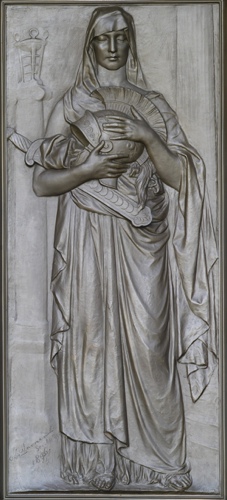
Memory, Bronze door at main entrance of the Library of Congress Thomas Jefferson Building
Olin Warner (completed by Herbert Adams)
http://en.wikipedia.org/wiki/File:Memory-Warner-Highsmith.jpeg


In the song the singer returns to a place he once called home. It has changed as he has changed and the scene the song evokes suggests the true meaning of nostalgia, the pain of coming home. Returning to a place where memories live is often an unpleasant enterprise. The place is never as we remember it and even if the changes in the place are not great the changes in us often are. Our changed selves are out of place in our old worlds. The bronze relief on the main door of the Library of Congress is titled Memory but what is being remembered? The figure in the door could be Penelope remembering Odysseus and wondering when or if he will return. It might be of any woman waiting for a warrior to return (and the objects she holds suggests she is remembering a warrior). Of course this woman could be the wife or mother of a soldier that has died and will not return. Perhaps the door is of a specific event that would be clear if I knew the door’s history but not knowing its history leaves the image open to many interpretations, all of which suggest the more melancholy aspects of memory. Perhaps all memory, by virtue of what it is, is tinged with melancholy.

There is a line from the Wallace Stevens poem “13 Ways of Looking at a Blackbird” (one of the ways of looking at the blackbird) that goes, “I do not know which to prefer, / The beauty of inflections / Or the beauty of innuendoes, / The blackbird whistling / Or just after.” I think what the poet is considering, especially in the last phrase, “The blackbird whistling / Or just after” is whether the event (“the blackbird whistling”) or the memory of the event (“just after”) is the more pleasant. Our memories of an experience, especially a pleasant experience, are often more pleasant and more “memorable” than the experience itself. This raises the question to what degree are we shaped by our experiences and to what degree are we shaped by our memories of those experiences, which are not always the same thing. This is perhaps what is being gotten at in the first phrase in the Stevens poem about “The beauty of inflections” and “the beauty of innuendoes.” Which is more beautiful the sounds that we hear or what those sounds suggest, hint at, or evoke? Are we shaped by inflections of memory or by their innuendoes?

The Last of England
Ford Maddox Brown
http://en.wikipedia.org/wiki/File:Brown_last_of_england.jpg


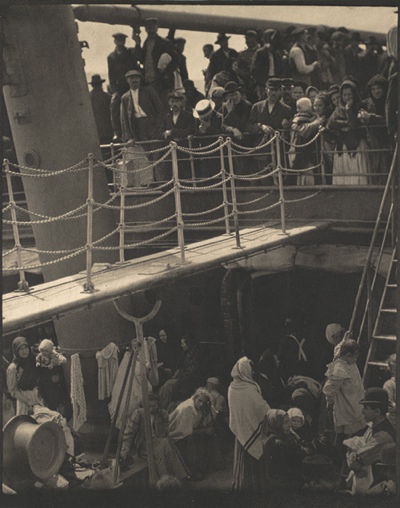
At the back of the song is also the suggestion of leaving home, he is visiting a house he lived in when he “first went out on (his) own.” The singer is not going to a new world in the same way the people depicted in Ford Maddox Brown’s painting above or Alfred Stieglitz’s photograph below are going to a new world, but in a sense when a young man or woman leaves home to make a home for him or herself in the world it is a new world that is opening up. It may not come with as much that is foreign and different as it was for the folks in the painting or the photograph but it still involves entering something of an unknown universe. When we leave home we know the landscape, the people around us look and dress largely as we do, they also speak our language. This helps, but the world is new nonetheless. It takes courage to go out on our own. Ours is a nation of immigrants, which means that for most us there is someone in our ancestry that made the trip the folks in the painting and the photograph are making.

The Steerage
Alfred Stieglitz
http://en.wikipedia.org/wiki/File:The_Steerage_1907_Stieglitz.jpg


I think that of the two, the journey in the painting and the photograph, the one depicted in the photograph had to be the most difficult. The folks in steerage are very different from the folks looking at them from above. The world the folks in steerage are entering is a very different world from the one they left. Of course I am assuming that the folks in the painting are going to America, as the folks in Steerage appear to be doing. Of course this is a guess on both parts. It could be the folks in the painting are going to India or Egypt, both parts of the English Commonwealth at the time. It may be the folks in steerage are going to another country that is more like the one they left and that it is those watching from above that will be the ones to feel most out of place. Our lives, perhaps, are shaped as much by our preconceptions as they are by our memories and there are no guarantees that either is entirely reliable.

There was an article in the Guardian, “The private life of books,” about what is at times found in second hand books. I know I often buy books that people have written in because I want to know the thoughts of others, if others have understood the book as I understood it or were affected by it as I was affected. The world of the used book is a very different world from that of the new book. I have books that I bought in various places that are quite old. Some were printed before the technology that “burst” or separated the pages was invented. When these books were bought in order to read them the reader had to first cut the pages. There is a scene in The Great Gatsby where the narrator, Nick, is commenting on Gatsby’s library and the magnificence of the volumes that fill the shelves. Nick pulls down a book and soon discovers that none of the pages in any of the books he looks into have been cut. This tells us the books in Gatsby’s library served more of a decorative than literary purpose. When I open a book that is a few hundred years old in which none of the pages have been cut, I am having the experience of reading that book for the first time, not just the first time I am reading that book but the first time anyone has read that book. I have not had this experience often, but each time I have had it, it has filled me with a kind of awe. I am the first person, other than the printer who set the page perhaps, to read this book though it has had a home on someone’s bookshelf for many, many years.

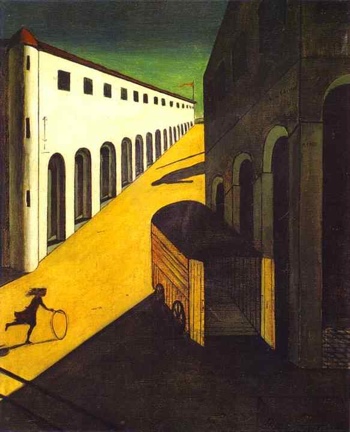
Mystery and Melancholy of a Street
Giorgio de Chirico.
http://www.abcgallery.com/C/chirico/chirico9.html


There was a review recently in the Washington Post, “Michael Dirda reviews 'Agatha Christie's Secret Notebooks' by John Curran,” of a book on Agatha Christie’s notebooks, the notebooks she kept as she was writing her mystery stories. I have always been a great fan of detective fiction in general and of Christie’s stories in particular. I remember riding my bicycle through Scotland. I was by the banks of Loch Ness when a rainstorm started. I found a bed and breakfast where I could stay until the rain passed. One of the other guests there recommended the Christie novel The Murder of Roger Ackroyd. There was a copy of the novel in one of the sitting rooms. I picked it up and it was the first full length novel I ever read in a single sitting. It kept me up all night long and I never got sleepy. This was not the first Agatha Christie novel I read, but it is among the most memorable. Of course there was more to the experience than the book, there was also the place, I was in Great Britain, in a place that was shrouded by its own aura mystery. The window in my room looked out over Loch Ness and I remember looking out each evening to see if there were any strange creatures swimming about. But of course there were not, and my memory refuses to “enliven” this recollection.

Spellbound
Alfred Hitchcock
Selznick International Pictures


The film is about a man trying to figure out who he is and the woman that is trying to help him. Something has happened to the man that has induced amnesia. All we know is that the event that brought on his forgetfulness seemed to involve something white and some lines. We only know this because of how he reacts to straight lines and the color white. The actor playing the old psychiatrist in the film is Michael Chekhov, Anton Chekhov’s nephew. He (Michael Chekhov) was a student of Constantin Stanislavski and went on to develop his own approach to the craft of acting. He is known for developing the concept of the "Psychological Gesture," a behavior or action that reveals an inner psychological reality in the character being portrayed. I think knowing this makes his portrayal of the psychiatrist in the movie that much more delightful. I think that Gregory Peck in his portrayal of the amnesiac makes use of this theatrical device at various times in the film, including those moments with razor in the clip above. It is also what we do not know about this character’s past (and what we think we know) that creates the tension that permeates this scene.

This suggests the limitations of knowledge or at least the limits of what we think we know. Knowledge can be deceptive. We think we know a thing; we have studied it and found out a lot about that thing. But if there is any complexity to what we know the odds are our knowledge is limited and the conclusions drawn from it are not always reliable. This can create problems because we often have to act on what we know and we often cannot be sure we know enough to act. Chekhov’s character in the film believes he must act on what he knows, but as the film will show he does not know enough to justify the conclusion that he draws. He wants to go to the police because he believes Peck’s character is dangerous. But this view may be questionable. You will have to watch the film to find out if Chekhov calls the police or listens to Ingrid Bergman and suspends judgment.

Memories make our lives richer. They enable us to derive pleasure from an experience over and over again. When I read a book that evokes or alludes to another book that I have read that evocation or allusion brings back the original experience of reading that book (or part of the experience). Of course there is the other side of memory, a side like that experienced by the character in the film, where memories, or the ghosts of memories, haunt us and keep us from enjoying the present or of building a future. And memories often will not be controlled. They will visit us in their own time and often stay longer than they are welcome. Little things often bring them out of hiding. For me the smell of diesel fuel takes me back to London in the 1970’s and graham crackers bring me back to a room above a plumbing store on Pacific Coast Highway in Redondo Beach, California. These are pleasant memories and I welcome them when they come. But there are always others that are less welcome that have their own triggers that I will not mention here for fear of provoking them.


Sunday, April 18, 2010

Words in Their Finery


God Bless the Child
Blood, Sweat, and Tears


Words in Their Finery

Page from an illuminated manuscript of the Rubaiyat of Omar Khayyam, watercolor, bodycolor and gold leaf. Calligraphy and ornamentation by William Morris, illustrations by Edward Burne-Jones
William Morris and Edward Burne-Jones
http://en.wikipedia.org/wiki/File:Rubaiyat_Morris_Burne-Jones_Manuscript.jpg


The image is from an edition of the Rubaiyat of Omar Khayyam designed by William Morris and Edward Burne-Jones. We can see in this image that the beauty of words and of language lies not solely in what the words mean but in their appearance as well. Or at least that words can have a beauty that is independent of the meanings assigned to them by Dr. Johnson or Noah Webster. Morris realized that even if Chaucer had been an inferior poet the Elsmere Manuscript would still be a thing of beauty and worth preserving. The creating of typefaces is an art in itself and the quality of a typeface contributes to the pleasure derived from reading books. The song says, “momma may have, poppa may have, but God bless the child that’s got his own.” In a work of literature the author and the words used by the author may be the momma and the poppa of the story but the typeface has its own something to offer. The texture and quality of the paper and the design of the letters on the page contribute something important to the experience of reading a book.

When students write a paper they often want to use unusual, decorative fonts. This has to be discouraged, of course, because those students that go onto college will have professors who are not likely to appreciate papers that stray too far from the conventional in their use of fonts or typefaces. It is unfortunate that one of the stories we have to tell our children is to be careful of the clothes in which they dress the stories that they tell. Though the decorative fonts used by students in term papers are often garish and inappropriate to the stories that they tell, these fonts are none the less a part of the student’s expression and reveal a bit of her or his imagination at work. If the design of a thing is as important, some say it is more important, than the task the thing has been given to perform than fonts chosen by students reveal something of their imaginative life and they are certainly an important part of the design of the paper in the student’s mind.

"Trolls with an abducted princess, from the annual, and still published, fairy tale collection Bland Tomtar och Troll
John Bauer
http://en.wikipedia.org/wiki/File:John_Bauer_1915.jpg


There was a recent article in the Boston Globe, “How fairy tales pit adults against kids,” about fairy tales and the stories that they tell. The point of the article is that these stories are often seen by adults as dangerous and that in the stories themselves adults are often portrayed as the enemy or at best more of a hindrance than a help. Because the first audiences for these stories were adults one wonders how the adults that enjoyed them viewed children and childhood. There is a short story by H. G. Wells, “The Magic Shop,” that follows in the vein of some of these stories in that by the end of the story a child’s parents live in terror of their child. Wells’ story actually reverses the roles of adults and children in the traditional stories. In stories like “Sleeping Beauty” and “Hansel and Gretel” it is the children that live in fear of the adults. Wells’ story, though, ends less happily for the adults than the traditional stories do for the children in that in the traditional stories the children overcome the malevolent adult forces, in Wells’ story the malevolent child is still in control when the story ends.

Language is a magical tool. The same words can be employed by different people to convey very different messages. In fact, the same words in a single text can even be interpreted by different people to convey very different messages as well. I introduce my students to literary theory by showing them how The Tale of Peter Rabbit can be interpreted as a story about the importance of listening to your parents when read one way but also about the importance of disobeying your parents when read another way. This suggests perhaps that we take from the stories we read the messages we need to find in them in order to live more effectively. Does the author put meaning into a story or do readers place in them the meanings they need to find. This is perhaps the crux of the postmodern problem, does meaning exist, does meaning matter? And if meanings do exist and meanings do matter, who gets to decide what those meanings are and where and how those meanings are found?

Alice surrounded by the characters of Wonderland
Peter Newell
http://en.wikipedia.org/wiki/File:Alice_in_Wonderland.jpg


Perhaps no book has as much fun with the “meaning” of things than Lewis Carrol’s Alice books. Humpty Dumpty tells us words mean whatever we want them to mean. There is truth to this of course, because this is how new meanings to old words evolve and new words are invented. It is also how poets employ words. Anyone who has read a poem by Wallace Stevens or Bob Dylan has encountered this amorphous use of language. I often imagine that “Pale Ramon” struggles as much with meaning as he does with order in Wallace Stevens’ poem.

There were two article recently, one in the Washington Post, “Michael Dirda reviews the biography "The Mystery of Lewis Carroll," by Jenny Woolf,” and one in the Guardian, “How the devastation caused by war came to inspire an artist's dark images of Alice,” about the Alice stories and their creator. The Guardian article focuses on the illustrations that Mervyn Peake did for these books. He, a bit like Humpty Dumpty perhaps, in that he brought his experiences as a war correspondent during World War II to his interpretation of Carroll’s text through the illustrations he created. He makes the text mean what he wants it to mean, which in many ways is not unlike Carroll’s meaning. Carroll depicted a world at times in chaos due to the ways in which adults employed power, Peake was placed in a world where this chaos was brought to life.

Dirda’s review discusses a book about Carroll that focuses on Carroll’s conventional and unconventional qualities, part Mad Hatter and, perhaps, part Alice, who seems to me to be the most conventional character in the story; a conventional young lady to whom very unconventional things happen. The story often revolves around a deep desire to find meaning and order in a world in which none appears to exist. Though of course Carroll, a mathematician, has created a world with a chaotic zaniness on its surface that conforms, under the surface, to a fairly precise mathematical structure. Perhaps life, when looked at from within the experience of the person living it, appears random and bewildering, when it is in fact orderly and systematic when looked at from the outside, as from within our experience our planet and solar system is the center of the universe, but when looked at from a different vantage point our planet and solar system are found nearer to the edge of the universe. Our point of view and our understanding of reality are shaped more by our vantage point than by the context of that vantage point in the larger universe. If we do not know where we stand we will not be able to properly interpret what we see.

Alice in Wonderland
Walt Disney Pictures

This is the version of Alice in Wonderland that I grew up with, though how I viewed it as a child was very different from how I viewed it as a young adult. As a child in the 1950’s I saw it as a magical story with odd characters and vivid colors, but as a young adult in the 1960’s it took on shades of psychedelia. Vivid colors and the caterpillar’s hookah took on different connotations. The world of the 1960’s offered a very different vantage point from that of the 1950’s, though the different lenses through which I viewed the film may have had as much to do with my age than with the age in which I lived. I wonder how the counter-culture of the 1950’s viewed the film.

W. H. Auden once said, “There are good books which are only for adults because their comprehension presupposes adult experience, but there are no good books only for children.” I believe this is true, but I also believe that adults read children’s books with adult experiences that often shape the way these stories are perceived and they are changed by the adult mind into something different from what they where for the child that first read them. “The Little Engine That Could” and “Stone Soup” have different meanings for me now than they did when I was a child. I enjoyed how the soldiers tricked the townspeople in “Stone Soup” but I did not fully comprehend the point it made about generosity. In fact my views of generosity may have been shaped in part by this story without my being fully aware of how my views were being formed.

There is a Woody Guthrie song, “Pretty Boy Floyd” that talks about the outlaw leaving money under the supper dish after he has been given a free meal. I think stories often work this way, there is a gift left under the surface of our consciousness that we are often unaware of until long after we have enjoyed the story’s telling and the magic of the narrative has faded a bit. Sometimes we come back to the stories we read as children and find the messages that have shaped us and we are not always pleased with the way in which our views have been manipulated. This is the rhetorical nature of story telling. We are taken to a world that operates according to certain rules and we learn these rules as we journey through this world, but we bring them back with us to the world of our day to day lives.

Illustration of Alice with the White Rabbit
Arthur Rackham
http://en.wikipedia.org/wiki/File:Rackham_Alice.jpg


The White Rabbit tries to live in Wonderland according to the rules of Victorian English society and he is somewhat out of place there. The rules of Victorian England did not apply in Wonderland, or perhaps they did but without their veneer of respectability. What happens to Victorian society, or any “respectable” society, if the rules encountered in Wonderland are brought home to the world on the other side of the looking glass? Which looks quirkier the rules seen in their true light or the individual just back from Wonderland confronting those rules? Sometimes stories do this, they open our eyes to the way things truly are, but in opening our eyes put us at odds with our neighbors whose eyes remain closed and who do not wish to have them opened.


Monday, March 29, 2010

The Genius Next Door


Teach Your Children Well
Crosby, Stills, Nash, and Young

The Genius Next Door

Genius of America
Adolphe Yvon
http://en.wikipedia.org/wiki/File:Adolphe_Yvon_-_Genius_of_America.jpg


There was a review in the New York Times, “How to Be Brilliant,” of a book on genius and how to become one, The Genius in All of Us. The premise of the book is that everyone has the potential to be a genius of one kind or another, mathematical, musical, and so on, it just requires a bit of hard work and tenacity. According to the book becoming the best at anything is a matter of dedication, self-confidence, and a willingness to fail often in pursuit of a single thing. The research suggests that anyone who achieved greatness at anything did so by working relentlessly at developing the necessary skills. This probably comes as no huge surprise but the question that seems to go unanswered is how many worked relentlessly and did not achieve. We know who Mozart and Einstein are because they achieved the thing that they pursued, but are there others who were as relentless in their pursuit that we never heard of because they never arrived at their goal.

Of course it is probably a good thing to pursue our interests wholeheartedly and to work as best we can at developing our abilities and interests, but is that in itself enough. Is there something extra that some have that others do not that is as important to success as hard work. I suppose if our aspirations are in proportion to our abilities than the hard work by itself should be enough, but is this how dreams and aspirations operate? In an American Idol culture many are infected with a dream but the American Idol culture suggests that at best one or two will actually succeed. The American culture is built on competition and where it is true that competition can bring out a person’s best, it is also true that competition usually allows for only one winner. There was a sign at the Olympic games held in Atlanta, for example, that said, “Second is the first loser.”

The song, Teach Your Children suggests that much comes down to being true to ourselves and teaching our children to be true to themselves. Having a code to live by is important, so is knowing ourselves and our abilities. It is also important to remember that not all genius is appreciated in its lifetime. Jonathan Swift said that “When a true genius appears in the world, you may know him by this sign, that the dunces are all in confederacy against him.” Swift is suggesting not only that most are not geniuses but also that most are resentful of the true genius when she or he appears. According to Peter Schaeffer’s play Amadeus Mozart was poisoned by another composer who was envious of Mozart’s ability. Though the history of this is a bit dubious, it does underscore that for the genius even if fame is not elusive there will always be rivals to contend with.

Copenhagen
PBS

The play Copenhagen is about a meeting between two physicists that were geniuses of their day, Niels Bohr and Werner Heisenberg. The meeting took place early in World War II and is of interest because Heisenberg was a German physicist working for the Nazis and Bohr was a Danish physicist of Jewish decent (his mother was Jewish). The two men were friends before the war but their relationship was to say the least a bit strained by the war and the ideology of the German government that fought it. I think this raises another important point about genius and that is it does not protect one from embracing idiotic ideas. Heisenberg may not have believed the Nazi ideology but he still worked for it. Germany at the time of the Nazis was one of the most intelligent countries in the world if intelligence is measured by the number of highly educated men and women, men and women of genius perhaps. Wisdom and genius are often not the same thing and perhaps if the former were revered more than the latter the world would be a better more benevolent place.

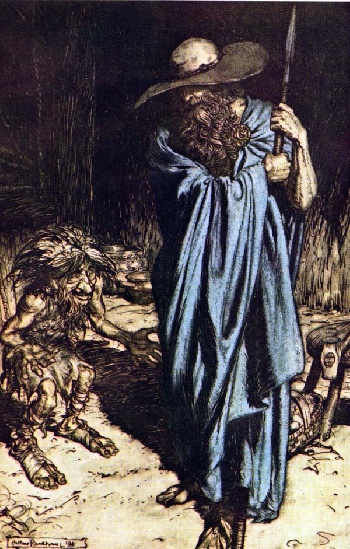
Wotan visits Mime and offers him his help
Arthur Rackham
http://en.wikipedia.org/wiki/File:Ring40.jpg

Another name for a genius is a “wiz,” an abbreviated form of wizard, someone for whom everything seems to come easily, someone who can work magic with ideas, a musical instrument, or a ball of one kind or another. I like the wizards in stories. The good ones not only can do marvelous things, but they are often wise to boot. According to the Oxford English Dictionary the word wizard etymologically means “wise one” (actually the word is formed from “wise” + “ard”) and it was once a word for a philosopher or sage, though even in its archaic sense it had a derogatory connotation, as it often does to this day. Still, it suggests that the true genius is not only intelligent, but also wise. If we keep Arthur C. Clarke’s third law in mind, “Any sufficiently advanced technology is indistinguishable from magic,” than the scientists that create the cutting edge technologies we use or are waiting for are themselves wizards in the mold of Merlin or Gandalf.

For most the science that runs our technology and many of our tools is like magic, we understand that they work and know how to make the machines do what we want them to do, but few of us understand how they work, how they do what they do. Science is for many a kind of magic that we believe in because the scientists that work the magic tell us there is nothing mysterious in it, that it all works according to certain rules. But then, those in the wizarding schools of J. K. Rowling or Ursula Le Guin are learning the rules by which the magic of those books work. There is, they would have us believe, a kind of “science” to the art of witchcraft and wizardry.

Map of "Mercury" as described in The Worm Ouroboros by E.R. Eddison
David Bedell
http://en.wikipedia.org/wiki/File:Ouroboros_map.jpg


The painting that started this off and the map above suggest the true meaning of genius and that is the spirit of a place or a person, or even a thing, one might say the spirit of a noun. The painting captures the spirit of America, some of what makes it a unique place and the painting is full of truly American images, like frontiersmen and frontiers that in the painting are a bit mysterious. But in this sense we are all geniuses in that we all have a spirit that in some way defines us. That spirit might also be summed up as our character, the spirit by which others know us. It is this kind of genius we all need to cultivate and to infuse with maturity and a bit of wisdom. Is our genius one of fidelity and courage, or of duplicity or timidity?

In most of the stories in which the great wizards appear, there is this concern for being true to something worthwhile and noble. Merlin wanted to make Britain a more just society, Gandalf wants to preserve what is best in Middle Earth, and Dumbledore wants to see magic used to promote wise and virtuous ends. The story of Ged, or Sparrowhawk, the wizard of The Wizard of Earthsea, is about finding redemption and the wisdom to use his skill with magic to better his world and himself.

Book cover art for the book A Wizard of Earthsea
Ruth Robbins
http://en.wikipedia.org/wiki/File:AWizardOfEarthsea(1stEd).jpg

Perhaps this is the true magic we all need to work, to transform ourselves from selfish people motivated by self-interest into more generous people who work at improving the worlds in which we live and wander. There is nothing wrong with aspiring to greatness of one kind or another. Many, though by no means all, that have been given the label of genius have not been good people. Their genius in that other sense was largely underdeveloped, or at least the more virtuous aspects of it were. Personally, I think that most of us are at some level a bit insecure and that some mask that insecurity with physical strength or some other kind of personal superiority. But even if this is not true, we are somehow diminished as people if we are incapable of living for anyone other than ourselves and in this regard it would benefit us all to develop the better angels of our genius.