Saturday, February 25, 2012

Our Books Ourselves

Teatime

Stackridge

Our Books Ourselves

MyLibrarySepia.jpg

My Library

J. D. Wilson, Jr.

There was an article in The New Republic, “Voluminous” by Leon Wieseltier that talks about how the books we read shape the people we become, about how some books will shape our biography. They do not just entertain us or move us, but become us, shape our memories and who we become, or as Wieseltier says “Many books are read but some books are lived, so that words and ideas lose their ethereality and become experiences, turning points in an insufficiently clarified existence and thereby acquire the almost mystical (but also fallible) intimacy of memory. In this sense one’s books are one’s biography.” A library is more than a collection of books, it contains those books with which we have established an intimacy; we have conversed with them, written in them and they have written upon us.

The photograph above is of my library and it suggests a lot about who I am. It is very diverse everything from Proust to Dr. Seuss; from the earliest myths and folk tales to The Changing Light at Sandover. It is very disordered and serendipitous, with stacks in front of books put away in the more conventional fashion, standing up with their backs to us; with many that were purchased on a whim or because they addressed a topic that at the time fascinated, and probably still fascinates, me. They are hugely overstocked suggesting an appetite that it is impossible to satisfy in that few, and certainly not me, are capable of consuming so much. It suggests my curiosity on subjects ranging from the American West, to the Pre-Raphaelite Brotherhood, to astronomy, psychology, and “great” thinkers past and present. But mostly there are stories from Scheherazade to Chekhov, from the mighty walls of Priam to Toad Hall and the Misty Mountains. The song that started things is called Teatime by a group I discovered in 1973 while walking through the streets of Edinburgh and one of the universities there (St. Andrews I think). The song is there because tea is an important adjunct to reading. C. S. Lewis once said something about there not being a book long enough or a cup of tea large enough. He said it much more eloquently of course, but I endorse the sentiment.

MyDesk.jpg

My Desk

J. D. Wilson, Jr.

The desk I work at in my library is uncluttered and more organized, though still surrounded by books that have significance for me, Shakespeare’s First Folio (a facsimile, not the original), Aubrey Beardsley’s edition of Le Mort d’Arthur, probably one of my favorite books and one of the books that drove me, in the sixth grade, towards serious literature. I could not read Malory’s and Caxton’s English, though I tried, but I had read one of the stories in my sixth grade reader at school, a modern adaptation, and so I wanted the “big book” the adaptation came from. I struggled with the opening chapters, but unlike some eleven year olds, the book was clearly beyond me. That said, though, any edition that does not open with the words “It came to pass in the days of Uther Pendragon, when he was king of all England, and so reigned, that there was a mighty duke in Cornwall that waged war against him a long time” is no edition for me. There is a sense that a library is a self-portrait of its owner and reveals a great deal about the person who possesses it, and is probably a good reason not to show one’s library to just anyone.

DysonLibraryofBabel.jpg

Érik Desmazières: La Salle des planètes, from his series of illustrations for Jorge Luis Borges’s story ‘The Library of Babel,’ 1997–2001. A new volume of Desmazières’s catalogue raisonné will be published by the Fitch-Febvrel Gallery later this year. Illustration © 2011 Artists Rights Society (ARS), New York/ADAGP, Paris.

http://www.nybooks.com/articles/archives/2011/mar/10/how-we-know/?pagination=false

Of course the quintessential library is Jorge Luis Borges’ “Library of Babel.” If the library we have speaks to who we are what do the libraries we imagine say about us. The Library of Babel is essentially unusable in its size and complexity though more complete than any could hope for. But part of what makes a real library a real library is selection, a library that includes everything cannot say much about the collector of the library because the only criteria is that it be in print. Theoretically the Library of Congress is something of an accumulation of everything published in America. It represents the depth and breadth of writing in America but being a collection of everything it does not pass judgment, it does not by exclusion and inclusion suggest what is worth reading and what is not. The case could be made that a public library also does not pass judgment on books, that they merely collect, but their collections often represent the interests of the communities they serve, while also including titles that suggest where the librarian thinks the community should be. Where a personal library may be a self-portrait of the person to whom it belongs a public library in many ways is a self-portrait of the community to whom it belongs.

SelfPortraitat13byAlbrechtDurer.jpg

Self-Portrait at the age of thirteen

Albrecht Durer

http://en.wikipedia.org/wiki/File:Self-portrait_at_13_by_Albrecht_Dürer.jpg

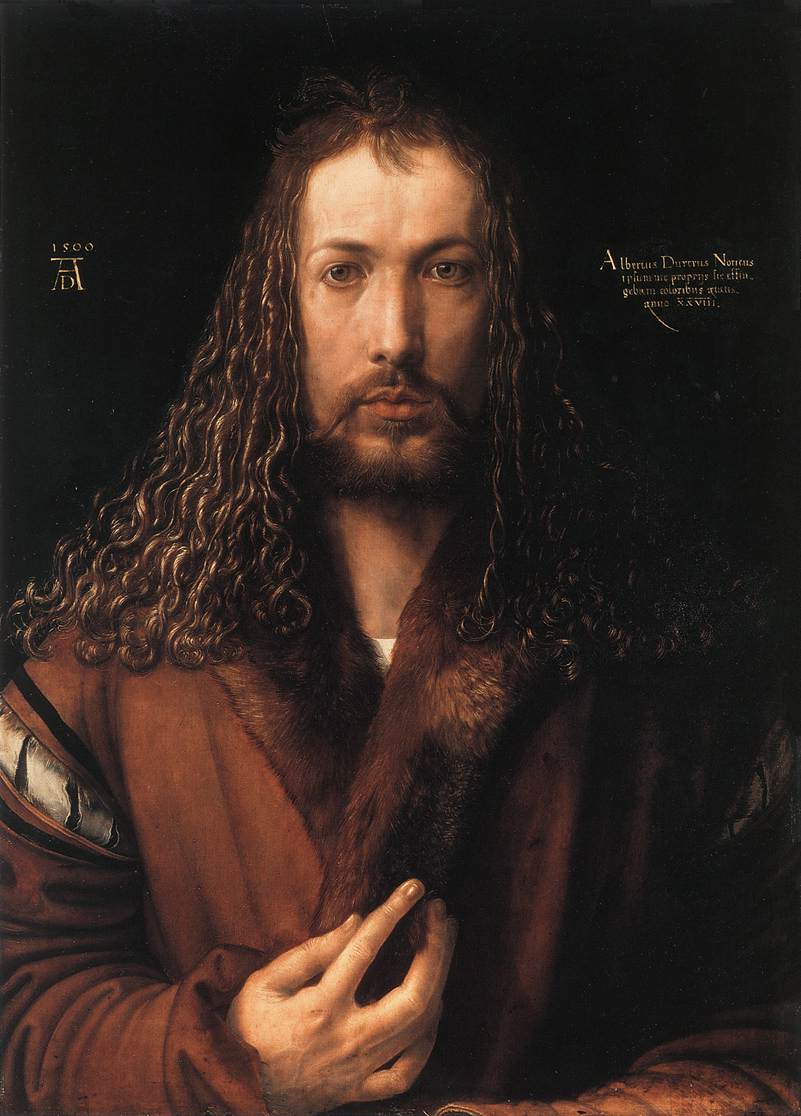
The drawing above and the painting below are self-portraits of Albrecht Durer, one at thirteen and one at twenty-nine. What do these portraits tell us about the artist and how the artist changed over those sixteen years? The first is much simpler and the subject much younger. The painting shows the unique signature that Durer developed, his initials actually, the letter “D” embedded in the letter “A”. Though both are detailed the later painting captures details that are more complex and intricate. The most obvious difference is probably that of color, which is perhaps the primary difference between a drawing and a painting. I have been told that hands are often the most difficult for an artist to do well. The hands in both the painting and the drawing are very well drawn and suggest the thirteen year old Durer was already a master craftsman. For me the significant difference is in what the artist attempts, the painting revealing an artist who has grown in skill and maturity.

DurerSelfPoritrait.jpg

Self-Portrait in a Fur-Collared Robe

Albrecht Durer

http://upload.wikimedia.org/wikipedia/commons/4/48/Durer_selfporitrait.jpg

Where paintings are snapshots of sorts, they capture a moment in time and the way things were at that moment, a library is more of a living self-portrait, it evolves and grows as its “curator” evolves and grows, and though the painting suggests growth and an evolution of style over the drawing, the painting does not contain the drawing in the same way a library contains some of its earlier manifestations. Also, with the passage of time some things are discarded and others are added. The library reveals the librarian then in two ways. What is discarded suggests those things that are left behind or outgrown; they reveal a change in intellectual, spiritual, and cultural directions. My first library included many Batman and Superman comics that are now no more. My brother picked up for a dime or a quarter a copy of the first Superman comic. He found it in a junk shop when we were children in San Pedro, California. That comic book and many others from about the same period were purchased by my brother and I from an old thrift shop three or four blocks up the street from the old ferry building and the ferry that would take my brother and I to the shipyard on Terminal Island where our father worked. There was a table toward the front of the store where the comics were scattered in no particular order. There were many of them and we would rummage for the oldest Batman and Superman comics we could find. We had never read them so they were like new to us, and a little cheaper than the brand new ones we could purchase at the drug store.

When he threw that book away he threw away what would come to be worth over a million dollars (the copy of the same edition having sold for that much in a recent auction). What does this suggest about the value of books and what we choose to keep and what we choose to discard. Is my library better served by this Superman comic or by the old Skeat edition of the works of Geoffrey Chaucer, with the navy blue bindings that identify it as one of the Standard Oxford Authors (they are roughly the same age, coming as they both do from the 1930’s)? I suppose how that question is answered says something as well about the keeper of the library and how he has grown as a person and a collector of literature.

CorreaMartiansvsThunderChild.jpg

Drawing for the novel The War of the Worlds, showing a Martian fighting-machine battling with the warship Thunder Child

Henrique Alvim Corrêa

http://en.wikipedia.org/wiki/File:Correa-Martians_vs._Thunder_Child.jpg

There were a number of other articles about books and the kinds of stories people have been attracted to over the millennia. There was an article in the London Review of Books, “Homer Inc”, on The Iliad and why, despite what Matt Damon said in Goodwill Hunting, it has from the beginning always been more popular than The Odyssey, which on the surface seems to tell the better story. There was a review of a book on the illustrations done for The Thousand and One Arabian Nights, “Visions of the Arabian Nights”, and how they have changed over time. There was a third article on monsters and what makes them attractive to readers, “Monsters, magic and miracles”. Each of these articles touches on different aspects of what makes a story attractive and draws readers to it. There are monsters in the Arabian Nights, but there are no monsters in The Iliad though The Odyssey is populated with a healthy number of monsters. It might be said that it is the humans in The Iliad that are somewhat monstrous in their behavior. Perhaps that is what combat does to people or maybe it is just a snapshot of a more primitive people who do view human life in quite the same way we do. There is also, generally, something epic in the battle with monsters, whether it is the Martians in The War of the Worlds or dragons in Beowulf and other stories from medieval Europe.

IvanBilibinRussianDragon.jpg

Zmey Gorynych, the Russian three-headed dragon

Ivan Yakovlevich Bilibin

http://upload.wikimedia.org/wikipedia/commons/3/38/Ivan_Bilibin_065.jpg

Monsters engage us perhaps because they are so different from us on one level, but on others not so different. We empathize at least as much with the monster in Frankenstein as we do with Frankenstein himself because we understand the monster’s loneliness and desire for companionship. I enjoy the scene in ET where ET and Eliot first see each other and each is terrified by the “monstrous” appearance of the other. ET needs help and Eliot empathizes with ET’s need, in this we see that they both share a common humanity in spite of their terrifying differences and their shared humanity enables each to befriend the other. This suggests that what makes a monster is relative. Polyphemus was not a monster in the eyes of the other Cyclopes with whom he lived. In my library there are many monsters and many monstrous acts depicted. There are monsters, like Frankenstein’s creature and Quasimodo that draw my empathy and others like Grendel and Wells’ extraterrestrial beings that evoke fear and terror. There are also many ghosts who evoke a different kind of terror. There is something in me that enjoys being horrified and seeks out terror in all its grisly forms.

My Immigration Story

Tan Le

TED Talk


The video tells another story of survival and acceptance. It is not a book; it is a video clip of the person telling their story. Oral histories have become more a part of our culture’s historical legacy. Of course there is nothing new in this. In The Last of the Mohicans we are introduced to Hawk-eye and Chingachgook as they discuss, among other things, the relative value of written versus oral history. Neither Hawk-eye nor Chingachgook trust written history, seeing them as shaped more by the interests of the historian than by giving an accurate account of what has occurred. I imagine the veracity of those telling the story, whether written down or spoken, has a lot to do with reliability of the narrative each presents. But how do we classify these stories, whether made up or stating facts? What do we do with films, recordings, photographs, all that other media that tell stories without writing anything down? Many libraries are film libraries or record (CD) libraries. What do these libraries reveal and should an honest “librarian” draw from all forms of story telling? I suppose this is a matter of taste, but Tan Le’s story has some of the qualities of Odysseus’s journey home. There are the predators, the overcoming of the odds, there are elements of fate and destiny. Stories, even true stories, are told after the fact, that is they are selective, events are included others are rejected, based on their relevance to the story being told. This suggests there is purpose to the story, that, even when the story is a true story, a memoir, that there is a kind of order to the events, the suggestion, perhaps, that the outcome was destined.

In the earliest of stories this was true, the Norns or the Fates cut the thread that wove the tapestry of a life when that life reached its end. No matter what the characters involved do, Oedipus will murder his father and will marry his mother. It will all happen inadvertently and no one is to blame for the way things go, but people are accountable nonetheless and all is foreordained. Today it is chance and serendipity that lead to these outcomes. Life is chaotic; there is no order or purpose. When I look at my library it has haphazardly come together the way it has, but there is also a guiding hand, my interests, my values, my tastes in literature; these are the “fates’ that guide my library’s destiny and shape the person my library has made. Perhaps these are the the fates that shape all our destinies. That said, when I look at my library I see the books I have read and collected and they have formed in many ways the person I have become, one can read in them all my strengths and failings, my inadequacies and redeeming qualities. It is where they first took breath.

SelfPortraitVanGogh.jpg

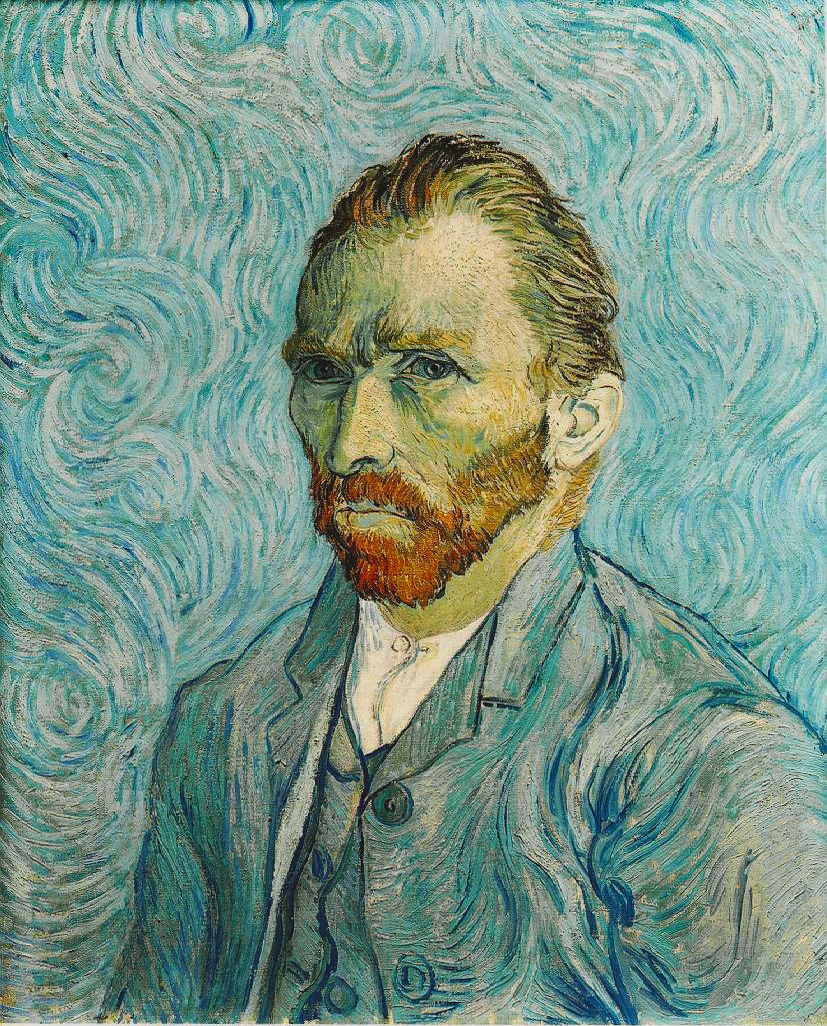
Self-Portrait

Vincent Van Gogh

http://upload.wikimedia.org/wikipedia/commons/6/6b/SelbstPortrait_VG2.jpg

Sunday, January 8, 2012

On Happiness with a Classical Twist

Vespers, Op. 37 – “Come, Let Us Worship”

Sergi Rachmaninov_

USSR Ministry Of Culture Chamber Choir

On Happiness with a Classical Twist

RedSquareSaintBasile.jpg

The Cathedral of Intercession of the Virgin on the Moat (St. Basil’s Cathedral)

Photograph by Christophe Menebeouf

http://en.wikipedia.org/wiki/File:RedSquare_SaintBasile_(pixinn.net).jpg


Even someone without religious convictions can appreciate, I think, the irony of a choir representing an atheistic state singing sacred music. Of course the music is beautiful and one need not be religious to appreciate the beauty of the music. Stephen Jay Gould, the author and Harvard professor of Evolutionary Biology used to take part in an annual performance of Hayden’s oratorio The Creation. This too is a beautiful piece of music based on the book of Genesis, and, though not religious, Gould took great delight (or so he said to Christopher Lydon on at least one occasion) in performing it. There is, of course, great happiness to be gotten from listening to great music, reading great stories, looking at great art, and all the other cabinets of the classical tradition. The photograph is of St. Basil’s Cathedral in Red Square in Moscow. To me it seems out of keeping with the image I have of Russia. When I think of Russia I think of a very cold place and its literature often evokes a tragic people (though this is by no means the same as a humorless people). The colors of the cathedral are bright and they are vibrant and they make me smile. I believe it was created with that intention.

A friend of mine was reading Crime and Punishment by Fydor Dostoevsky a few years ago. She was in the middle and was finding it a very moving but a very sad book. I told her that much of the book was sad, but that it ended happily. I do not think many think the ending of Crime and Punishment a happy one; my friend did not. But I think it is happy. Albert Camus in his essay “The Myth of Sisyphus” tells us, after pointing out that Sisyphus’s life is a cycle of anguish, forlornness, and despair, that we must imagine Sisyphus happy.

If this is so, how much more happy must Raskolnikov be. He is a man who has committed a heinous crime. He is a man who appears through most of the novel to be devoid of conscience. He evokes for me in his intensity the line from Yeats “The best lack all conviction, while the worst / Are full of passionate intensity.” He finds, though, at the end of the novel, redemption and forgiveness. He finds peace with himself, his world, and his God. He accepts responsibility for his actions and he is sent to Siberia, one of the harshest, most forlorn locations on the planet. Yet he goes into this harsh physical environment at peace with himself and no longer fighting the much harsher and more relentless demons of his mind and spirit, of his inner self. In addition, he goes into this exile with the woman he loves.

IvanBilibinBuyan.jpg

Buyan

Ivan Bilibin

http://en.wikipedia.org/wiki/File:Ivanbilibin.jpg

Granted, just as Cinderella, though we are told she lived happily ever after with her prince, must have had moments of conflict with her beloved in the process of that happily ever after. No doubt Raskolnikov and Sonya had their moments of tension as well, but there is no reason to believe they did not live happily every after. Also, for all its civilized refinements and comforts, St. Petersburg has its own impediments to happiness. The issue of happiness is an important one in the novel. Does it rest in our ambitions, our self-image or does it live somewhere else? Does happiness depend on external circumstance or does it come from within us? There are other issues raised in the book, of course, but I think for our time, the idea of where happiness is found and what it proceeds from is an important question. It is one of the questions humans hope to find answered in the books that they read. The painting above is of Buyan, a mythical place, a kind of paradise. It is a place of fairy tales. Neither Siberia nor St. Petersburg are such a place, but on the other hand, perhaps, Buyan and the other earthly paradises of myth, folklore, and story are more of an inner than an outer reality and to a certain extent stories help us to find that inner reality.

There was an essay in the Los Angeles Times recently by James M. Cain (author of hard boiled detective novels like The Postman Always Rings Twice). The essay is titled “Paradise” and it looks at how California in the 1930’s was portrayed in advertising as a paradise. Cain considers issues like truth in advertising, but more importantly he considers what makes any place, not just Southern California, a paradise. The essay finds much in Southern California that ought to make it a paradise, a “Buyan,” but like St. Petersburg in Dostoyevsky’s novel it takes more than creature comforts and cultivated society to make a paradise and, considering Raskolnikov’s Siberian destination, more than sunshine, warmth, and a day at the beach as well.

Great Expectations was recently voted, by readers of The Guardian,(“Great Expectations voted readers' favourite Dickens novel”) Dickens’ best novel. This, too, is a book about a man looking for happiness in many of the wrong places who eventually comes to find a bit of it. But like many of us he has to learn it in a very difficult way. Though we may not ever have had Pip’s expectations or Raskolnikov’s demons we understand, and hopefully empathize, with their struggles. Raskolnikov is especially difficult to like. His crime is a brutal one, his self-justifications are very troubling, and his behavior throughout the novel is very hard to forgive. But at the end of the book, I find myself drawn to his character. In some ways Raskolnikov is a kind of Macbeth in reverse. We begin by seeing Macbeth as likeable, as having remarkable qualities and a potential for greatness. We end by seeing him as something of a monstrosity. Raskolnikov is villainous at the outset but by the story’s end he wins our empathy and we care about what happens to him and want him to be well.

Parnaso.jpg

The Parnassus (detail of Dante, Homer, and Virgil)

Raphael

http://en.wikipedia.org/wiki/File:Parnaso_09.jpg

There was an article in The New York Review of Books, “Do the Classics Have a Future?” by Mary Beard, a classics professor at Cambridge University. She makes the point that classics have been eulogized and declared dead on a fairly regular basis over the centuries. Jonathan Swift wrote a short story called “The Battle of the Books” that focused on the conflict between the classical tradition and the upstart modernists of his day. Many of the moderns that Swift found wanting have gone on to find their place in the “classical canon” of Western Literature but most of the classical canon of Swift’s day remains intact. The books may be difficult to understand at times, their characters and concerns may seem strange to us, at least they probably will if they are not properly introduced, but if understood these books continue to speak to us and their characters and concerns are found not be as odd as they first appeared. Beard also points out that the classics were written in what are now dead languages, or, as is the case with Chaucer or Dante, a language that no longer resembles the vernacular of our day no matter how vernacular the languages were in their own day. This is what language does, it grows, it develops, it changes.

Beard suggests that one of the better modern translations of The Iliad was done by Christopher Logue who knows no Greek, but has retold the story, using various translations as reference points, in a modern style and idiom. She and others have found Logue’s poetry to be very moving. It has been dramatized and performed successfully suggesting there is something in this story that still resonates. Stephen Mitchell has just in the past month or so come out with another modern translation of The Iliad. Why such fuss over such an old book if no reads it anymore? The answer is, of course, that people do read it, and will probably go on reading it for quite some time.

One of my “History of the English Language” books when I was in college was called In Forme of Speche is Chaunge. It was a collection of readings from different periods n the growth and development of the English Language, from it’s earliest written forms to its most modern and the earliest bore little resemblance to the latest. Because language is constantly changing books written in other languages have to be constantly retranslated, because an 18th century translation, for example, of a book like The Iliad will present difficulties to the modern English reader. I remember while reading Spenser’s Faerie Queene that for the English reader there were advantages to reading someone like Dante who is always retranslated into the current form of the language, but with Spenser I had to struggle through a language that was a bit anachronistic when it was written and was even more anachronistic to a 20th century reader like myself. Still, I believed at the time and still believe Spenser was worth the time I invested in him.

Trojan Women

Cinerama

Michael Cacoyannis, Director

The play, Trojan Women, on which this film was based, was written by the Greek playwright Euripides in the 5th century B. C. It is set even earlier in the Trojan War, the subject of Homer’s epic The Iliad mentioned above. This film version was made in the 1970’s and was seen as a commentary on the Vietnam War. Were it to be done again today there are conflicts aplenty about which it would have much to say. The scene in the clip focuses on a young child taken from his mother and killed. The child’s parentage makes him a threat to the Greek occupation. Easier to kill him now instead of later. The play at the very least reminds us that the horrors of war have always been seen as horrors. When Euripides wrote the play it was seen as a commentary on the Peloponnesian Wars and the behavior of the Athenians in that war. Like Swift’s Gulliver in the conflict between the Lilliputians and the Blefuscans, Euripides did not want to play a part in the subjugation of a free people.

Happiness often has a social component. It could be argued that Euripides wrote his play because the behavior of the society of his day impinged upon his happiness. It is difficult for a conscientious people to be happy when the behavior of the society in which they live disturbs their conscience. It is generally true that the majority of the people in a society, especially a free society, are relatively content. But at what cost is that contentment purchased? And if that cost is largely born by others, how easy is it to ignore the cost? Reading stories, even the classics, will not make one wise or virtuous in and of itself. But these books often raise the issues that a people of conscience ought to consider.

Swift once said of satire that it “is a kind of glass, wherein beholders do generally discover everybody’s face but their own.” The problem with reading, even when that reading is in the wisest and most revealing of books, is that we often take only from them what we wish to take and leave the rest alone. Often it is the bit that is left alone that is essential for us to comprehend. Raskolnikov ended happily because he allowed himself to be changed. We all are shaped by history and we all have a history. One of the lessons that stories teach us is that all change begins with individuals and that to change a society we often need to begin by changing ourselves. It is often in these changes that happiness is found.


GyzisHistoria.jpg


Historia

Nikolaos Gyzis

http://en.wikipedia.org/wiki/File:Gyzis_006_(Ηistoria).jpeg

Sunday, December 11, 2011

Where Meanings Live

I Wonder as I Wander

Anne Sofie von Otter

John Jacob Niles

Where Meanings Live

JamesAbbotMcNeillWhistler_007.jpg

Harmony in blue and silver: Trouville

James McNeill Whistler

http://en.wikipedia.org/wiki/File:James_Abbot_McNeill_Whistler_007.jpg

The song is “I Wonder as I Wander.” It is a Christmas song. I remember listening to this song while in my senior year of college. It was Christmas time and I was, with many other students in my History of the English Language class at our professor’s house preparing for the final exam. She invited us all over and served home made donuts, cider, and, of course, coffee (we had to stay awake after all). In the background Joan Baez’s album Noel was playing, one of the songs of which is “I Wonder as I Wander.” To this day when I hear that album I am transported back to that evening in 1975. I used the Anne Sofie von Otter version here because she has a wonderful voice (though so does Joan Baez), but also because I like the somber sound of the cello in the background. The song asks us to contemplate the journey we are on, the life we are living and where this life is taking us. As a Christmas song it asks us to contemplate both beginnings and endings.

In the same year I took this course on the English Language I also took a course from W. D. Snodgrass on the interpretation of modern poetry. He told in that class a story about John Jacob Niles, the writer of the song. Niles did not like photographers or being photographed. Snodgrass said that he attended a concert given by Niles where a photographer came down the aisle while Niles was in the middle of a song. Niles saw the photographer, stopped singing and put his head down on the lectern or whatever it was that he was standing behind. He would not look up, but asked from time to time “has he gone yet.” And when the answer came back that he was, Niles raised his head and continued the song he was singing. So whenever I hear this song, I think about that evening learning about the history of the English language and a man who lived by his principles.

GutenbergBibleOldTetamentEpistleofStJerome.jpg

The beginning of the Gutenberg Bible: Volume 1, Old Testament, Epistle of St. Jerome. (The Epistle is not a part of the Bible itself, but an introduction by St. Jerome, the translator of the Bible into Latin Vulgate, which the Gutenberg Bible is written in.)

http://en.wikipedia.org/wiki/File:Gutenberg_bible_Old_Testament_Epistle_of_St_Jerome.jpg

This is the 400th anniversary of the King James Translation of the Bible, the only great work of literature (and it is that in addition to whatever value it has to people as a religious work) that was composed by a committee, it is, I suppose the exception that proves the rule that nothing of value comes out of a committee. Of course it should be acknowledged that large chunks of this translation came from Tyndale and the translators of the Geneva Bible. There was an article recently in the National Geographic magazine about the making of this translation, “The Bible of King James.” One of the things that Adam Nicholson, the author of the article, points out is that the committee was as concerned with how the text sounded when spoken aloud as they were for the quality of the translation. They did not compromise accuracy in favor of a more musical language, but sought the most musical text that was at the same time an accurate translation. They wanted those listening to the words as they were spoken to be as moved by the sound of what they were hearing as they were by the sense.

I think this is the reason the translation has fared so well and become such an important part of the cultural history of the English speaking people. The paper I did for that History of the English Language class looked at different translations of The Book of Common Prayer because I thought that a religious text would strive for the greatest accuracy and speak as clearly as possible to the time that it was written and that as a result the changes in the language used would suggest two things, a change in cultural attitudes and beliefs within that religious community and changes in the language as well. I no longer have a copy of that paper and I am sure I am much more impressed by the memory of it, than I could hope to be by anything I had to say in that paper. But such is memory.

Medieval theologians believed Biblical texts could be understood on four levels, levels of interpretation that increased in difficulty and required greater depths of knowledge and understanding. I think the seriousness with which the medieval theologian approached the Biblical texts, especially the language of the text, is useful to consider when reading and trying to understand, any difficult text, sacred or secular. The four levels of interpretation are:

  1. The Literal Interpretation, that is the words mean what they say and can be understood at this level by anyone capable of reading the words (which may have required more education than most living in the Middle Ages possessed). The medieval theologian would assert that all scripture would have to be understood at this level before the interpreter could move on to the next level. In fact each level presupposes an adequate understanding of the text at the level that precedes it.
  2. The Historical Interpretation, that is the text needs next be understood within an historical, and probably cultural, context. This level of interpretation suggests that an understanding of the time and circumstances that produced the text amplifies our understanding of that text and brings out additional dimensions to our understanding of what we are reading. The medieval theologian would probably assert also that no understanding suggested by the historical or cultural context can contradict or in any way diminish the literal understanding, and this is to be understood as true for each of the levels of interpretation that follows, as the interpreter proceeds from one level of interpretation to the next nothing found in a previous level can be contradicted. Part of what guarantees a proper understanding of the text is that each interpretation has to be, if not supported, not contradicted by any other level of interpretation, it must be true at all levels.
  3. The Allegorical Interpretation, that is characters, events, themes, etc. are all “types”, that is they represent principles, values, and truths, that make them models for daily life, they are guideposts that reveal to the interpreter how life should and should not be lived.
  4. The Eschatological Interpretation, that is the texts point to how all things will end and the knowledge necessary for meeting that ultimate end. This refers to the ending of all things in a final judgment, but it also to each individual’s ending at the time of their death and therefore gives each individual truths that need to be known in order to prepare for that death.

Obviously these levels of interpretation cannot be introduced, at least not in this fashion into an English class, or into any other kind of public school classroom, but there are principles here that are transferable and it is useful to bear in mind that any literary text, that is any text that can withstand multiple readings at different stages in one’s life, operates at many different levels and what a story, poem, essay, or play means at a literal level is probably only a place to begin. Many who read literature, not the stuff read solely for entertainment, though no work of literature would be likely to survive if it did not entertain, but the complicated, multi-layered texts that make a literary work literary, read not only for the story it tells but for all the things going on around the story.

JohnConstable.jpg

The Cornfield

John Constable

http://en.wikipedia.org/wiki/File:John_Constable_008.jpg

Middlemarch is about people living in a rural English town, it is about the reforms that some try to implement and others try to thwart, it is about relationships and families. But it also raises deep questions that are often made clearer by an understanding of the time and place that produced the story. It also makes suggestions about how life ought to be lived if we are to be happy and are to see that our lives have counted for something when we reach the end of them. Each of the characters at some level fails to live up to the expectations they have set for themselves, some are thwarted by the cruelty or bigotry of other characters, others are thwarted because they did not fully understand themselves or the potential of the gifts they were born with and therefore did not develop those gifts to their fullest or in a timely enough fashion to put them to their best use. Some characters believed much more of themselves and their gifts than their actual abilities would warrant. And almost all at crucial times made foolish choices or were lacking in courage.

ShishkinDozVDubLesu.jpg

Rain in an Oak Forest

Ivan Shishkin

http://en.wikipedia.org/wiki/File:Shishkin_DozVDubLesu_114.jpg

In reading a story like Middlemarch we can see how Dorothy, Casaubon, the good doctor, and the Pre-Raphaelite painter (I left out the names of the last two characters in part because I forgot them but in part to provoke curiosity, after all with the technology available today it would not be difficult to retrieve the names) can be seen as having allegorical or archetypal qualities; they represent certain kinds of people and certain attitudes towards life and success. The book is a big book and a lot happens. We do not see these people as snapshots but we see their growth over time, so they illustrate not just the consequences of choices made but how those choices came to be made in the first place and how they were lived out in the second. They help us to see what it means to be human and how we might more fully and deeply put our humanity to good use and in a way that brings us greater satisfaction and a greater sense of fulfillment when we each face our own eschatological moment.


Kathryn Schultz

TED Talk

The video is about regret and the importance of being regretful. It begins with a quote from a literary work that encourages us to get on with things, that what is done is done and cannot be undone. You know from the video who it is that said this and what it is she and her husband had done and why it is they needed to spend more time with their regrets learning from them and the consequences of failing to learn from our regrets, for ourselves of course and for those that live around us, some of whom we love quite deeply. Regret ultimately killed the character that exhorted us to get on with things. This too is an important element of the literary text (and even of texts that aren’t so literary) they give us the opportunity of learning from others’ mistakes. The Greek drama existed to remind its audience that actions had consequences that did not go unnoticed. Sometimes the consequences to the performer of those actions were years in coming but they always came and those consequences were always tragic. That was the point. At the end of the tragedy the culture is cleansed and order is reestablished. We weep for the hero, but we leave the theater knowing all is well, or at least becoming well, with the world.

GreatGallery.jpg

This portion of the Great Gallery, found in Horseshoe Canyon, is an example of a Barrier Canyon Style pictograph (painted rock art). The full panel is 200 feet long, 15 feet high and the paintings are life-sized human figures. The largest figure pictured is about 7 feet tall.

http://en.wikipedia.org/wiki/File:GreatGalleryedit.jpg

As a teacher of English these (Middlemarch, concepts like regret, and the Greek tragedy) capture the importance of story telling, or reading literature; not just to say we read a great book but to grow in wisdom and self understanding. I am not the characters I admire (or those I detest for that matter) in the books I read but I admire the characters in the books I read for qualities which I either lack or do not realize as fully as I would like, so for me they hold up a standard and a challenge, just as those I detest force me to confront in myself qualities I do not wish to acknowledge. But of course it is only in knowing ourselves that we can change ourselves and exercise some control over the direction our lives take. There was an article in The Atlantic about being wrong and admitting it, “I Was Wrong and So Are You”. The writer of the article published another article a year and a half or so earlier which argued that the latest evidence revealed that Conservatives knew their stuff about the economy and that liberals were woefully misinformed. A year later he did some more research and found that in fact the questions in the first survey were slanted in favor of conservative respondents.

This was not done deliberately, it happened by accident, but he was, being a libertarian, overjoyed with the findings. What the later study revealed is that we gravitate towards those statements we already believe and that the conservatives did so well because they were being asked to essentially affirm what they already believed. The new study was more balanced and therefore produced a much different result. But the real conclusion he drew was that we are all victims of “conclusion bias” and that we all need to be open to the fact that the rightness of our views and the wrongness of the views of others may be a form of self-deception. I think stories, to get back to the original point, help us avoid this form of deception. Stories are told from many points of view, informed by many different worldviews, and often require us to get a bit outside ourselves in order to experience the world of the story.

Students often, like the respondents to Daniel B. Klein’s survey, read only the stories, or at least only immerse themselves in the stories, that feed the views, interests, and passions that they bring to the story and avoid those stories that confront those views interests, and passions. It is not necessary to enjoy Henry James to appreciate the world he creates in his fiction and to contemplate the psychology of his characters and how that psychology produces certain behaviors. Even if you fundamentally disagree with the psychology, there is value in considering why you disagree. The problem with James, for many, is that we have to spend a lot of time learning what makes his characters tick. We need not share the interests of James or his characters to learn something about how it is important to be aware of where our mind’s inclinations are leading us. It is important for all of us to recognize that the views of those we do not like or understand have some merit, and that for the people holding those views there is often a rational body of thought that underscores them, and what is worse there may not be an equally rational body of thought underscoring what we believe. It is at least worth thinking about.

When we study a book in my class these things are not always (perhaps it would be more truthful to say they are rarely) what the students want to explore or consider. They are for the most part, like me at their age, captivated by plot. They want fun and excitement and this is not a bad place to begin, the history, the archetypes, and the psychology can come later. With many a good story, a focus on the literal meaning of the work can be a useful place to begin, if, of course, the students can relate to the characters and what they are experiencing. After some success has been achieved at this initial level, I think there is value to spending time considering some of the deeper levels of meaning that are to be found in a story, just as we want students to look for deeper meanings in most things they will experience in life and not live superficially. There was an article on Lionel Trilling in The Daily Beast, “Adam Kirsch’s Why Trilling Matters Reminds Us of Power of Reading”. Trilling also makes this point, that reading is our “best hope for being better” (this is the reviewers summary of Trilling). So there is a place for considering the history that produced the story and the archetypes the story contains, and the suggestions it offers for living a better, richer, fuller life that is not clothed in too much disappointment when time’s winged chariot begins its approach.

LevitanNadVechPok28.jpg

Above the Eternal Tranquility

Isaac Levitan

http://en.wikipedia.org/wiki/File:Levitan_nad_vech_pok28.jpg

Sunday, November 13, 2011

Where Dreams are Found

Sonny’s Blues

Jean Redpath

Where Dreams are Found

HenriRousseauACarnivalEvening.jpg

A Carnival Evening

Henri Rousseau

http://en.wikipedia.org/wiki/File:Henri_Rousseau_-_A_Carnival_Evening.jpg

The song is about a young man who becomes an old man who never pursues his dreams because his mother needs him at home, sort of like Luke Skywalker's uncle needs Luke about the farm. Later in the song we are told:

Sonny's dreams can't be real, they're just stories he's read

They're just stars in his eyes, they're just dreams in his head

And he's hungry inside for the wide world outside

And I know I can't hold him though I've tried and I've tried

The lyric tells us that Sonny’s dreams can’t be real because they are just stories, stories from books, stories he’s been told, or stories from films, television, and songs that are just made up. The school where I teach is reconsidering its curriculum. We are told on the one hand that the new standards require students to do more with non-fiction and real life type “stuff.” Fiction, of course, is all made up and therefore it can’t be real and cannot really tell us much about life and how it is lived, or so some would suggest to us. Of course it should be remembered that there is a great deal of non-fiction that, if read correctly, is going to be read for more than just the information it provides, that is a body of literature as worthy of study as any important work of fiction, but I fear non-fiction of this variety is seen to be as irrelevant to the school curriculum as the fiction that is being replaced.

They tell us that for the study of literature to have value it must provide students the opportunity to search and to find information. There is no point, for example, to studying Macbeth (or perhaps Edmund Burke or John Locke) if this study does not result in students learning facts they did not previously know; facts that will be useful to them in the future. The future, it seems, is all about gathering information and finding proper uses for it. I think Macbeth has much to teach us, but I do not know if there are many useful facts to be found.

The painting is of a clown and a woman standing under a cloudy, starlit sky. The title tells us it is a painting of a “carnival evening.” I am not sure what an evening must possess in order for it to be a carnival, but the painting captures whatever that something is. There was an article in the New York Times, “The Children’s Authors Who Broke the Rules”, about Maurice Sendak and other writers of children’s stories that did not play by the rules, whatever the rules are. There is much that is dreamlike, especially in Sendak, in the stories that these and other writers of children’s books tell. C. S. Lewis said of his Narnia books that they began with a dream he had of a faun standing by a lamppost in the middle of a snowy wood. On one level there is, of course, nothing real in a dream. On another, though, the stuff of dreams is immensely important and it silhouettes some of the deeper realities of our lives, realities that are perhaps too difficult to face in a more realistic setting.

Even if we do not believe what the likes of Jung and Freud tell us about dreams, the literature of the world, both sacred and profane, gives great significance to dreams. Malory’s Le Morte d’Arthur is packed with allegorical dreams. I particularly enjoy all the dreams that the various knights seeking the Holy Grail have. They are dreams that contain important information, life and death information, and there is always someone, usually a monk or hermit of some kind, who can tell the knight what the dream means. On at least one occasion the interpreter of the dream is a fraud whose interpretation of the dream is also a fraud. Dreams being what they are, it is not difficult to spin them in a number of different ways, not all of which are enlightening. There is a message here as well; that it is not enough to dream, but it is also important to understand our dreams correctly.

GrimshawNightfallThames.jpg

Nightfall down the Thames

John Atkinson Grimshaw

http://en.wikipedia.org/wiki/File:Grimshaw-NightfallThames.jpg

But what has all this to do with curriculum standards and the usefulness of fiction? Aristotle thought that poetry, and by poetry we soon realize he means story telling, has value because, unlike history, it does not tell us what has happened, but what might be. Aristotle also thought that stories show us how a philosophy of life might be lived out. They answer (or suggest answers) to questions like: What are the implications of our philosophy for our futures? How do our beliefs guide our choices? What does our philosophy teach us? The problem with non-fiction, or much of it and certainly the kind of non-fiction the proponents of the new standards seem to have in mind, is that it just presents information that we can accumulate, it does not make us wise, it does not teach us what to do with the information once we acquire it. The paintings above and below are of seaports, one on the River Thames and one on the River Clyde. This is suggestive because these seaports are not on the sea but on rivers that lead to the sea. What is important is not where we are, but where we can get to from where we are. What is important in what we read is not the information that is conveyed, but where that information can take us. A manual that shows us how to properly set up and configure our computers tells us nothing about why we would want or need to set up and configure that computer in the first place.

ShippingontheClyde.jpg

Shipping on the Clyde

John Atkinson Grimshaw

http://en.wikipedia.org/wiki/File:Shipping_on_the_Clyde.jpg

Both of the seaports are shrouded in mist. This mist limits our vision, we cannot see as far in a fog as we can when the horizons are clear and sunlit. To read for information only, without a clear idea as to what the value of the information is, or to even care if it has value, is to read in a fog and at the end of the day all we will have is information without an imagination adequate enough to put that information to good use, or to pass judgment on it and discard it when it has no use or is, worse yet, deceptive or unhealthy. I was told when I was in school that medieval scholars believed everything they read in books, even when what they read in different books was contradictory. This was both a strength and a weakness; a strength because it prodded them to seek synthesis, to find a way to bring these contradictory ideas together to reveal a hopefully deeper truth. A weakness because it produced a kind of naiveté that gave greater value to some of what they read than was warranted or even wise. There is something of this medieval view in the attitude we are being encouraged to take towards non-fiction. It is what justifies the teaching of informational texts in place of literature. But reading for information only is not reading critically, it is premised on the belief that what is written in books must be true and therefore can be trusted.

I am sure that I am oversimplifying the new curriculum standard and the way it is being presented, but one of the things that reading literature does, if we read deeply and well, is to make judgments about characters and ideas and the implications of the actions of the characters in the stories. When we read books like The Catcher in the Rye or The Turn of the Screw we must evaluate the narrators and the validity of the stories they are telling us. For even if these narrators truly believe the stories that they tell and believe they are telling us what happened as it truly happened, we see throughout their narratives that they are not reliable witnesses. In many ways they are the most convincing witnesses against the truth of the story they tell. We in our lives will encounter every day people who will tell us stories that cannot be true, even though on occasion the people telling the stories may honestly believe in the truth of the tale they tell.

When we read fiction well we are learning from experience, from experiences we are having with other people who, even if they are fictional, are forcing us to make judgments about what they say and do and we avoid these judgments to our peril. If we read the books mentioned above for information alone all we know at the end of the story is that Holden Caulfield had a harrowing few days in New York City and a child died in a governess’ arms. What we do not know is whether the most harrowing events are taking place in the city or in the mind of the young narrator or if the governess is the child’s protector or his killer.

PaulCezanneChateauNoir.jpg

Château Noir

Paul Cezanne

http://en.wikipedia.org/wiki/File:Paul_Cézanne_026.jpg

There is another value to reading fiction and that relates to Aristotle’s first point about the value of stories; that they show us what might be. They stimulate the imagination. Neal Stephenson in an article in the World Policy Journal, “Innovation Starvation”, suggests that many of the advancements in science and technology that took place in the 1950’s and 1960’s had their origins in science fiction novels that speculated about the future. And even where the predictions in these novels did not come to pass, they still stimulated the imagination. Stephenson talks about waking up early to watch the old Gemini mission launches. I remember waking up to watch not only the Gemini launches, but the Mercury launches as well and like Stephenson I followed the space program from its glorious beginnings to its more mundane ending. It seems to me that as our cultural imagination went into decline so did our cultural ambitions. We exchanged a dream of visiting other planets and solar systems for a fleet of celestial cargo ships. When the imagination necessary to pursue the dream declined and vanished, the dream died. It is not necessary that the new dreams that replace the old involve space travel, but they do need to involve something large, something that inspires and rekindles our enthusiasm for accomplishing the sublime.


What We Learned from 5 Million Books

TED Talks

The video is not just about collecting books digitally so that they will always be with us, but about the power of language and the value of preserving that language. Aiden and Michel in their presentation point out that much has been lost and is unrecoverable from antiquity. It may be that much, even most, of what has been lost has been lost for good reason. But we cannot know that for sure. There was a review of a new book by Stephen Greenblatt, The Swerve, in the Guardian, “The Swerve: How the Renaissance Began by Stephen Greenblatt – review”. The book tells the story of the re-discovery of Lucretius’ book On the Nature of Things, a book that had been lost for many centuries and existed only as oblique references in the work of other ancient authors. The name of Lucretius was known as was the name of the book, but the book itself was lost. This book that was lost and was found went on to inspire many Renaissance writers, thinkers, and scientists. The Guardian is of the opinion that Greenblatt’s claims may be a bit exaggerated, but it recognizes the value of the book itself.

In another review in the New York Times, “The Almost-Lost Poem That Changed the World” (which you must be a subscriber to the New York Times to read) Greenblatt is quoted saying, “I am constantly struck,” Greenblatt told The Harvard Gazette in 2000, when he was named a university professor, “by the strangeness of reading works that seem addressed, personally and intimately, to me, and yet were written by people who crumbled to dust long ago.” And this is at the heart of why we read literature. Books are letters of a sort, a kind of correspondence where we communicate with those long dead because the content of the conversation will always have relevance if we take the time to understand what is being said to us. Maimonides, St. Paul, Confucius, Homer, Scheherazade, and all the other writers long dead who continue to inspire the living and, if given the opportunity, many generations to come, desire to chat (and I use this word not to be flippant but to suggest the intensely personal nature of the conversation) with us. Like Socrates in the Agora they engage us with questions about life and how it is lived and what gives it meaning.

And even if we do not agree with their conclusions there is value in letting them help us shape our own conclusions, if only by accepting the challenge to think as deeply about things as they have thought, so that our conclusions, though different, will be as acutely considered. Or as Sarah Bakewell, quoting Petrarch, pointed out later in her New York Times review of the Greenblatt book, “Gold, silver, jewels, purple garments, houses built of marble, groomed estates, pious paintings, caparisoned steeds and other things of this kind offer a mutable and superficial pleasure; books give delight to the very marrow of one’s bones. They speak to us, consult with us and join with us in a living and intense intimacy.” I wonder if a book can have an impact this profound if it is read solely for information, or what is worse, if the only books we read are those that provide information to be gleaned without inspiring the reader to do much of substance with what’s been found.


MondrianRedTree.jpg


Red Tree

Piet Mondrian

http://www.artchive.com/artchive/M/mondrian/mondrian_red_tree.jpg.html