Monday, February 9, 2015
For the Sake of Argument
Monday, August 25, 2014
In Three Minds
From Symphony #2 Age of Anxiety, “Seven Ages of Man
New York Philharmonic
Leonard Bernstein
“Helpless”
Crosby, Stills, Nash, & Young
Neil Young
“Yellow on the Broom”
Jean Redpath
Traditional
Panis Angelicus
Kiri Te Kanawa; Barry Rose: English Chamber Orchestra
César Franck
In Three Minds
Coup of Doubt
Victor Brauner
http://www.wikiart.org/en/victor-brauner/coup-of-doubt-1946
Wallace Stevens describes the second way he looks at blackbirds like this:
II
I was of three minds,
Like a tree
In which there are three blackbirds.
From “Thirteen Ways of Looking at a Blackbird”
A common euphemism for doubt is to be in two minds, so I suppose Stevens is telling us his doubt is a little bit more profound than that of the rest of us. The painting above captures an image of someone who appears “double minded.” Her profile suggests one mind, but the second eye suggesting the full face suggests a second mind, as there are clearly, to me anyway, two sides of the same face depicted. Doubt is a state of mind we often try to avoid, it is an uncomfortable place to live and we want to move on as quickly as we can, and the more minds we are in the more quickly we want to move on. Stevens’ poem is written in the past tense, and perhaps he had moved on and was no longer “trifurcated” in his thinking, but who is to say. The music runs through a gamut of attitudes, emotions, states of mind that often accompany doubt: anxiety, helplessness, hope, and faith. Hope and faith, to some, are the antithesis of doubt, but hope is often what gets us through our doubt and faith needs doubt to keep it alive, to keep it from slipping into complacency. The issue is never doubt, doubt will always be there, the issue is what we do with doubt when it comes.
Self-Portrait as the Allegory of Paining
Artemisia Gentileschi
Emerson famously said, “A foolish consistency is the hobgoblin of little minds.” I think he is suggesting that if we are thoughtful and reflective we are going to change our minds. That there will be things we assert one day that we will rethink and “un-assert” the next day. Walt Whitman in “Song of Myself” said, “Do I contradict myself? Very well, than I contradict myself, I am large, I contain multitudes.” Whitman is suggesting, and I think this is a part of Emerson’s comment as well, that there will be times when we will hold contradictory ideas. We should not be afraid or ashamed of this; we just need to remain open minded to both. It may come about that we will see the strength in one and the weakness in the other, it may be that there are times when we hold “irreconcilable differences” within ourselves, or it may come about that the inconsistencies over time will resolve themselves. In the meantime we live with the doubt and discomfort that this produces, or we shrug our shoulder, move on, and let it be.
Francis Bacon (the Elizabethan essayist, not the 20th century painter) thought a bit differently about doubt. He observed, “If a man will begin with certainties, he shall end in doubts; but if he will be content to begin with doubts, he shall end in certainties.” I do not think he meant that if we began doubting the truths we hold that they would eventually over time become certainties. I think what he meant is that if we continue to question the truths we hold they will eventually be confirmed as truth where such is the case or they will be shown to be wanting and will be abandoned and replaced by something more substantial, which over time will in turn be either affirmed or abandoned. But at the end of the quest, if we continue to question, our quest will be rewarded. And if the quest is to be made successfully, doubt and uncertainty are states of mind we have to learn to live with, perhaps even to enjoy.
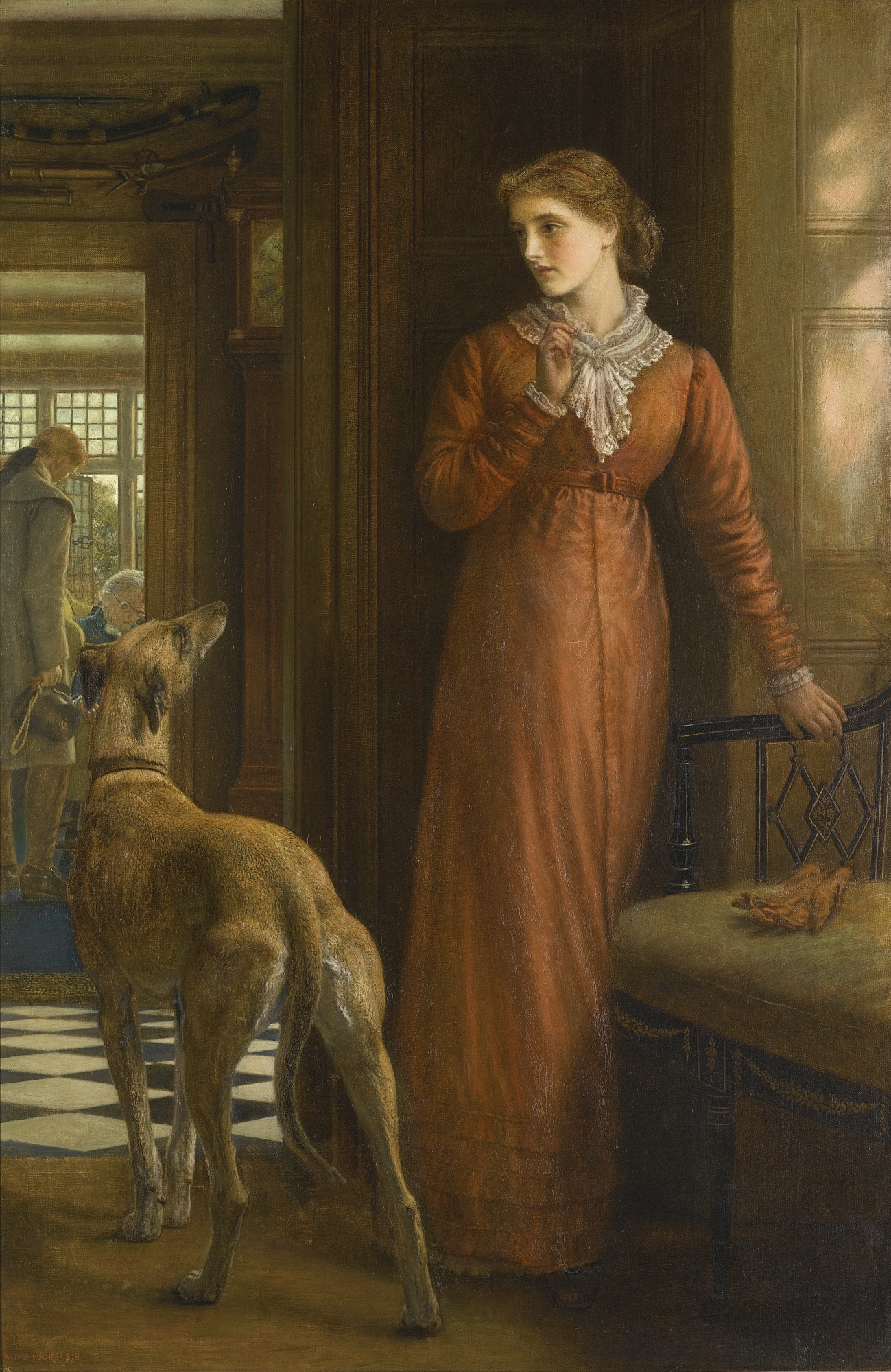
Uncertinty
Arthur Hughes
http://upload.wikimedia.org/wikipedia/commons/5/5c/Arthur_Hughes_Uncertainty_1878.jpg
Nicholas Kristof in discussing the humanities (“Don’t Dismiss the Humanities”) observed, “University students focusing on the humanities may end up, at least in their parents’ nightmares, as dog-walkers for those majoring in computer science. But, for me, the humanities are not only relevant but also give us a toolbox to think seriously about ourselves and the world.” It is the toolbox we need if we are to make the journey from doubt to certainty and that will give us the comfort and insight we need to make that journey, which, in all probability will last a lifetime. It is in reading philosophy that we learn not only how to question, but often the questions to ask. It is in reading novels, poems, stories, and essays that we learn how others have made or are making that journey. In a conversation about the humanities and the sciences (“The Way We Live Our Lives in Stories“) Jonathan Gottschall suggests “We live our lives in stories, and it's sort of mysterious that we do this. We're not really sure why we do this. It's one of these questions—storytelling—that falls in the gap between the sciences and the humanities.” Gottschall wants to find that common ground where the Sciences and the Humanities can live and work together. Both, in their different ways, are trying to sort through their doubts to find certainties. Philip Ball in “Why Physicists Make Up Stories in the Dark” suggests that many physicists have discovered what is true about physics by making up stories and than pursuing the implications of those stories. Often, maybe usually, the stories end up having no basis in reality, but they help get the journey started and in the course of the journey the truth comes out.
Bacchus and Ariadne
Titian
http://en.wikipedia.org/wiki/Bacchus_and_Ariadne#mediaviewer/File:Titian_Bacchus_and_Ariadne.jpg
The painting tells the story of Bacchus and Ariadne. The myth explains how the heavens came to be the way they are, or at least that part of the heavens where the Corona constellation is found. Often this was, perhaps still is, the function that myth and folklore served, they oriented the cultures that devised them, explained why things are as they are. Perhaps many or even most saw them as metaphors explaining the universe and our place in it. To a pre-scientific people they may even have had a ring of truth, though I think it is unwise to assume that pre-scientific people were less intelligent than we and perhaps even they only saw these stories as ways of illustrating things they did not have the tools to fully investigate and understand. But on another level, the myths are less concerned with the origins of things and more concerned with understanding human behavior and what proper and improper behavior looked like. Myth often has more to do with psychology than with physics or biology.
Calumny of Apelles
Sandro Botticelli
Botticelli’s painting is an attempt to recreate a painting from Classical antiquity that had been lost. Botticelli constructed his painting around the description by Lucian of a painting by Apelles. Lucian’s description also explained the allegory found in the painting. Though many details are difficult to see when the painting is reduced to a size that will fit on the page, they are clearly seen when the painting is viewed in its actual size.
Detail from The Calumny of Apelles
Sandro Botticelli
In this detail from the painting we can see that the man sitting on the throne has donkey’s ears, he is King Midas. The two women on either side of him represent ignorance and suspicion. The man reaching his hand out to Midas is envy. The painting tells a story about the human heart, what it wants to hear, what it often closes its eyes to, those it listens to and those it ignores. Midas in all the myths is a foolish man and the painting suggests that fools are easy prey to the darker sides of humanity. Midas’ folly is rooted in his certainties, that he can trust those around him; the darker sides of his humanity play to his “certainties.” In the painting the innocent are naked; they have no defenses and must trust to others to protect them, must trust to justice, which may or may not save the day for them. The woman in the back who is dressed in black rags represents repentance. She is largely ignored. The others, with the exception of envy, are richly dressed and appear to be rich and powerful; they all represent the antithesis of truth: slander, suspicion, and ignorance. As a story it suggests to us, as it suggested to those that first saw it, whether they saw Apelles’ painting or Botticelli’s recreation of it, that it is unwise to trust to appearances; that it is unwise to listen to those that tell us what we want to hear. Those Midas listens to are like him, they are of his class and like him they are wealthy. Maybe he believes that because they are like him they are worthy of his trust or perhaps he only listens to people like himself.
Lament for Icarus
Herbert Draper
It may be that those that first heard the story of Icarus believed that it was possible to construct wings that would enable them to fly, but whether they did or did not, they understood the emotion captured in the story, the excitement that comes from doing something novel and new and the imprudence that emotion can produce. We get carried away and the wings of our ecstasy often melt. The wings of Icarus in the painting are beautiful and splendid in the light of the setting sun. There is a beauty to Icarus himself. But neither his beauty, nor the beauty of his wings can save him. Often this is the way of things. We get excited by what we have discovered or what we have created and in our enthusiasm to play with what we have made we fall into unintended consequences. Our science and technology, among other things, have enabled us to do things that were once unimaginable, but they have also created problems that will not easily go away, whether it is damage to our environment or the tools that might eventually destroy the planet, and less apocalyptic problems like congested highways and urban blight. This is not to suggest that science and technology are “evils” to be avoided, but that we should be careful. We should make an effort to see what is behind the door our science and technology has opened. The wings of Icarus were are a good and marvelous thing, they would have led him to freedom, but not everything the wings enabled Icarus to do was prudent. To do a thing because we can is not always the best thing to do.
Triumph of Faith over Idolatry
Jean-Baptiste Theodon
http://en.wikipedia.org/wiki/Faith#mediaviewer/File:Triumph_of_Faith_over_Idolatry_Theodon.jpg
There is also the issue of which stories we listen to and how we apply those stories to the way we live our lives. The statue depicts the Triumph of Faith over Idolatry. But the stories represented by the idols were believed in as religiously as the stories represented by faith. St. Augustine wrote The City of God in part to answer the charges made by the believers in Rome’s pagan religion that it was because Rome had become Christianized and had abandoned the gods that the Roman Empire fell to the barbarians. A person’s faith is real to that person even if it is not real to anyone else. When a faith dies, it is difficult for those that come after to understand how it could ever have been taken seriously, just as it is difficult for those that do not share a faith to understand how those that adhere to that faith can take that faith seriously. But the truths that the stories these faiths tell are a part of who we are whether we accept the faiths that gave them to us or not. They are a part of our cultural inheritance. As Americans we believe in certain truths that are self evident, though we may not always be certain of their origins. We believe in justice, that to the extent possible those that have been wronged should receive justice that we should be treated justly. But if we live in a Darwinian world, why should we expect justice?
The Parnassus
Raphael
The painting above is from a series that depicts the four areas of human knowledge, philosophy, religion, poetry, and law. The paintings capture the whole of the Humanities. The poets are represented; the philosophers, painters, and musicians are represented. Even lawyers and priests are represented. This painting, The Parnassus, captures the poets, which today would include playwrights and novelists as well. Musicians are also included. Perhaps the stories they tell address our doubts and uncertainties, but even if they do not, they bring light into our lives and relief from the struggle. Stories are fun to listen to, they are fun to read, to watch on television or at the movies or in the playhouse. They do not need to be profound they do not need to give us the answers we seek. They delight the heart even if they do nothing else.
Albert Manguel writes about reading as “Conversations with the Dead.” Though not every book we read comes to us from a dead person, many do. He begins by saying:
Reading has always been for me a sort of practical cartography. Like other readers, I have an absolute trust in the capability that reading has to map my world. I know that on a page somewhere on my shelves, staring down at me now, is the question I’m struggling with today, put into words long ago, perhaps, by someone who could not have known of my existence. The relationship between a reader and a book is one that eliminates the barriers of time and space and allows for what Francisco de Quevedo, in the sixteenth century, called “conversations with the dead.” In those conversations I’m revealed. They shape me and lend me a certain magical power.
The Sorceress
John Williams Waterhouse
Many of the problems I confront are new to me, but they are not new to the world and because they are not new to the world there is someone somewhere who has written about her or his struggles with my problem. In reading I discover how others have dealt with my problems. (I also learn something about how others have experienced my joys and accomplishments, because these are not new to the world either.) I may not come to the conclusions these earlier writers arrived at, but they give me help on the journey nonetheless. Like those physicists telling stories in the dark. The reading I do does not always provide me with an answer (to be honest I rarely read solely to find answers) but it usually gives me a way of proceeding, though the reading has almost always been done earlier when I had no need of answers or ways of proceeding. What we read stays with us and is there when we need it. Manguel ends his essay:
Almost twenty years have elapsed since I finished (or abandoned) A History of Reading. At the time, I thought I was exploring the act of reading, the perceived characteristics of the craft and how these came into being. I didn’t know I was in fact affirming our right as readers to pursue our vocation (or passion) beyond economic, political, and technological concerns, in a boundless, imaginative realm where the reader is not forced to choose and, like Eve, can have it all. Literature is not dogma: it offers questions, not conclusive answers. Libraries are essentially places of intellectual freedom: any constraints imposed upon them are our own. Reading is, or can be, the open-ended means by which we come to know a little more about the world and about ourselves, not through opposition but through recognition of words addressed to us individually, far away, and long ago.
Uncertainty and doubt frame much of our existence. No matter how loudly we tell ourselves we understand, we know what’s what, we have the truth. But even when we have the truth doubt malingers. For the truth to stay true it needs regularly to be renewed. Literature is not dogma (well, perhaps some is, but when it is, its life expectancy is rarely long); it gives us a map not a doctrine. Mary Beard in an article on laughter (“What’s So Funny”) says “The pleasure and excitement of studying laughter, for a historian, is that it generates many more questions than answers. Theories of laughter have always been ‘theories of theories,’ a way of talking about laughter and ‘something else.’" This is true of reading and of most all serious study, at least within the Humanities.
From Spellbound
Alfred Hitchcock
Selznick International Pictures
The film clip captures another aspect of doubt and uncertainty. It is an essential element for films and stories like Hitchcock’s Spellbound. Ingrid Bergman’s character, Dr. Petersen, believes in her patient John Ballantyne’s (played by Gregory Peck) innocence. Her old teacher, Dr. Brulov (played by Michael Chekhov) explains to her why that belief is irrational. Brulov is, of course, correct. There is no evidence, other than Dr. Petersen’s faith, that Ballantyne is innocent, in fact all the evidence suggests otherwise, except perhaps, Ballantyne’s character. But, as Dr. Brulov points out, one of the characteristics of a psychopath is that their character often appears trustworthy. It is because there is so much uncertainty and because Dr. Petersen’s faith appears so irrational, that the tension and the terror builds. If what Dr. Brulov tells us were not true we would have no thriller. If Dr. Petersen were not correct in her judgment concerning the character of Ballantyne we would not have a happy ending.
Circe Invidiosa
John Williams Waterhouse
Perhaps one of the reasons we find thrillers, horror films, and other stories that play to our fear (and our desire to be frightened) so attractive is because they are a kind of metaphor for the world as we often experience it. There is much that goes on around us that is frightening, that is beyond our control, that leaves us feeling powerless. In stories that play to our fears and terrify us we see fear and terror confronted. We often, though not always, see fear and terror defeated. This is encouraging. In some ways these stories work according to Aristotle’s notion of “catharsis,” they purge our fear, we live through the terror created on the page or on the screen and we survive. Even if we do not know who Circe in the painting above is, her look inspires fear, if we know her story, we know what lurks behind that look. Also, if we know her story, we know she is eventually overcome. Circe’s is an old story, and the existence of her story suggests that the human desire to be terrified is an old one.
Witches’ Sabbath
Goya
Dan Piepenbring in “So Vivid You Can’t Get Free of Them” writes about Ray Bradbury’s love of metaphor. The article begins with a quote from Bradbury’s book The Art of Fiction,
Do you know why teachers use me? Because I speak in tongues. I write metaphors. Every one of my stories is a metaphor you can remember. The great religions are all metaphor. We appreciate things like Daniel and the lion’s den, and the Tower of Babel. People remember these metaphors because they are so vivid you can’t get free of them and that’s what kids like in school. They read about rocket ships and encounters in space, tales of dinosaurs. All my life I’ve been running through the fields and picking up bright objects. I turn one over and say, Yeah, there’s a story.
Many of Bradbury’s stories terrify, they speak to something at the heart of us. When as a child I went to the movies, more often than not what I went to see was a horror film. Also, as the paintings above and below suggest, horror stories did not begin with the movies. These paintings capture themes from classical mythology and suggest that the delight we take in being terrified goes back to the beginnings of human story telling. These films spoke to me differently, though, than they spoke to my parents. I remember going to the drive-in in the 1950’s when Godzilla and Rodan were both playing, it was a double feature, and at the time these were new movies, first time release in this country (they were originally released in Japan, and I am told the Japanese versions are better than their American counterparts, but I have not seen the Japanese versions). To me the films were about monsters. The premise behind how the monsters came to be did not speak much to me, I wasn’t interested, but I think they spoke to my parents. These films, and another I remember, Beginning of the End, revolved around nuclear power. It was a new thing at the time. I remember reading a “Weekly Reader” (I think) article about radiation being used to grow giant tomatoes. The point though is that the monsters were metaphors for the fears the society was living with at the time the films were made.
Hercules
John Singer Sargent
In Beginning of the End these experiments result in giant grasshoppers converging on the city of Chicago. But the reality of nuclear power was not that real to me as child in the 1950’s. My father, however, fought in the Pacific during World War II and was involved in some way with the atomic bomb that was dropped on Nagasaki. I have photographs my father took of the aftermath and of the bomb itself (though I do not think my father took that picture). For him nuclear power was something much more real and fearful. So for my parents, that which evoked the fear in these movies was much more real and the terror they provoked was probably much more real, though, like for me, it was still just a story.
Warning Sign in Cologne
US-Army History Images
http://en.wikipedia.org/wiki/Cologne_Cathedral#mediaviewer/File:Warning_sign_in_cologne.jpg
Another film from that era starred Steve McQueen and was called The Blob. At the end of the film it is discovered that the monster, the blob of the title, could not withstand the cold. It was rendered powerless in the freezer compartment of the supermarket, from whence it was taken and flown to the North Pole. The movie ends with Steve McQueen’s girlfriend suggesting that now they are safe, to which Steve McQueen responds, “As long as the North Pole don’t melt.” I suppose when the film was made there was not much chance of that happening. Today, however, who knows. Perhaps we should be on the lookout for a gooey carnivorous substance moving south.
The substance of our fears may change, but fear, like doubt and uncertainty, is a human constant, and the stories we tell are often our first defense against it. There will always be a place for stories about monsters and the overcoming of monsters. Even if our faith has no room for evil, even if like Alexander Pope we say, “All nature is but art, unknown to thee; / All chance, direction, which thou canst not see; / All discord, harmony, not understood; / All partial evil, universal good: / And, spite of pride, in erring reason's spite, / One truth is clear, Whatever is, is right” there is much that we encounter that is troubling and does not appear to go by the name of goodness. Whatever you call trouble when it comes; I hope you have a story to see you through to the end of it.
Ophelia
Arthur Hughes
Tuesday, August 7, 2012
Truth Be Told
Die Zauberflote, “Overture”
Wolfgang Amadeus Mozart
Roger Norrington and the London Classical Players
A Midsummer Night's Dream, Op. 21, “Overture”
Felix Mendelssohn
London Symphony Orchestra
Truth Be Told
The Princess Sabra Led to the Dragon (Rescued by St. George)
Edward Burne-Jones
http://en.wikipedia.org/wiki/File:Burne_,Princess_Sabra_Led_to_the_Dragon.jpg
The music suggests the mythical and the magical. Mozart’s Magic Flute has Masonic mysteries (I am told) at its heart and a good bit of magic and wizardry. Mendelssohn’s music was composed to accompany Shakespeare’s play A Midsummer Night’s Dream. The play is a comic variation, at least the centerpiece of the play is, on the beauty and the beast story. The Queen of the fairies, Titania, falls in love with a man, Bottom, given the head of a donkey. Of course everything happens by magic, the falling in love, the donkey’s head, the romancing in the enchanted forest. Eventually all is set right and everyone goes about their regular business, just as Papageno and Papagena are restored to each other and live happily ever after in the opera. In the opera it is the “beauties” that save the young Tomino, the handsome prince in the story, from the beast. There are all the characters of the traditional beauty and the beast story; they just do not play their traditional roles. The Queen of the Night, whose ladies were the beauties that saved Tomino from the dragon, instructs him to restore to her her daughter. Tomino is given Papageno as company, and both are given magical instruments, Tomino a flute and Papageno bells, to aid them in their task as well as three childlike spirits to watch over them.
The painting also tells a beauty and the beast story, that of the Princess Sabra, a dragon, and St. George. The princess has drawn the lot condemning her to be the dragon’s next victim. I think the faces in this painting are very revealing. The guard seems relatively unconcerned; the ladies following the princess look sad and wistful, perhaps thankful, for the moment, that someone else drew the short straw. But the Princess Sabra’s face reveals her fear, her sadness, and her resignation to her fate. Her hands that clutch at her garments reinforce the emotions her face reveals. Unlike Shakespeare’s play, there is nothing comic about this scene, and unlike Mozart’s opera, there is nothing and no one, man, woman, or spirit, that can offer her any hope or consolation. The story does, though, have a happy ending. St. George kills the dragon and peace and harmony are restored.
The painting below captures the beauty and the beast tale that is most likely to come to mind when we think of beauty and the beast stories. They come in a number of guises, the ones mentioned above and the one below. But there are other variations where the woman is the beast and it is the man that is the beast’s victim. My favorite of these stories is Gawain and the Loathly Lady. It revolves around a man in trouble, Gawain, who is helped by a very ugly and bestial lady. The ending is not that different from the story we usually think of, except the roles are reversed. The story of the Loathly Lady is also told, a bit more crudely, by Chaucer’s Wife of Bath. It seems people have always been attracted to stories about beautiful people being pursued by monstrous and terrifying creatures.
Beauty and the Beast
Warwick Goble
http://en.wikipedia.org/wiki/File:Warwick_goble_beauty_and_beast.jpg
There were a couple of articles recently about the power of myth and folk tales, “Once Upon a Time” and “Chasing rainbows: why myths matter,” that reflect on the power of these stories and the contribution they make to helping us all live a healthy and psychologically balanced life. “Once Upon a Time” addresses the folk tales of the Brothers Grimm. These stories have enchanted adults and children (pretty much in that order) from their first appearance in print. Most of us are used to the sanitized versions of these stories found in films by Walt Disney and others. We think of them with warm and fuzzy feelings of childhood. But the stories are terrifying, they are cruel, and they are incredibly violent, often in ways that offers few if any redeeming features to mitigate or soften the violence. The article concludes that one scholar of these stories, Jack Zipe, likes them because they offer hope and a sense that justice can prevail in the world. But the author of the article, Joan Acocella, thinks differently; she thinks they validate what is, the world as it really works. She concludes the article by saying, “Though Wilhelm tried to Christianize the tales, they still invoke nature, more than God, as life’s driving force, and nature is not kind.” The stories would seem to support this view, but, on the other hand, in stories like Cinderella, characters do find justice and the villains, whether they be stepsisters or stepmothers, are more than adequately punished. Sometimes there is justice, but it is a very rough justice and perhaps what is missing most is not justice, but mercy or redemption. Of course there are other stories in the Grimm collection that offer neither comfort, nor justice, nor hope. But, as the article suggests, the stories were written in a time when the world was cruel and violent and harsh and that what the stories portray is life as it is, with a little magic thrown in. Unfortunately the magic often does not take sides.
“Chasing rainbows: why myths matter” on the other hand takes a more positive view towards myth and folklore. Damien Walker points out that yes, those, Richard Dawkins particularly, that tells us the myths aren’t real are telling us the truth but they miss the point. Stories, especially mythic stories, function in the realm of metaphor. It does not much matter whether the world was created in six days or not, what matters is that it was created. They teach us lessons about who we are and how we best survive in the world; how we live productively and wholly/holy in the world. Literally interpreting myth is not really helpful. What they help us with is finding our courage, helping us deal with loss, helping us get in touch with our inner self, our spirit, our ethos. As is often true with poetry, we feel the message of the myth before we fully understand it.
Vasilisa
Ivan Bilibin
http://en.wikipedia.org/wiki/File:Vasilisa.jpg
The painting above is of a character from Russian folklore, Vasilisa. The part of the story the painting captures seems, to me, horrifying. Vasilisa is holding a human skull that functions as a lantern. When she needs light, light pours out of the eye sockets of the skull and when she does not need light, the eye sockets are dark. This “lamp” is given to her by a witch who demands that Vasilisa leave. She gives Vasilisa the skull on a stick to light her way. I am not sure what the correct interpretation of this story is, but I think it is true that wisdom and direction are often given to us by our ancestors, often dead ancestors through the stories they have passed along and the stories that have been told about them. Vasilisa, unlike many women in folk tales, is very resourceful and courageous. She is fearless, or perhaps it would be better to say that she has her fear under control; it is not that she does not experience fear but that she does not let that fear debilitate her. This is a message of folklore and myth, we are pursued by our fears, we all must overcome them if we are to act, perhaps it is more precise to say that we need the wisdom to distinguish between those fears that keep us from harm and those fears that keeping us from doing what must be done. The same fear that keeps us from running in front of a speeding automobile keeps us from standing up to wickedness. The fear tells us that wickedness is powerful and it is important that we understand that, but it is also important that we resist it and perhaps the proper office of fear is not to make us powerless but to help us use our power properly, to understand what that proper use is, to use it with wisdom and discretion.
Cotopaxi (1862)
Frederic Edwin Church
http://en.wikipedia.org/wiki/File:Cotopaxi_church.jpg
The paintings above and below capture the sublime. They are beautiful but they are capture scenes that are powerful, they capture scenes that depict nature’s power, the first in the form of an erupting volcano and the second in the form of a treacherous mountain path. I think of the “Fellowship of the Ring” trying to get over the mountains on their way to Mordor. This is the nature of the sublime. It is powerful, awesomely so and it is not always pretty. Church did an earlier painting of this same place, Cotopaxi, but it was bucolic and peaceful and the mountain in the background was silent. Both paintings are beautiful, but the later is sublime as well. There was an article in The New Republic, “Art Over Biology,” about art and its evolutionary origins. What does art contribute to our survival, what has caused the “art” gene to survive and be passed along from generation to generation? The article points out that art often acts as a cultural catalyst, that is, it becomes one of those things that tie a culture together, that makes a people a “People.” But where this is a real benefit to the culture it is often of little benefit to the artist. I am not sure that Adam Kirsch’s conclusions actually happen the way he describes them, especially those concerning the artist and children. He points to evidence that suggests that artists are private people who often do not do well in social situations and therefore are not in the best position to procreate. And there is much to suggest that there is truth to this assertion, but it is also true that artists often have families, some have large families. Granted they may be terrible spouses and terrible parents, but they do produce children to carry their genes forward.
The Passage of the St. Gothard
J. M. W. Turner
http://www.wikipaintings.org/en/william-turner/the-passage-of-the-st-gothard
But of course the larger issue is why do we produce art? There is a poem by Wallace Stevens, “Poetry Is a Destructive Force” that seems to suggest that this desire to produce art, poetry, novels, is not a pleasant desire to live with, it is to be “like a man / In the body of a violent beast.” It is to be entirely under the control of some other. According to the evidence that Kirsch cites it is to be, often, terribly alone and misunderstood. Of course the rewards of those that succeed are often very satisfying. The successful artist often receives a lot praise and attention, something that humans seem to crave and often these are accompanied with prosperity and comfort. Perhaps these are rewards enough to make the less pleasant aspects of the life of the artist more acceptable. But in the end the article suggests there are no satisfying evolutionary answers to explain how art came to be. But the article goes further to suggest that an evolutionary answer, were one to be found, would not change much because with art it is not the why that is really important. For a Darwinian explanation to have value, it must be “useful” and “it is hard to see how it would change the way we experience art, any more than knowing the mechanics of the eye makes a difference to the avidity of our sight.” Just as knowing how the eye works does not change the way we see and experience sight so knowing how art came to be, though it may satisfy some bits of our curiosity, does not affect our appreciation or understanding of the work of art itself.
Kakinomoto no hitomaro
Utagawa Kuniyoshi
http://en.wikipedia.org/wiki/File:Kakinomoto_no_hitomaro.jpg
The painting is of a prominent 8th century Japanese poet, Kakinomoto no Hitomaro. An article in the Boston Review, “Poetry Changed the World,” looks at another contribution of art, especially literary art. Reflecting on a new book by Steven Pinker, The Better Angels of Our Nature, Elaine Perry, the author of the article, considers how the written word has made humans more peaceful, empathetic, and nurturing creatures. She has problems with Pinker’s conclusions and how they are reached, but she agrees that when we look at how people have changed over time that reading has had a civilizing effect on people; that as books became more readily available and as more and more people were taught how to read them, people have become less brutal. Perry points out two ways that reading has changed us. One relates to the poetry itself. Early poetry often presented their themes in the form of debates. The article points to poems in different cultures in different parts of the world and at different times that present arguments for and against various issues. Often they function like Plato’s dialogues. She points out how different poetic forms, like the eclogue and the sonnet, are structurally suited to debate. In this way poetry encouraged deliberation over hasty action.
But the more powerful change is the one produced by novels. When reading a novel the reader enters into the experiences of the characters in the stories and begins to see the world through the eyes of these characters. This can have a profound effect upon readers; it takes readers out of their own mind, experience, and point of view and places them in the mind, experience, and point of view of the characters in the story. C. S. Lewis once said that in reading he became a thousand other men but remained himself. This ability to become thousands of other people develops empathy for others on the part of the reader, by expanding their understanding of others. Instead of judging people and events from our own perspective, reading stories encourages us to look for other ways of understanding what is happening around us, so that we do not look solely at the effect events taking place around us have on us alone, we start to look at how these events effect others, giving us a larger perspective, enabling us to understand not just how we are affected, but how the culture as a whole in which we live is affected.
From The Thief of Bagdad
Douglas Fairbanks Pictures
Republic Pictures
The film, The Thief of Bagdad, captures the spirit of the 1001 Arabian Knights. These stories illustrate the power of story upon the imagination. These stories have influenced the literature of cultures all over the world to the point that we cannot know for sure which came first Odysseus or Sinbad, for example, or if there were a third voyager, now lost, that inspired both stories. There was an article in Times Literary Supplement, “The magic of the Nights,” about the impact of these stories on world culture. The book is specifically addressing the stories of the 1001 Nights but it contributes to the discussion found in other articles about the power of stories, the power they have over us, the power they have to color how we interpret the world around us. The stories themselves are of uncertain origin, some come from Persia, some from Arabia, some had their origins in Sanskrit, but no one is quite certain where the stories found in this book first appeared. The book as it has come down to us is not even from a single collection of stories. The first of the Arabian Nights stories I encountered as a child was the film Ali Baba and the Forty Thieves. Looking at the film as an adult it is difficult to understand what was so appealing to my childhood imagination, but appealing it was. But Ali Baba was not one of the stories that made up the “original” Arabian Nights; it was added to the collection by editors trying to account for all one thousand and one nights. Sinbad and Aladdin were also absent from the earliest editions of the Nights. Any modern editor that tries to assemble a more “authentic” version of the tales by limiting their edition to only those stories found in the earliest, most authentic editions is eventually forced, we are told, to add the missing stories. We know them too well and they have touched us too deeply.
The Flying Carpet
Viktor Vasnetsov
http://en.wikipedia.org/wiki/File:Vasnetsov_samolet.jpg
One story that has included elements of the Arabian Night is Jonathan Swift’s book Gulliver’s Travels. In the second voyage the bird that takes Gulliver from Bobdingnag and drops him out to sea is instantly identified as the Roc that Sinbad encountered, instantly identified by anyone familiar with the stories that is. The Yahoos Gulliver encounters on his last voyage also have antecedents in the 1001 Nights. There was an article in The New Atlantis, “The Truth About Human Nature” that applies the lessons Gulliver takes from his various voyages, especially his last voyage, to our common human experience. The thrust of the article is that we cannot live entirely in a rational world; that as admirable as the Houyhnhnms may be to Gulliver, they are missing something, they are not, to state the obvious, human and where a life governed entirely by reason may be ideal for horses and other animals, it is not ideal for the human animal. The article suggests that what the Houyhnhnms lack that humans need is imagination. Gulliver is standing in front of them, he was brought to their island on a ship, but the Houyhnhnms cannot conceive of a ship, they do not have the imagination for it. And this is something that stories provoke and provide that makes the human experience richer and more profound. The article also tells us that the Houyhnhnm is not capable of telling a lie. This I think is not true. The master Houyhnhnm has in him the “milk of human kindness” in that he will not reveal the true nature of Gulliver’s appearance, that the clothes Gulliver wears are not his skin. The Master Houyhnhnm does not tell overt lies to conceal this fact about Gulliver; he just does not correct the misimpressions those around him have formed concerning Gulliver. This raises another issue, the issue of what constitutes a lie and is a lie always spoken or can a lie be told by saying nothing. I think the Master Houyhnhnm says the thing that is not when he says nothing at all about Gulliver’s clothes. He is perpetrating a lie and it is a humane lie, it shows compassion and a desire to protect a friend, something Houyhnhnms as rule do not do. Perhaps the stories that Gulliver has told his master Houyhnhnm has humanized the Horse, has done for the horse what Elaine Perry suggests the novel has done for us, it has given him a larger view of the world.
Illustration from Gulliver’s Travles
Richard Redgrave
http://en.wikipedia.org/wiki/File:Gulliver.jpg