Sunday, February 13, 2011

A Storied Life


Scheherazade, symphonic suite for orchestra, Op. 35: III. “The Young Prince and the Young Princess. Andantino Quasi Allegretto”
Nikolai Rimsky-Korsako
Fanfare for the Common Man
Aaron Copeland


A Storied Life

Medieval Town by WaterAfter a painting by Karl Friedrich Schinkel (original painting destroyed by fire)
http://commons.wikimedia.org/wiki/File:Medieval_Town_By_Water.png


Ezra Pound in one of his saner moments said, “Man reading should be man intensely alive. The book should be a ball of light in one’s hand.” Books work magic, it is not clear how, not to me anyway, but that is the nature of magic, perhaps the definition of magic itself, something marvelous that defies definition. Reading, or appreciating art of any kind, does not make us better people; some of the worst people that have ever lived had very profound artistic sensibilities. They read the best books, listened to the best music, were moved by the best paintings and sculptures. This ability to appreciate the sublime added depth to their experience of life, but it did not make them good people. It enriched their experience; it did not impact on their humanity. Of course it can also be said that many of the most humane people that ever lived had this same experience of the sublime. It may be that those that brought virtue to their experience of the sublime experienced and understood more fully and more deeply, but that is something that cannot be known with any certainty.

When I look at the painting above I wonder what the original looked like. I am saddened that it has been destroyed because I find the copy so moving. Perhaps the painting that lives in my imagination is not only finer than the copy, but finer than the original as well (as far as that goes, the copy may be finer than the original for all that anyone can know). There was an article in the Boston Globe, “Well worth not reading,” about the books we imagine based on the blurbs on the back cover, or the cover illustration, or a sampling of the text. It is about the books we have encountered but have not read. I am not sure I like this article as much as I imagined I would when I began to understand its premise, though I do think there is truth to it. It is a bit unsettling perhaps for someone who teaches others to read books to contemplate the advantages of not reading them, but it must be owned that there are many books that I have read that did not live up to the expectations created by the first impressions they made. I am glad though that I gave them the opportunity to speak their piece.

The music suggests our first experience with stories, the fairy tale story of the princess and the prince, and the audience for stories, the common man. Though Scheherazade’s princesses and princes often behaved as princesses and princes should, those of the Brothers Grimm and other tellers of folk tales often behaved as though their origins were a bit more humble. When as children we read fairy tales that involved royalty we often looked at those “royals” as though they were just like us that there was not much difference between the pauper and the prince and at some level this is what lies at the heart of any good story, it is what makes the story attractive. It may not be a belief that we and they are the same but it is a belief that we and they share a common humanity and we have something to learn from how they encounter the world.
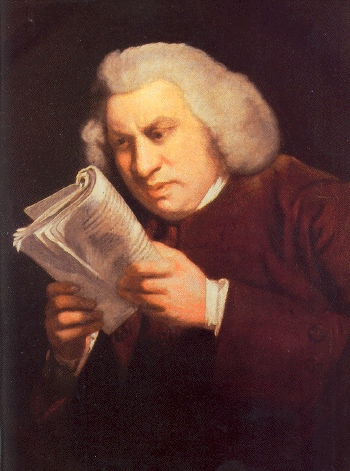
A portrait of Samuel Johnson
Joshua Reynolds
http://en.wikipedia.org/wiki/File:Samuel_Johnson_by_Joshua_Reynolds_2.png


The painting above is of Samuel Johnson, one of the English Language’s finest professional readers. In the painting he is reading intently, but according to the blurb accompanying the painting this was in part to dispel the image of “blinking Sam,” it was to offer a “counter-narrative” to one that was current at the time. But it makes one wonder, or at least it makes me wonder, why do we read? Because Samuel Johnson was who Samuel Johnson was it also makes me wonder why we analyze what we read? Is literary criticism something readers do to understand a text or does it superimpose the reader's vision on that of the writer? What makes some readers more “authoritative” readers than others, that is, why do we give more weight to the judgments drawn from the reading done by some than to that done by others?


There was a series of articles recently in the New York Times (I looked at these three, “The Will Not to Power, but to Self-Understanding,” “Translating the Code Into Everyday Language,” and “From the Critical Impulse, the Growth of Literature”) about literary criticism and its usefulness. The articles addressed meanings of literary texts and the like, but the main conclusion they all seemed to come to was that criticism contributes to a literate culture in that it provides a platform for discussing literature, its deeper meaning, and its impact on the culture at large. I enjoyed all of the articles but I was intrigued by Elif Batuman’s applying Freud’s method of interpreting dreams to the interpretation of literature or at least that aspect of Freud’s thinking that recognized the complexity of dreams and the multiplicity of possible meanings that they contain. According to Batuman this same dynamic is at work in our analysis of stories.

Farmer Sitting by the Fire, ReadingVincent Van Gogh
Watercolor, Charcoal, watercolour, heightened with white
Etten: October, 1881
Kröller-Müller Museum Otterlo, The Netherlands, Europe
F: 897, JH: 63
http://www.vangoghgallery.com/catalog/Watercolor/1816/Farmer-Sitting-at-the-Fireside,-Reading.html


The painting above is of a farmer sitting by his fire reading a book. This suggests that the printed word can work its magic not only on those that do not read for a living, but those who earn their living from occupations very different from those of “professional” readers. Farmers of course, at least good farmers, are always reading the literature of their trade so it shouldn’t surprise us that farmers read. But when they are reading the literature of their trade they are reading for information, not for enchantment. What are the respective values of each kind of reading, is one better than the other or do each provide their own unique kind of value? At the level at which each works they teach us how to profit from living, on the one hand how to earn a living and on the other how to spend a life in a way that is meaningful and not just productive.

Elderly Man at a WindowYves Trevedy
http://www.artinconnu.com/2008_04_01_archive.html


The paintings above and below are of an old man reading and of a young man reading. They are both engrossed and as one might expect the old man is farther along in his book than the young man, the old man is finishing his book while the young man is starting his. The old man is alone with a single book while the young man has an assortment of books propping up the book he is reading. There are perhaps some obvious metaphors that could be drawn but I’ll let others draw them. What I find attractive about these paintings is the intensity that each reader brings to the reading that he is doing. The young man is described as a student in the painting’s title and perhaps he is reading in the same fashion the farmer reads his agricultural journals, but perhaps not. The old man has his back to the window and to the beautiful landscape that is life as it truly is. Is the man turning his back on reality or is the reality he finds in his book more real than the one outside his window? In my experience all reading teaches and the books that capture my imagination the most intensely make the world outside my window more real and more understandable. As Pound suggests reading makes me and the world outside more intensely alive and more intensely real and comprehensible.

The Young Student
Ozias Leduc
http://cybermuse.gallery.ca/cybermuse/search/artwork_zoom_e.jsp?mkey=1361


John Connolly in his book The Book of Lost Things says, “The stories in books hate the stories contained in newspapers, David’s mother would say. Newspaper stories were like newly caught fish, worthy of attention only for as long as they remained fresh, which was not very long at all. They were like the street urchins hawking the evening editions all shouty and insistent, while stories – real stories, proper made-up stories – were like stern but helpful librarians in a well-stocked library. Newspaper stories were insubstantial as smoke, as long-lived as mayflies. They did not take root but were instead like weeds that crawled along the ground, stealing the sunlight from more deserving tales.” It might be that the books we read for information are short lived, they do not deliver anything magical, they are a pragmatic bunch that teach us what we need to know to keep the pantry stocked, but the truths they tell are only true for a short time, relatively, and will in all likelihood be soon replaced with other truths.

The truths contained in stories often help us unravel the mysteries that surround who we are; they help to teach ourselves to ourselves. There was a review by Sarah Bakewell in the New York Times about the lives of great philosophers, “Lives of the Philosophers, Warts and All”. The book points out that most philosophers led very muddled lives and that no matter how profound their insights, the art of living well and happily remained elusive. I am not sure that stories succeed any better at explaining life or simplifying day to day existence, but they do teach us that everyone has problems and that what really matters more than solving our problems is living with integrity while pursuing those solutions.

Elif Shafak
TED Talk


The film is about storytelling or more precisely perhaps being a storyteller. Ms. Shafak tells us that others try to tell her the kinds of stories she should tell, but she does not want to tell those stories. She suggests that as a writer she is pursuing in stories the same things I am as a reader of stories, she wants to explore what makes people from different backgrounds behave as they do. Modern storytelling has become a bit obsessed with the relationship between the characters in a story and the writers that create those characters; that J. D. Salinger, for example, must be a lot like Holden Caulfield, that novelists and storytellers of all stripes are actually engaged in a kind of autobiographical masquerade. When in fact most of the best storytellers from the past made little use of their personal lives. One reason some critics today do not believe Shakespeare could have written Shakespeare is because the stories Shakespeare told were so far removed from his life experience, that somehow because he had never been a nobleman he could not possibly comprehend what it was like to be one. Storytellers that cannot imagine the inner lives of characters different from themselves cannot amount to much as storytellers, their insights, like mine are all local. If I as a reader can enter the inner lives of characters different from myself as I read about them, why can’t storytellers do the same as they write about them?

The painting below is of an emperor of China who was also a literary critic. It is not unusual for a monarch to be engaged in literary pursuits, the first Queen Elizabeth wrote poetry and translated Latin texts, like Boethius’ Consolation of Philosophy. Alexander the great had Aristotle for a teacher. Some learned more from the literature they studied than did others, but it is difficult to imagine that even those who learned the least were not enriched by what they read. If stories do nothing else they take away our excuses. When we read we make judgments about the characters and the things the characters do. This suggests that we have an inner sense of what is just and recognize injustice when we see it; that we understand the need for compassion and recognize cruelty when we see it; that we understand the quality of mercy and recognize hardness of heart when we see it. Some of these conclusions we are led artfully to see due to the skill of the storyteller, but the fact that these virtues are so much more likely to be found in the stories we read than the vices suggests that there is something true about these virtues that resonates in all of us.

Cao Pi, Emperor of Wei (Emperor of China and Literary Critic)
Yan Li-pen
http://en.wikipedia.org/wiki/File:Cao_Pi_Tang.jpg


Sunday, January 2, 2011

Beholders of Ocean


The King of the Fairies
Alan Stivell

Beholders of Ocean

A Man with a Quilted Sleeve
Titian
http://en.wikipedia.org/wiki/File:Tizian_078.jpg

There is a story by Lord Dunsany called “Poltarnees, Beholder of Ocean.” It is about an idyllic place, a place of safety and comfort where no one is content, or at least very few are. On the one hand I suppose this is a story of discontent and the harm that it can do, but on the other, the more significant hand perhaps, it is about forsaking comfort and the illusion of contentment for what provides true satisfaction to the soul and spirit. In the story it is the ocean that everyone that leaves is seeking, but it could be anything. This suggests a question that each ought consider. Where is contentment found and what does it look like?

The song, The King of the Fairies, is by Alan Stivell. He is credited by some with re-popularizing the Irish Harp, though he does not play it on this selection. I first heard of him while taking a course on the Irish Renaissance while I was in college in 1975. Stivell is from Brittany, or the Irish province of France. The music of Stivell and others like him fed and cultivated my interest in Celtic myth and folklore, of which Arthur, the Irish story The Tain, and the Welsh stories of The Mabinogion were a part. These stories share a world in common, one in which the natural and the supernatural interact with one another and in which magic and wizardry are somewhat commonplace. In the Arthur stories Merlin is a difficult character to reconcile to the Christianity of the time when they were written down. He is a wizard and wizards are of the devil, but he is also a wise and trusted councilor and everyone in the stories trusts him, even as they are calling him a “son of the devil.” The stories also revolve around heroic characters and the adventures that befall them. They are exciting reading.

The painting is, according to some, of Ariosto (others say it is a self-portrait). Ariosto’s epic Orlando Furioso is also an important story for me because it caters both to my enjoyment of comedy, satire, and farce and the heroic stories mentioned earlier. It has been recently translated anew into English by David Slavitt. The characters in the story have an epic pedigree and they act as would be expected based on that pedigree. But this pedigree and the order of knighthood in general are also mocked and hence the irreverent humor. It too is exciting reading.

Earliest known portrayal of Thomas Becket's murder in Canterbury Cathedral.
http://en.wikipedia.org/wiki/File:Thomas_Becket_Murder.JPG


The paintings above and below are from medieval illuminated manuscripts. The one above depicts the assassination of Thomas a’ Becket. The one below depicts an episode from one of the King Arthur stories. These images evoke the political intrigue of the Middle Ages and its conflicts between Church and State (some things do not change) as well as the heroic tradition of its story telling. There is a passage in the “Prologue” to The Canterbury Tales where Harry Bailey (though he has not yet been identified by name) says to the pilgrims “We are all free men.” The Canterbury Tales is a book written at the end of the 14th century, barely a hundred years since the final version of The Magna Carta was issued, and it is the first instance I am aware of (though I would not be surprised to learn there are earlier instances) where the commons claim equality with the church and aristocracy and in truth I am probably reading this line within a 21st century context and perhaps Harry does not see himself in as free a light as I do.

I wonder, though, at times if the equality that Harry speaks of is the beginning of a new tradition, a more realistic tradition, that is a bit at odds with that of Medieval Romance. There was an article in The Guardian over Christmas about science fiction, “Stranger than science fiction,” that wonders if our present interest in science fiction is not an attempt to escape the limitations of realism, that is “stuck” with things as they are and often offers few suggestions as to how to live harmoniously with things as they are, other than pretending perhaps that things as they are aren’t so bad. Science fiction also offers us a kind of story telling that is not just “lifelike” but often much larger than life and it is this something larger that readers also find attractive, they want to loose themselves in a world that is more heroic than mundane. The article suggests that it is important to identify the kind of story in which we would like to live or ought to live. The world of the 21st century offers many stories that though they may not be in conflict with each other are often more interested in selling us something, from products to points of view, than they are with helping us learn to live with ourselves, with others, or the world around us.

'King Arthur fighting the Saxons' - illustration taken from the Rochefoucauld Grail
http://en.wikipedia.org/wiki/File:Rochefoucauld_Grail.jpg


Leading up to Christmas there were also some articles in The Guardian about favorite Christmas stories. Two caught my interest; they were about The Lion, the Witch, and the Wardrobe by C. S. Lewis and The Dark Is Rising by Susan Cooper (“Season's Readings: The Lion, the Witch and the Wardrobe by CS Lewis” and “Season's readings: The Dark Is Rising by Susan Cooper”). I read and enjoyed these stories as an adult and their use of myth and folklore (Greek and Roman myth by Lewis and Welsh myth by Cooper) nourished an interest I have always had in myth and folklore and the power of the stories that they tell. The Cooper story especially, with its use of motifs from The Mabinogion fed my interest in things Arthurian. But these were not the stories that provoked my interest initially.

The Nightingal
Edmond Dulac
http://en.wikipedia.org/wiki/File:Edmund_Dulac_-_The_Nightingale_2.jpg


Above and below are illustrations from children’s stories. Like the illuminated manuscript images above, these help create a world, a magical world, that evoke the stories they illustrate and pique the imagination. Also as was true with some medieval illuminations they help tell the story to those who cannot yet read. When I was in the seventh grade my school gave students the opportunity to purchase books through the Weekly Reader and the Scholastic Book Service. One of the books that I bought was Eleanore Jewett’s book The Hidden Treasure of Glaston. I do not remember much of the book but its opening made a strong impression as well as its use of the Grail legend. The story revolves around a young boy whose father has left him with the monks of Glastonbury (one of the alleged resting places of King Arthur). His father is a knight who has been implicated in the murder of Thomas a’ Becket and must flee the country. The boy, though, is bookish and lame and a disappointment. I empathized with the boy (something we must all do before we can truly enjoy a story) and was fascinated by the Arthurian elements.

The Mermaid and The Prince
Edmond Dulac
http://en.wikipedia.org/wiki/File:Edmund_Dulac_-_The_Mermaid_-_The_Prince.jpg


But what does this have to do with anything like beholding oceans? I suppose because both my parents were mathematicians I did not think that literature was anyplace I ought to end up. My father was also an aerospace engineer who brought home pictures and articles on space vehicles and rockets. I remember looking at artists’ conceptions of the Apollo spacecraft and the Lunar Excursion Module while watching the Mercury launches on television. Nonetheless I was attracted to a different ocean. If we are to be happy we must find our own ocean and pursue it as best we can and hopefully one day we will behold it. For me the ocean I behold is a sea of stories.

Why Medieval
Dr. Richard Scott Nokes


Dr. Richard Scott Nokes writes a blog, “Unlocked Wordhoard,” that I enjoy. He posted the above video to explain his interest in Medieval Literature and how that interest came about. Sharing a similar interest I found the video attractive but the important point it raises is not about the Middle Ages or even about literature, it is about finding whatever it is in us that motivates us, that gives us joy and satisfaction. We all need to consider what it is we are going to spend our lives doing. On the whole it is a pretty good thing if we can find a way to get someone to pay us for doing what we would do for free. If we must earn a living why not find a way to enjoy ourselves while earning that living.

Elif Batuman in the introduction to her book The Possessed writes, “I stopped believing that ‘theory’ had the power to ruin literature for anyone, or that it was possible to compromise something you loved by studying it. Was love really such a tenuous thing? Wasn’t the point of love that it made you want to learn more, to immerse yourself, to become possessed?” This resonates with me as a teacher of stories, but it also resonates at a different level. We all need to find whatever it is for us that we can spend a lifetime loving, and whatever it is, it must be substantial enough to reward a lifetime’s effort.

As a teacher it is important that I communicate to students who have little interest in what I teach the passion that motivates me to teach what I teach. It is not all about emotions, but than there is perhaps more to passion than emotion. Richard Feynman was at least as passionate about physics and the logic that is its foundation as I am about stories and their logic. Poltarnees may be a high and difficult mountain to climb, but it is wonderful thing to behold the ocean.

Christmas Eve
Carl Larsson
http://en.wikipedia.org/wiki/File:Julaftonen_av_Carl_Larsson_1904.jpg


Saturday, November 27, 2010

Caricature and Content


Political Science
Randy Newman

Caricature and Content

Let Us Prey
Thomas Nast
http://en.wikipedia.org/wiki/File:1871_0923_vultures_200.jpg


There was a review in The Guardian, “Garry Trudeau: 'Doonesbury quickly became a cause of trouble'”, of a retrospective collection of Gary Trudeau’s Doonesbury comic strip. In the book Trudeau comments on satire and its essential unfairness. He said, “Satire is unfair. It's rude and uncivil. It lacks balance and proportion, and it obeys none of the normal rules of engagement. Satire picks a one-sided fight, and the more its intended target reacts, the more its practitioner gains the advantage. And as if that weren't enough, this savage, unregulated sport is protected by the United States constitution. Cool, huh?" This captures satire in all its guises. It may not always be clear when something is intended as a satiric comment or just a general observation (is Glen Beck, for example, a satirist or a political analyst, and can the two coexist in one and the same person at one and the same time) but it is generally clear that someone is being ridiculed and belittled.

But whether it is the right at the mercy of Trudeau or the left at the mercy of Beck (I am not sure if Beck is a satirist or not I only know I respond to Beck much the same way the targets of Doonesbury respond to Trudeau) the targets of each feel they have been misrepresented or even “lied about.” But as Trudeau points out it is all protected by the Constitution and it is all very “cool.” As the Nast cartoon above suggests ridicule is a far more effective weapon for engaging the enemy than rational debate. The most ludicrous of positions can be made to sound reasonable, but even the most reasonable of positions struggles with its credibility when it is made to look ridiculous. Tweed and his cronies survived most assaults upon their power, they did not survive Nast and if we remember Tweed at all it is probably the Tweed of the Nast cartoons we remember and though people were being “nasty” long before Nast, he gave the word an additional twist.

Randy Newman’s song underscores this astringent quality of satire. The world is not treating us we deserve to be treated so we’ll show them, we’ll blow them off the face of the planet. Even if our analysis of our treatment is correct, the satiric response is hardly a measured one. As with most humor it has at its heart adults behaving childishly. Kim Stanley Robinson’s novel Red Mars begins with a conflict between two colonial factions on Mars, one that wants to create a homogeneous planet by only allowing people of a certain nationalistic view to settle there and the other that wants to create a diverse society with all the conflicts that diversity brings with it. Can satire exist in a world with a single point of view? Can a single point of view be long maintained or do humans by their very natures split into factions and groups incapable of remaining “homogenized”? When we get around to choosing up sides and staking out our satiric positions we are not likely to remain judicious in our portrayals of those with whom we disagree.

The Name of Dante Gabriel Rossetti is Heard for the First Time in the Western States of America
Max Beerbohm
http://en.wikipedia.org/wiki/File:Max-oscar-1916.jpg


But is it the goal of satire to offend its targets while it amuses those that share its values? The caricatures above and below by Max Beerbohm and Andre Gill suggest that their intent was to give some offense, whether to gain a laugh at the subjects expense or to make a point it is up to the viewer to decide. In Beerbohm’s drawing is it Oscar Wilde or his western audience that is being satirized or is it perhaps both? The Gill cartoon suggests that Darwin and Littré are confronting the ignorance of the time, but they have also been dehumanized in the process. Is there a separate message in that? There are times perhaps when it is the satirist’s intention to offend everyone.

Charles Darwin and Émile Littré depicted as performing monkeys at a circus breaking through gullibility (credulité), superstitions, errors, and ignorance
Andre Gill
http://en.wikipedia.org/wiki/File:Ch_Darwin-Emile_Littré_by_André_Gill.jpg


There was an article recently in The London Times, “Misreading Gulliver's Travels,” about Jonathan Swift’s book Gulliver’s Travels and it suggests that those that read this book as a misanthropic attack on the whole human race miss the point. The article quotes from a letter Swift wrote to Alexander Pope where he says, “But principally I hate and detest that animal called man, although I heartily love John, Peter, Thomas, and so forth. This is the system upon which I have governed myself many years, but do not tell." This suggests that it is not people that Swift despises but what people do when they get together and form a group. Individuals are lovable, groups less so. Those that read of Gulliver and his travels without keeping this thought in mind are bound to misread the book, though, it could be argued that those that misread in this way have not really been paying attention.

Ben Jonson wrote of his plays that they had two audiences, the “understanders,” who got the jokes, but were also illuminated by them and the “pretenders,” who laughed but learned nothing, who essentially missed the point. In his introduction to the play The Alchemist he wrote:

"If thou beest more, thou art an understander, and then I trust thee. If thou art one that takest up, and but a pretender, beware of what hands thou receivest thy commodity; for thou wert never more fair in the way to be cozened, than in this age, in poetry, especially in plays: wherein, now the concupiscence of dances and of antics so reigneth, as to run away from nature, and be afraid of her, is the only point of art that tickles the spectators. But how out of purpose, and place, do I name art? When the professors are grown so obstinate contemners of it, and presumers on their own naturals, as they are deriders of all diligence that way, and, by simple mocking at the terms, when they understand not the things, think to get off wittily with their ignorance." (The Alchemist, Ben Jonson)

Jonson is attacking the critics of his day that would praise a play, or a poem, for the “business,” the humor and action but miss the artistry and the message. The understanders are changed by what they see on stage or read from the printed page, the pretenders are merely entertained. Jonson goes on to say, “I speak not this, out of a hope to do good to any man against his will,” suggesting that we all must play a role in our own reformation and even if Jonson wished to make his audience into better people, they cannot hitchhike on his good intentions. Jonathan Swift echoes Jonson’s view when he says, “Satire is a sort of glass, wherein the beholders do generally discover everybody’s face but their own; which is the chief reason for that kind of reception it meets in the world and that so very few are offended with it.” (Jonathan Swift, The Battle of the Books) Few are offended because they believe that others and not themselves are on the receiving end of the humor. Swift suggests, I think, that the best satire puts everyone, even the satirist, under the microscope and that we all have something to learn from it.

Patrick Chappatte 2010G On Editorial Cartooning
TED Talks


The film clip is about the influence of satire and cartooning on society. The understander will see a bit or her or himself in many of the cartoons Patrick Chappatte presents but there is also a troubling side to the cartoonist, in general, and the way in which some societies and some cultures respond to the cartoon. The power of the editorial cartoon is, as pointed out above by Gary Trudeau, that it is not always fair and that ridicule reduces anyone, no matter how innocent of the accusation being made, to something small and laughable. Few respond well to such a one sided attack and as in the case of the Danish cartoons ridiculing Islam, not all responses to the satire are docile or good natured.

Jonathan Swift attacked an attempt of the English government to flood Ireland with a currency that was not worth the metal it was stamped from. He made his attack from behind the mask of an anonymous Dublin draper who wrote a series of letters to the newspapers revealing the currency for what it was. The English government offered a substantial reward to anyone who would provide evidence that would lead to the draper’s arrest. The government believed Swift wrote the letters but they could not prove the charge. Unfortunately, for the British, no one was willing to collect the reward and identify Swift as the perpetrator of the letters.

Daniel Defoe also published a bit of satire attacking the religious attitudes of powerful people. He was convicted of libel and pilloried for his crime. At the time being put in the pillory where the convict’s head and hands were secured making movement impossible, could be a very harsh sentence. Passersby could throw most anything at the pilloried individual and it was not unusual to leave the pillory much the worse for wear. In Defoe’s case, though, the crowds sided with him and instead of sticks and stones they threw flowers and came to drink his health. Even when the satirist is legitimately in the wrong, which is questionable in Defoe’s case, it is unwise to respond too harshly, because public sympathy is often disinclined to side with the powerful and it often enjoys a bit of fun at their expense.

When satire is done well, everyone occupies a bit of the frame. We may not be powerful, we may not be guilty of the offenses that are being ridiculed, but as human beings we should be able to recognize that given the opportunity and the ability to take advantage of it we have in ourselves at least the propensity for acting as dubiously as those in the center of the frame. Though there may be a specific individual targeted in the humor, what gives the humor its force is that the behavior under attack is one to which all humans are susceptible and if we are wise we do not laugh at the object of the satire without laughing a bit at ourselves.

Zonker Harris
Gary Trudeau
http://en.wikipedia.org/wiki/File:Zonkerharris.jpg


Sunday, November 7, 2010

A Common Shelf


Make a Better World
Blind Boys of Alabama

A Common Shelf

Anonymous Commonplace book in manuscript
http://en.wikipedia.org/wiki/File:Commonplace_book_mid_17th_century.jpg


There is a series of books assembled in the early 1900’s by Charles Eliot, president of Harvard at the time, called the “Harvard Classics.” It has been nicknamed the “five foot bookshelf” as that is the size of the shelf required, at least so it is alleged, to hold all the volumes. The idea behind this “bookshelf” was that a person could receive a fairly complete education by spending fifteen minutes a day in these books. I m not sure that a lifetime of fifteen minute daily reading would get a person through everything on the “bookshelf” but it might, it probably depends on reading speed and comprehension of the reader, but it may well be doable.

There was once a practice of compiling “literary scrapbooks” called “commonplace books,” John Milton, for example, kept one. These books were literary journals of sorts in which a person jotted down quotes and passages encountered in the day’s reading, or just random ideas. These could then be reflected upon later, shared with others, or developed into reflective essays, poems, or stories. The photograph above is of such a commonplace book. It can be seen that they were not always neatly kept and the handwriting may be difficult to follow, but than it was more for personal than public consumption.

Virginia Woolf compiled two books of essays called A Common Reader (volumes one and two of course). They were essays on books and writers that were important to her and other “common readers” of her generation. The introduction to the first volume begins with a summary of Dr. Johnson’s definition of the common reader:

"The common reader, as Dr. Johnson implies, differs from the critic and the scholar. He is worse educated, and nature has not gifted him so generously. He reads for his own pleasure rather than to impart knowledge or correct the opinions of others. Above all, he is guided by an instinct to create for himself, out of whatever odds and ends he can come by, some kind of whole — a portrait of a man, a sketch of an age, a theory of the art of writing."

The important thing to see in this is that people of all generations have had a shared literature, a literature that was important to the educated and the uneducated. It is said that Boston policemen could point out Henry James to tourists when Mr. James was walking about town. It was also to be understood that both the tourist and the policemen were familiar with Mr. James’ stories.

There was a recent article in The Guardian, “What happened to essential books?,” about the shared stories, or the lack of shared stories, among the present generation. The article laments the lack of a shared literature, though it acknowledges some shared stories that do not quite meet up to the author’s definition of literature. Perhaps the problem is with the author’s definition of literature, but I do not think so, time, though will tell. Of course those that are alive while a generations “literature” is being created are rarely the best judges of its quality or its endurance, so who is to say if it rises or not to a literary standard. It is probably best to suspend judgment on this generations shared stories and on their literary quality.

The song encourages us to “make a better world;” it encourages us to do this by singing together and the songs we sing together are another form of story telling, another kind of shared literature. The song encourages us to “love our neighbor” and to care for one another. Not a bad story to tell and a story that many of the classic and not so classic stories do tell. One of George Eliot’s characters ponders in Middlemarch, “What do we live for if it is not to make life less difficult to each other.” The Blind Boys would probably echo that, as should we all. It is sentiment that is also found in the shared literature of many generations.

Canto 34 of Orlando Furioso
Francesco Franceschi
http://en.wikipedia.org/wiki/File:Orlando_furioso_canto34.jpg


The images above and below were made to illustrate two narrative poems. My “common reader” would include many titles from the Renaissance and the Middle Ages. The image above came from Ariosto’s poem Orlando Furioso and the image below is from Sir Gawain and the Green Knight. I enjoy these two poems because they are both epic and comic. I think Orlando Furioso is a cross between Jonathan Swift and J. R. R. Tolkien; it has moments of heroic struggle and of broad, satiric humor. On one level it follows in the tradition of Lucianic satire and on another level it is in the tradition of The Song of Roland with which it shares a hero. It is an adventure, for me anyway, full of laughter.

One thing I particularly enjoy about this poem is that one of the heroic knights of this story is a woman. This woman warrior character was also introduced into a few later poems inspired by Ariosto, Tasso’s Liberation of Jerusalem and Edmund Spenser’s The Faerie Queen. These women are the ancestors of Kara Thrace, or as she is more commonly known, Starbuck, in the television series Battlestar Galactica, though she is a bit more worldly than her sixteenth century counterparts. When I first encountered these characters I was taken by surprise because they seemed so out of keeping for the patriarchal societies that created these stories. Perhaps there is a literary lesson in this as well about the danger of imposing our presumptions upon what we read.

Sir Gawain and the Green Knight
Medieval Illumination
http://en.wikipedia.org/wiki/File:Gawain_and_the_Green_Knight.jpg


Sir Gawain and the Green Knight is also a comic adventure. On the comic side Sir Gawain with its courtly love gender reversal has elements in common with Billy Wilder’s film comedy Some Like It Hot with a bit of a nod to Damon Runyon’s advice concerning bets one should not take, while on the heroic side it is has all the splendor and adventure of King Arthur and his Round Table knights. The Gawain of this story is very likeable, unlike the Gawain of the Le Morte d’Arthur stories told by Thomas Malory. Gawain is also very human and we understand his failures and ought to realize we may not behave very differently under similar circumstances. But it succeeds for me because of its blend of humor and adventure.

What this suggests also is that those things that make us laugh, make us wonder, make us hang on to the edge of our seats have always made people, laugh and wonder and hang on to the edge of their seats. We may not always understand the nature of the humor due to differences in our cultures, but once those differences are explained the mysteries disappear, of course as with any joke that requires an explanation the humor, on this initial “go-round” anyway, disappears as well. It is difficult to know what makes a story resonate with one and not another. It is even more difficult, perhaps, for the lifelong reader to easily identify the kinds of stories she or he will enjoy, for anyone who has read extensively has been surprised by a story that falls outside the anointed categories. We often get around this by labeling the odd title as something other than it is. I had an English teacher who did not believe there existed such a thing as a well written science fiction story. Someone mentioned 1984 and he said that it was too well written to be science fiction. By this definition, of course, there is no such thing as a well written science fiction story, but is this definition honest.

Tintin – Destination Moon
Ellipse Programmé

The film clip is from a series of animated features based on Herge’s stories of Tintin. I am especially fond of this story because when I was child living in Granada Hills, a suburb of Los Angeles, I remember walking down the main street one day and going up a side street. About a block up I came to a storefront with a series of pictures and cel transparencies from this animated film displayed in its big front window. There was no store at this “storefront,” the inside of the building appeared to be empty; there were just these wonderful pictures. Tintin and the movie title Destination Moon were referenced on the display but there was no one inside you could ask about what the display was for, nor was it displayed where anyone was likely to see it on this out of the way side street that neither foot nor automobile traffic was likely to find. I found it though and was fascinated by it.

When I grew older I sought out the stories and read some but it is this story that is the most significant of the Tintin stories for me because of the nature of my discovery of it and the mystery that surrounded it. If there had been someone in the shop that day I could have asked about the story I am not sure it would have had the impact that it had on me as a long unanswered question. There may not be a rhyme or reason that explains how a story makes it into our common reader, but the stories that do find a home there follow us wherever we go and become major destinations on the map of our life’s journey. To a degree they make us the people that we are, they fill more than our conversations and our memories, they shape our characters.

Cover of the Tintin comic book Destination Moon
Herge
http://en.wikipedia.org/wiki/File:Tintin_cover_-_Destination_Moon.jpg


Sunday, October 17, 2010

For Love of the Game


Playing Right Field
Prairie Orchid

For Love of the Game

Comenius on a 20 KCS bill
http://wapedia.mobi/en/File:Comenius20.jpg


The picture is of old Soviet era currency from Czechoslovakia. The man depicted on the bill is John Comenius. He was a 17th century philosopher/theologian who is responsible for developing the form that public education takes to this day. He developed a structure for schooling of kindergarten, elementary school, secondary school, college, and university that is the basic structure of public education in America today. He also articulated a philosophy of education centered on thought and investigation, an application of the scientific method to the classroom, that is also practiced in many classrooms to this day. Lastly, his influence on the curriculum and the course of study is also still felt; a belief that getting an education should be enjoyable and that it should be universal both in its scope and in its availability; that it should cover the breadth of human knowledge and that it should be available to all. He was a product of his time and there are things he believed were important that may not be seen as important today, but nonetheless his influence on education is a profound one.

At the heart of modern education is testing. In America in any given year students spend many weeks taking tests. They may be the conventional tests associated with midterms and finals or the completion of a unit of study or the ever more ubiquitous state and federal tests that are being imposed on schools across the land. Most of the time spent testing probably runs counter to Comenius’ belief that getting an education should be pleasant, though if the stress that is placed on grades were less onerous it might be easier to see a test as a pleasant challenge than as a threat to future prospects. There was an article in The Guardian a few weeks ago, “'You may now turn over your papers',” about four English writers who were given “the most difficult test in the world” just for the fun of it. Will Self was given the question “Is there something inherently coarsening about sport?” The song at the beginning, Playing Right Field underscores one area in which it coarsens, that of choosing up sides. The last to be chosen have been marked and that mark often never leaves. Though the song is humorous, the issue at its heart can be devastating to the individual experiencing it.

But it is not really this aspect of the coarseness of sport that Self’s essay addressed. Self’s concern is that sport dulls the mind’s capacity to think; that in taking games too seriously we do not take life seriously enough; we become more engrossed in earned run averages than in the maintenance of our democracy. This to an extent can be seen when riot police are sent to secure the streets after a local team wins a championship. This does not always happen and it does not happen everywhere, but it does happen. It is also too often true that too many can draw intelligent conclusions from the statistics surrounding their favorite sport, but cannot do the same with the statistics that surround a mortgage or the choices that life often calls upon all of us to make.

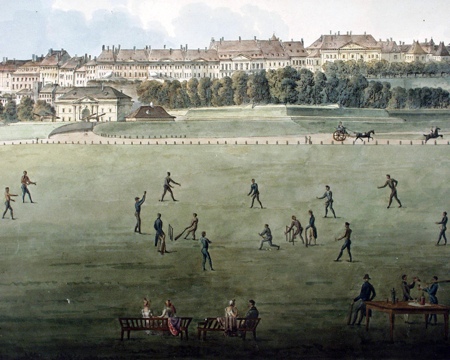
Plaine de Plainpalais with cricket's players, 1817
http://en.wikipedia.org/wiki/File:Plainpalais-1817.jpg


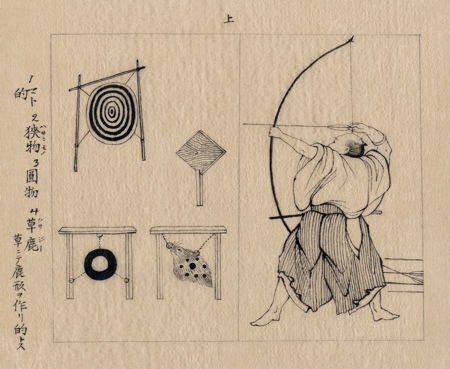
The painting above and the woodcut below are of two “elegant" sports, cricket and archery. It is difficult to see cricket as a sport that coarsens. It is structured around the daily life of the typical Englishman, a match begins after breakfast with a break for lunch and tea and ends at suppertime. It is played over a weekend, or so I was told by the man in Salisbury, England who sold me the bicycle I rode throughout Britain and the Continent. He may have been teasing me a bit, I do not know. Wikipedia, though, says a typical match lasts five hours and a test match can take five days to play, so maybe he was not deceiving me, or at least not much. But it is a sport where everyone wears white and is civil to one another, at least in theory.

Japanese Archer
http://en.wikipedia.org/wiki/File:Japanese_archer_1878b.jpg


Archery is also an elegant sport. Though the bow and arrow is an effective weapon the sport involves shooting at targets and there is no physical contact between competitors and both winners and losers go home in one piece. When Robin Hood competed for a prize he was a sportsman not a soldier and everyone could enjoy his prowess. There is, of course the less civilized use of the bow that created a greater tension between Robin Hood and the civil authorities of his day. There is, I suppose an aspect of all sport where everyone can enjoy and appreciate the skill and focus of the athlete. To play any sport well requires a great deal of intelligence, discipline, focus, and dedication; qualities that serve anyone well in the long term and have an important place in modern education.

A view from inside the mob taken at the 2006 Royal Shrovetide Football Match (Mob Football)
Gary Austin
http://en.wikipedia.org/wiki/File:Japanese_archer_1878b.jpg


The photograph above was taken at a “Mob Football” match from the midst of the festivities. It is said of mob football that there is one rule, you cannot commit manslaughter or murder, but evidently, everything else is fair play. It is also a very democratic sport in that anyone who wishes and who plays by the rule, can compete. It is a game that can accommodate an unlimited number of players. Shakespeare includes in his play Comedy of Errors a football joke, “Am I so round with you, as you with me, That like a foot-ball you do spurn me thus: You spurn me hence, and he will spurn me hither, If I last in this service, you must case me in leather.” Of course for Shakespeare, as for most in the world to this day, football is soccer, though the football being played in the photograph is a medieval antecedent to rugby.

Truro hurling ball
http://en.wikipedia.org/wiki/File:Truroball2.JPG


Mob football is another name for Cornish Hurling, which was adapted from the Celtic game of hurling or shinty. It is interesting, perhaps, that hurling was an antecedent of the modern sport of ice hockey, it was played with a ball on a field of grass with what look like field hockey sticks and Cornish hurling was an antecedent of the modern American sport of football, as well as of rugby; perhaps three of the most aggressive sports being played today and perhaps what Mr. Self had in mind when he wrote of the coarsening influence of sport. A sixteenth century gentleman said of Cornish hurling, “The Cornish-men they are strong, hardy and nimble, so are their exercises violent, two especially, Wrestling and Hurling, sharp and severe activities; and in neither of these doth any Country exceed or equal them. The first is violent, but the second is dangerous.” The photograph above is of the ball that is used in Cornish hurling. It is made of silver and weighs about a pound. It reminds me of the golden snitch that Harry Potter pursues in his games of quidditch, a sport that shares some of hurling’s physicality.

The game was a competition between those who lived in town and those who lived in the country and reflects the tension that has always seemed to exist between those that live in town and those that live in the country. I think the rules of Cornish Hurling amusing and you might also find them so and here, according to Wikipedia, are a few of them:

  • Field of play. The game takes place mainly in streets still open to traffic. The game can also extend onto private property including gardens and fields and sometimes through houses or pubs. The game can stop at any time so that members of the watching crowd can handle the ball. Touching the ball is said to be lucky and can bring good health and fertility. The parish of St. Columb Major is the world's largest pitch for any ball game, with an area of about 20 square miles.
  • Goals and winning. There are two goals but no goal-keepers. The goals are made of granite. The town goal is the base of an old Celtic cross and the country goal is a shallow stone trough. To win the team must carry the ball to its own goal. Another way to win is to carry the ball out of the parish, which can be up to 3 miles. As soon as the ball is goaled or carried out of the parish, the game finishes.
  • Rules. There is no referee, no official written rules and no organizing committee. The two teams have unequal numbers. The Town team has the larger team since the town has grown larger in size. Before the 1940s the Country team was stronger in numbers due to the number of people who were employed in agriculture.
  • Serious injuries are very rare. The game attracts visitors from miles away but most watchers are local to the area.
  • Time of games. There are only two games a year. The first game is held on Shrove Tuesday. The second game is on the Saturday of a following week. The game is always started at 4:30 pm. The game can last anything up to two hours. After the game the ball is always returned to the start point.


Though the influence of sport may be coarsening, it also teaches collaboration and the importance of teamwork to the achieving of a goal and this has a place not only in sport and education, but also in the fruitful and happy living of a life.

Steven Johnson Where Ideas Come From
TED Talk


This film clip illustrates the importance of inspiration, collaboration, and of thought conducted over time. The image of the coffee house as a space where ideas could be exchanged and developed is a fruitful one. It is not just that the consumption of coffee replaced the consumption of alcohol (or at least moderated its consumption) but that the coffee house provided a space for sober conversation. But I think the most moving part of the clip concerned the incubators sent to impoverished corners of the world where infant mortality rates were high. As long as the machines worked the babies survived, but when after a year or two of use they broke down, there was no one who could fix them. This part of presentation suggests the importance of design and that design be adapted to the circumstances of those the design is intended to serve. Where these machines went there were few skilled in the maintenance of high tech machines, but many skilled in the maintenance of automobiles and an incubator made of car parts could accomplish more than its high tech cousin. Most innovation begins with someone thinking differently about something. But the end product usually takes time and often requires some help and input from others; that without collaboration innovation may be much slower in coming if it comes at all.

Perhaps sport illustrates this, and perhaps this is a way in which its influence does not coarsen. Though every team has its star players, the team is at the end of the day a team and if they all do not work together the stars cannot make the team successful. When I was a boy there was a new team in Los Angele, The Los Angeles Clippers (I think they have moved since to San Diego). I remember one sports writer saying that this team had some very talented players on it but that they were all playing for themselves; too many aspired to be team’s “star player” to the extent that they were incapable of playing like a team. Skill by itself is often not enough to make us successful in life, it helps if we also know how to play well with others, to collaborate and allow our ideas to be nurtured and nourished by the ideas of others. It also helps to have a place, like the coffee shop perhaps, where ideas can be shared. Ideas and innovation need both the den and the conference room to achieve their potential.

I like Rabelais description of the Abbey of Theleme. His is a Renaissance idea of the perfect space and it is idealistic (though it may not be agreeable to the ideals of all). But what I like about Rabelais is his enthusiasm for life and thought and his belief that a happy life cannot be a “thoughtless” life, that thought is essential to happiness. If Comenius was correct in his belief that learning should give pleasure than Rabelais must also be, at least in part, correct. I think the problem with sport is that it is often given too much space in our lives; we equate “happiness” and “fulfillment” with fun. Not that there is no place for fun, but that it is necessary to recognize, perhaps, its limitations; though often I think the problem is much more profound. Many have forgotten how to have fun at anything other than play, or perhaps more precisely they have lost the ability to find the play and the fun in the work that they do.


Tuesday, September 28, 2010

The Beginning of Things


High Hopes
Frank Sinatra

The Beginning of Things

Norns
Arthur Rackham
http://en.wikipedia.org/wiki/File:Norns1.jpg

The song talks about having “high hopes” and that with those high hopes a great deal can be accomplished that does not, from appearances, seem to be possible. Much of life revolves around confronting the impossible and often what is labeled impossible has as much to do with lack of confidence as it does with lack of ability. Of course there are probably many things we do not have the skills or abilities to accomplish, but why begin by assuming that a beguiling challenge is beyond us; why do we not first try to prove to ourselves we cannot do a thing rather than assume we cannot?

The Norns in the painting above represent fate or destiny. These are familiar figures in the myth and folklore of many parts of the world. In the German myths the Norns were, as were the Fates in the myths of Greece and Rome, weavers who wove the tapestries of individual lives and when a life was done, they cut the thread and the tapestry that was that individual life was finished. But how was the tapestry created. Did the Norns weave into the tapestry what an individual accomplished or did the tapestry come first, preordaining what that individual would accomplish? It probably does not make much difference which came first, the tapestry or the acts that were woven into it, what is important is that the action is done, that the attempt is made. We will find out soon enough if it is our “destiny” or not and if it is not there are other “destinies” to pursue.

The Seven Virtues – “Hope”
Giotto Di Bondone
http://www.giottodibondone.org/No.-46-The-Seven-Virtues--Hope-1306-large.html

Succeeding at most things involves taking something we hope for or dream of and making it real, bringing it to pass. Often the difference between something hoped for and a goal is planning, figuring out how to get to where we want to go, or at least planning out the first few steps on the journey, perhaps its just figuring out where to start. Hope often has more to do with yearning than with planning, but perhaps often hope is where goal setting begins. It is after all one of the “Seven Virtues.” There was an article in The Boston Globe a few weeks ago, “The bright side of wrong” about the importance of making mistakes, of being willing to get it wrong. The article suggests that a great deal of success is the product of intuition, of insight into a problem or a project that is instantaneous and does not appear to be the product of careful thought. Sometimes decisions have to be made quickly and there is no time to “think things through.” We know many things and our minds can process the many things we know quickly and often what seems the product of intuition is the result of a kind of sorting process our minds can complete with speed and efficiency.

The article gives the following example to demonstrate this:

"To change how we think about wrongness, we must start by understanding how we get things right.

"Try filling in the following blank: “The giraffe had a very long ____.”

"You can answer that question in a flash, and so can my 4-year-old neighbor. Yet a computer — a machine that can calculate pi out to a thousand digits while you sneeze — would be completely stymied by it. Long after you’ve moved on from the giraffe and finished the sports section and gone for a walk, the computer would still be frantically spitting out ideas to fill in that blank. Maybe the giraffe had a very long...tongue? Flight from Kenya? History of drug abuse? Paralyzed by so many potentially right answers, the computer would struggle to generate any answer at all."

This reasoning process, even when it is applied to much more complicated problems than the neck of a giraffe, is a reliable one more often than not for most of us. The more one has learned the more this is probably true. We have to be willing to live with the embarrassment that comes from getting it wrong from time to time if we are to enjoy the success that comes from getting it right at some crucial moment. It also means running the risk of getting it wrong in one of those crucial moments.

The Garden of EdenThomas Cole

The paintings above and below depict The Garden of Eden, the one above of Adam and Eve enjoying the garden and the one below of them being sent out of the garden, after getting it wrong in what was for them a crucial moment. Cole’s vision of paradise may not be your vision of paradise but most of us know what it is to have attained and lost something beautiful, something secure and life sustaining. There is a sense that every major disappointment is a lose of paradise, something we have hung our hopes on has been denied, maybe it is losing an important game, getting a poor grade on a test we thought we were ready for. Maybe it is losing a job or failing to achieve a goal. Unlike Adam and Eve’s loss, though, most of our disappointments lose a bit of their significance with time and reflection. If we are wise we realize we must reassess if we are to be happy, it is important to feel the disappointment as a part of the healing process, but it is also important to grow beyond it.

Fyodor Dostoyevsky was celebrated as Russia’s greatest author upon the publication of his first novel. His second novel was published two weeks later and he was labeled among one of Russia’s worst writers, the praise had turned to scorn. He became insufferably cocky after his first book was published and well received. After his fall from grace fifteen days later he never recovered his confidence, though he did indeed go on to become one of Russia’s greatest novelists. His first book wasn’t as good as everyone said it was and his second book may not have been as bad, but the work of his maturity is recognized by most as truly great and part of what made it great probably lies somewhere in that earlier success and failure.

Expulsion from the Garden of Eden
Thomas Cole
http://en.wikipedia.org/wiki/File:Cole_Thomas_Expulsion_from_the_Garden_of_Eden_1828.jpg

When Adam and Eve lost paradise it was for them truly lost. For us, though, it is often a bit different. It is not unusual for people to set their sights too low, to settle for something less because it appears to be easily achievable. We, often, must lose an inadequate conception of paradise, through disappointment perhaps, to wake up to a truer more worthy view of paradise. Of course it could as easily happen that the fruit of our disappointment is to give up on paradise altogether. Still, I think there is a place for looking at failure as a kind of gift that puts us on a more rewarding path; a path more in keeping with our gifts and temperament.

Caroline Phillips: Hurdy-gurdy for beginners
TED Talks


The video is a TED Talk about the Hurdy-gurdy. As the clip suggests it is an odd instrument. My first exposure to the hurdy-gurdy was in the film Captains Courageous. Manuel, a Portugese fisherman played by Spencer Tracy in the film, plays the hurdy-gurdy to pass the long times of inactivity at sea. When I saw the instrument being played in the film I thought it could only play one tune; that it worked like a music box playing a pre-programmed song. From the video I learned that it is in fact an instrument that can play any tune, though its inner workings are odd and unlike any other instrument I know of. Learning is often like this, it surprises us, it draws us out of preconceptions and introduces us to new ways the world, or those things in it, work. Learning often opens the mind by teaching us something new about those things we believed we already knew, if not all there was to be known, at least all that was worth knowing. This is another way that hope is kept alive and “high hopes” are reawakened. The closer we get to learning all that is worth learning, the less interesting life becomes. It is often the surprises in life that keep it from becoming mundane and when we reach a place where we think we know all that is worth knowing we begin to believe there are no more surprises and this can be disheartening.

The painting below is of Ra setting forth on his nightly cruise of the underworld. This journey takes Ra through night and the land of the dead to the next morning and the world’s recreation. Each day the world is made anew and brings with it new possibilities. There is a sense that the failures of the previous day have been put behind us and we start the new day with not just renewed energy, but perhaps with new abilities or beliefs in existing abilities we did not possess the day before.

Book of Gates Barque of Ra
http://en.wikipedia.org/wiki/File:Book_of_Gates_Barque_of_Ra_cropped.jpg

There was a review recently in The Guardian, “On Evil by Terry Eagleton,” of a book on evil by Terry Eagleton. The book is something of a paradox. Eagleton a Marxist, and one would assume, perhaps incorrectly, an atheist, has written a book on preserving the idea of evil as it is understood from, if not a Christian, at least a religions perspective. But the issue here is not evil, but a reminder that we can never quite know who all of our friends are and that sometimes discovering a friend can come as something of a surprise. Insights of this sort, too, recreate the world for us, because they make it a bit less hostile. Of course these insights can also go in the other direction and expose enemies we once believed were friends.

Still, the knowledge does us good and is probably worth having. It is a good thing to learn stuff, the good stuff and the bad. Learning can renew hope, and it can make us wiser if we use that learning to pursue wisdom. In the drawing below St. Anthony is reading a book. Reading is one of the conventional means by which learning is attained, though it is certainly not the only means. Still, if we are to read well when we open a book, it helps to open our minds first.

St. Anthony
Albrecht Durer
http://www.albrecht-durer.org/St--Anthony-large.html