Monday, April 26, 2010

Only a Memory


Looking into You
Jackson Browne

Only a Memory
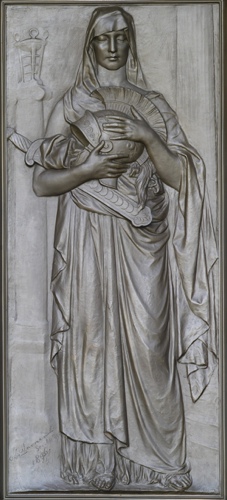
Memory, Bronze door at main entrance of the Library of Congress Thomas Jefferson Building
Olin Warner (completed by Herbert Adams)
http://en.wikipedia.org/wiki/File:Memory-Warner-Highsmith.jpeg


In the song the singer returns to a place he once called home. It has changed as he has changed and the scene the song evokes suggests the true meaning of nostalgia, the pain of coming home. Returning to a place where memories live is often an unpleasant enterprise. The place is never as we remember it and even if the changes in the place are not great the changes in us often are. Our changed selves are out of place in our old worlds. The bronze relief on the main door of the Library of Congress is titled Memory but what is being remembered? The figure in the door could be Penelope remembering Odysseus and wondering when or if he will return. It might be of any woman waiting for a warrior to return (and the objects she holds suggests she is remembering a warrior). Of course this woman could be the wife or mother of a soldier that has died and will not return. Perhaps the door is of a specific event that would be clear if I knew the door’s history but not knowing its history leaves the image open to many interpretations, all of which suggest the more melancholy aspects of memory. Perhaps all memory, by virtue of what it is, is tinged with melancholy.

There is a line from the Wallace Stevens poem “13 Ways of Looking at a Blackbird” (one of the ways of looking at the blackbird) that goes, “I do not know which to prefer, / The beauty of inflections / Or the beauty of innuendoes, / The blackbird whistling / Or just after.” I think what the poet is considering, especially in the last phrase, “The blackbird whistling / Or just after” is whether the event (“the blackbird whistling”) or the memory of the event (“just after”) is the more pleasant. Our memories of an experience, especially a pleasant experience, are often more pleasant and more “memorable” than the experience itself. This raises the question to what degree are we shaped by our experiences and to what degree are we shaped by our memories of those experiences, which are not always the same thing. This is perhaps what is being gotten at in the first phrase in the Stevens poem about “The beauty of inflections” and “the beauty of innuendoes.” Which is more beautiful the sounds that we hear or what those sounds suggest, hint at, or evoke? Are we shaped by inflections of memory or by their innuendoes?

The Last of England
Ford Maddox Brown
http://en.wikipedia.org/wiki/File:Brown_last_of_england.jpg


At the back of the song is also the suggestion of leaving home, he is visiting a house he lived in when he “first went out on (his) own.” The singer is not going to a new world in the same way the people depicted in Ford Maddox Brown’s painting above or Alfred Stieglitz’s photograph below are going to a new world, but in a sense when a young man or woman leaves home to make a home for him or herself in the world it is a new world that is opening up. It may not come with as much that is foreign and different as it was for the folks in the painting or the photograph but it still involves entering something of an unknown universe. When we leave home we know the landscape, the people around us look and dress largely as we do, they also speak our language. This helps, but the world is new nonetheless. It takes courage to go out on our own. Ours is a nation of immigrants, which means that for most us there is someone in our ancestry that made the trip the folks in the painting and the photograph are making.
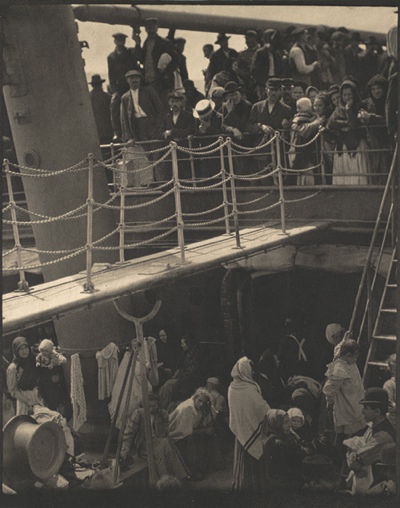
The Steerage
Alfred Stieglitz
http://en.wikipedia.org/wiki/File:The_Steerage_1907_Stieglitz.jpg


I think that of the two, the journey in the painting and the photograph, the one depicted in the photograph had to be the most difficult. The folks in steerage are very different from the folks looking at them from above. The world the folks in steerage are entering is a very different world from the one they left. Of course I am assuming that the folks in the painting are going to America, as the folks in Steerage appear to be doing. Of course this is a guess on both parts. It could be the folks in the painting are going to India or Egypt, both parts of the English Commonwealth at the time. It may be the folks in steerage are going to another country that is more like the one they left and that it is those watching from above that will be the ones to feel most out of place. Our lives, perhaps, are shaped as much by our preconceptions as they are by our memories and there are no guarantees that either is entirely reliable.

There was an article in the Guardian, “The private life of books,” about what is at times found in second hand books. I know I often buy books that people have written in because I want to know the thoughts of others, if others have understood the book as I understood it or were affected by it as I was affected. The world of the used book is a very different world from that of the new book. I have books that I bought in various places that are quite old. Some were printed before the technology that “burst” or separated the pages was invented. When these books were bought in order to read them the reader had to first cut the pages. There is a scene in The Great Gatsby where the narrator, Nick, is commenting on Gatsby’s library and the magnificence of the volumes that fill the shelves. Nick pulls down a book and soon discovers that none of the pages in any of the books he looks into have been cut. This tells us the books in Gatsby’s library served more of a decorative than literary purpose. When I open a book that is a few hundred years old in which none of the pages have been cut, I am having the experience of reading that book for the first time, not just the first time I am reading that book but the first time anyone has read that book. I have not had this experience often, but each time I have had it, it has filled me with a kind of awe. I am the first person, other than the printer who set the page perhaps, to read this book though it has had a home on someone’s bookshelf for many, many years.
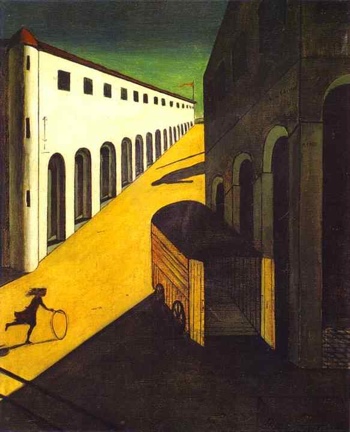
Mystery and Melancholy of a Street
Giorgio de Chirico.
http://www.abcgallery.com/C/chirico/chirico9.html


There was a review recently in the Washington Post, “Michael Dirda reviews 'Agatha Christie's Secret Notebooks' by John Curran,” of a book on Agatha Christie’s notebooks, the notebooks she kept as she was writing her mystery stories. I have always been a great fan of detective fiction in general and of Christie’s stories in particular. I remember riding my bicycle through Scotland. I was by the banks of Loch Ness when a rainstorm started. I found a bed and breakfast where I could stay until the rain passed. One of the other guests there recommended the Christie novel The Murder of Roger Ackroyd. There was a copy of the novel in one of the sitting rooms. I picked it up and it was the first full length novel I ever read in a single sitting. It kept me up all night long and I never got sleepy. This was not the first Agatha Christie novel I read, but it is among the most memorable. Of course there was more to the experience than the book, there was also the place, I was in Great Britain, in a place that was shrouded by its own aura mystery. The window in my room looked out over Loch Ness and I remember looking out each evening to see if there were any strange creatures swimming about. But of course there were not, and my memory refuses to “enliven” this recollection.

Spellbound
Alfred Hitchcock
Selznick International Pictures


The film is about a man trying to figure out who he is and the woman that is trying to help him. Something has happened to the man that has induced amnesia. All we know is that the event that brought on his forgetfulness seemed to involve something white and some lines. We only know this because of how he reacts to straight lines and the color white. The actor playing the old psychiatrist in the film is Michael Chekhov, Anton Chekhov’s nephew. He (Michael Chekhov) was a student of Constantin Stanislavski and went on to develop his own approach to the craft of acting. He is known for developing the concept of the "Psychological Gesture," a behavior or action that reveals an inner psychological reality in the character being portrayed. I think knowing this makes his portrayal of the psychiatrist in the movie that much more delightful. I think that Gregory Peck in his portrayal of the amnesiac makes use of this theatrical device at various times in the film, including those moments with razor in the clip above. It is also what we do not know about this character’s past (and what we think we know) that creates the tension that permeates this scene.

This suggests the limitations of knowledge or at least the limits of what we think we know. Knowledge can be deceptive. We think we know a thing; we have studied it and found out a lot about that thing. But if there is any complexity to what we know the odds are our knowledge is limited and the conclusions drawn from it are not always reliable. This can create problems because we often have to act on what we know and we often cannot be sure we know enough to act. Chekhov’s character in the film believes he must act on what he knows, but as the film will show he does not know enough to justify the conclusion that he draws. He wants to go to the police because he believes Peck’s character is dangerous. But this view may be questionable. You will have to watch the film to find out if Chekhov calls the police or listens to Ingrid Bergman and suspends judgment.

Memories make our lives richer. They enable us to derive pleasure from an experience over and over again. When I read a book that evokes or alludes to another book that I have read that evocation or allusion brings back the original experience of reading that book (or part of the experience). Of course there is the other side of memory, a side like that experienced by the character in the film, where memories, or the ghosts of memories, haunt us and keep us from enjoying the present or of building a future. And memories often will not be controlled. They will visit us in their own time and often stay longer than they are welcome. Little things often bring them out of hiding. For me the smell of diesel fuel takes me back to London in the 1970’s and graham crackers bring me back to a room above a plumbing store on Pacific Coast Highway in Redondo Beach, California. These are pleasant memories and I welcome them when they come. But there are always others that are less welcome that have their own triggers that I will not mention here for fear of provoking them.


Sunday, April 18, 2010

Words in Their Finery


God Bless the Child
Blood, Sweat, and Tears


Words in Their Finery

Page from an illuminated manuscript of the Rubaiyat of Omar Khayyam, watercolor, bodycolor and gold leaf. Calligraphy and ornamentation by William Morris, illustrations by Edward Burne-Jones
William Morris and Edward Burne-Jones
http://en.wikipedia.org/wiki/File:Rubaiyat_Morris_Burne-Jones_Manuscript.jpg


The image is from an edition of the Rubaiyat of Omar Khayyam designed by William Morris and Edward Burne-Jones. We can see in this image that the beauty of words and of language lies not solely in what the words mean but in their appearance as well. Or at least that words can have a beauty that is independent of the meanings assigned to them by Dr. Johnson or Noah Webster. Morris realized that even if Chaucer had been an inferior poet the Elsmere Manuscript would still be a thing of beauty and worth preserving. The creating of typefaces is an art in itself and the quality of a typeface contributes to the pleasure derived from reading books. The song says, “momma may have, poppa may have, but God bless the child that’s got his own.” In a work of literature the author and the words used by the author may be the momma and the poppa of the story but the typeface has its own something to offer. The texture and quality of the paper and the design of the letters on the page contribute something important to the experience of reading a book.

When students write a paper they often want to use unusual, decorative fonts. This has to be discouraged, of course, because those students that go onto college will have professors who are not likely to appreciate papers that stray too far from the conventional in their use of fonts or typefaces. It is unfortunate that one of the stories we have to tell our children is to be careful of the clothes in which they dress the stories that they tell. Though the decorative fonts used by students in term papers are often garish and inappropriate to the stories that they tell, these fonts are none the less a part of the student’s expression and reveal a bit of her or his imagination at work. If the design of a thing is as important, some say it is more important, than the task the thing has been given to perform than fonts chosen by students reveal something of their imaginative life and they are certainly an important part of the design of the paper in the student’s mind.

"Trolls with an abducted princess, from the annual, and still published, fairy tale collection Bland Tomtar och Troll
John Bauer
http://en.wikipedia.org/wiki/File:John_Bauer_1915.jpg


There was a recent article in the Boston Globe, “How fairy tales pit adults against kids,” about fairy tales and the stories that they tell. The point of the article is that these stories are often seen by adults as dangerous and that in the stories themselves adults are often portrayed as the enemy or at best more of a hindrance than a help. Because the first audiences for these stories were adults one wonders how the adults that enjoyed them viewed children and childhood. There is a short story by H. G. Wells, “The Magic Shop,” that follows in the vein of some of these stories in that by the end of the story a child’s parents live in terror of their child. Wells’ story actually reverses the roles of adults and children in the traditional stories. In stories like “Sleeping Beauty” and “Hansel and Gretel” it is the children that live in fear of the adults. Wells’ story, though, ends less happily for the adults than the traditional stories do for the children in that in the traditional stories the children overcome the malevolent adult forces, in Wells’ story the malevolent child is still in control when the story ends.

Language is a magical tool. The same words can be employed by different people to convey very different messages. In fact, the same words in a single text can even be interpreted by different people to convey very different messages as well. I introduce my students to literary theory by showing them how The Tale of Peter Rabbit can be interpreted as a story about the importance of listening to your parents when read one way but also about the importance of disobeying your parents when read another way. This suggests perhaps that we take from the stories we read the messages we need to find in them in order to live more effectively. Does the author put meaning into a story or do readers place in them the meanings they need to find. This is perhaps the crux of the postmodern problem, does meaning exist, does meaning matter? And if meanings do exist and meanings do matter, who gets to decide what those meanings are and where and how those meanings are found?

Alice surrounded by the characters of Wonderland
Peter Newell
http://en.wikipedia.org/wiki/File:Alice_in_Wonderland.jpg


Perhaps no book has as much fun with the “meaning” of things than Lewis Carrol’s Alice books. Humpty Dumpty tells us words mean whatever we want them to mean. There is truth to this of course, because this is how new meanings to old words evolve and new words are invented. It is also how poets employ words. Anyone who has read a poem by Wallace Stevens or Bob Dylan has encountered this amorphous use of language. I often imagine that “Pale Ramon” struggles as much with meaning as he does with order in Wallace Stevens’ poem.

There were two article recently, one in the Washington Post, “Michael Dirda reviews the biography "The Mystery of Lewis Carroll," by Jenny Woolf,” and one in the Guardian, “How the devastation caused by war came to inspire an artist's dark images of Alice,” about the Alice stories and their creator. The Guardian article focuses on the illustrations that Mervyn Peake did for these books. He, a bit like Humpty Dumpty perhaps, in that he brought his experiences as a war correspondent during World War II to his interpretation of Carroll’s text through the illustrations he created. He makes the text mean what he wants it to mean, which in many ways is not unlike Carroll’s meaning. Carroll depicted a world at times in chaos due to the ways in which adults employed power, Peake was placed in a world where this chaos was brought to life.

Dirda’s review discusses a book about Carroll that focuses on Carroll’s conventional and unconventional qualities, part Mad Hatter and, perhaps, part Alice, who seems to me to be the most conventional character in the story; a conventional young lady to whom very unconventional things happen. The story often revolves around a deep desire to find meaning and order in a world in which none appears to exist. Though of course Carroll, a mathematician, has created a world with a chaotic zaniness on its surface that conforms, under the surface, to a fairly precise mathematical structure. Perhaps life, when looked at from within the experience of the person living it, appears random and bewildering, when it is in fact orderly and systematic when looked at from the outside, as from within our experience our planet and solar system is the center of the universe, but when looked at from a different vantage point our planet and solar system are found nearer to the edge of the universe. Our point of view and our understanding of reality are shaped more by our vantage point than by the context of that vantage point in the larger universe. If we do not know where we stand we will not be able to properly interpret what we see.

Alice in Wonderland
Walt Disney Pictures

This is the version of Alice in Wonderland that I grew up with, though how I viewed it as a child was very different from how I viewed it as a young adult. As a child in the 1950’s I saw it as a magical story with odd characters and vivid colors, but as a young adult in the 1960’s it took on shades of psychedelia. Vivid colors and the caterpillar’s hookah took on different connotations. The world of the 1960’s offered a very different vantage point from that of the 1950’s, though the different lenses through which I viewed the film may have had as much to do with my age than with the age in which I lived. I wonder how the counter-culture of the 1950’s viewed the film.

W. H. Auden once said, “There are good books which are only for adults because their comprehension presupposes adult experience, but there are no good books only for children.” I believe this is true, but I also believe that adults read children’s books with adult experiences that often shape the way these stories are perceived and they are changed by the adult mind into something different from what they where for the child that first read them. “The Little Engine That Could” and “Stone Soup” have different meanings for me now than they did when I was a child. I enjoyed how the soldiers tricked the townspeople in “Stone Soup” but I did not fully comprehend the point it made about generosity. In fact my views of generosity may have been shaped in part by this story without my being fully aware of how my views were being formed.

There is a Woody Guthrie song, “Pretty Boy Floyd” that talks about the outlaw leaving money under the supper dish after he has been given a free meal. I think stories often work this way, there is a gift left under the surface of our consciousness that we are often unaware of until long after we have enjoyed the story’s telling and the magic of the narrative has faded a bit. Sometimes we come back to the stories we read as children and find the messages that have shaped us and we are not always pleased with the way in which our views have been manipulated. This is the rhetorical nature of story telling. We are taken to a world that operates according to certain rules and we learn these rules as we journey through this world, but we bring them back with us to the world of our day to day lives.

Illustration of Alice with the White Rabbit
Arthur Rackham
http://en.wikipedia.org/wiki/File:Rackham_Alice.jpg


The White Rabbit tries to live in Wonderland according to the rules of Victorian English society and he is somewhat out of place there. The rules of Victorian England did not apply in Wonderland, or perhaps they did but without their veneer of respectability. What happens to Victorian society, or any “respectable” society, if the rules encountered in Wonderland are brought home to the world on the other side of the looking glass? Which looks quirkier the rules seen in their true light or the individual just back from Wonderland confronting those rules? Sometimes stories do this, they open our eyes to the way things truly are, but in opening our eyes put us at odds with our neighbors whose eyes remain closed and who do not wish to have them opened.


Monday, March 29, 2010

The Genius Next Door


Teach Your Children Well
Crosby, Stills, Nash, and Young

The Genius Next Door

Genius of America
Adolphe Yvon
http://en.wikipedia.org/wiki/File:Adolphe_Yvon_-_Genius_of_America.jpg


There was a review in the New York Times, “How to Be Brilliant,” of a book on genius and how to become one, The Genius in All of Us. The premise of the book is that everyone has the potential to be a genius of one kind or another, mathematical, musical, and so on, it just requires a bit of hard work and tenacity. According to the book becoming the best at anything is a matter of dedication, self-confidence, and a willingness to fail often in pursuit of a single thing. The research suggests that anyone who achieved greatness at anything did so by working relentlessly at developing the necessary skills. This probably comes as no huge surprise but the question that seems to go unanswered is how many worked relentlessly and did not achieve. We know who Mozart and Einstein are because they achieved the thing that they pursued, but are there others who were as relentless in their pursuit that we never heard of because they never arrived at their goal.

Of course it is probably a good thing to pursue our interests wholeheartedly and to work as best we can at developing our abilities and interests, but is that in itself enough. Is there something extra that some have that others do not that is as important to success as hard work. I suppose if our aspirations are in proportion to our abilities than the hard work by itself should be enough, but is this how dreams and aspirations operate? In an American Idol culture many are infected with a dream but the American Idol culture suggests that at best one or two will actually succeed. The American culture is built on competition and where it is true that competition can bring out a person’s best, it is also true that competition usually allows for only one winner. There was a sign at the Olympic games held in Atlanta, for example, that said, “Second is the first loser.”

The song, Teach Your Children suggests that much comes down to being true to ourselves and teaching our children to be true to themselves. Having a code to live by is important, so is knowing ourselves and our abilities. It is also important to remember that not all genius is appreciated in its lifetime. Jonathan Swift said that “When a true genius appears in the world, you may know him by this sign, that the dunces are all in confederacy against him.” Swift is suggesting not only that most are not geniuses but also that most are resentful of the true genius when she or he appears. According to Peter Schaeffer’s play Amadeus Mozart was poisoned by another composer who was envious of Mozart’s ability. Though the history of this is a bit dubious, it does underscore that for the genius even if fame is not elusive there will always be rivals to contend with.

Copenhagen
PBS

The play Copenhagen is about a meeting between two physicists that were geniuses of their day, Niels Bohr and Werner Heisenberg. The meeting took place early in World War II and is of interest because Heisenberg was a German physicist working for the Nazis and Bohr was a Danish physicist of Jewish decent (his mother was Jewish). The two men were friends before the war but their relationship was to say the least a bit strained by the war and the ideology of the German government that fought it. I think this raises another important point about genius and that is it does not protect one from embracing idiotic ideas. Heisenberg may not have believed the Nazi ideology but he still worked for it. Germany at the time of the Nazis was one of the most intelligent countries in the world if intelligence is measured by the number of highly educated men and women, men and women of genius perhaps. Wisdom and genius are often not the same thing and perhaps if the former were revered more than the latter the world would be a better more benevolent place.

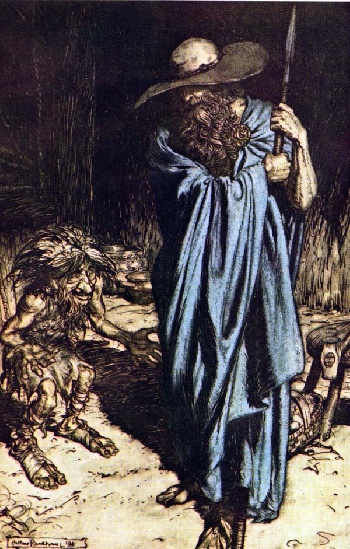
Wotan visits Mime and offers him his help
Arthur Rackham
http://en.wikipedia.org/wiki/File:Ring40.jpg

Another name for a genius is a “wiz,” an abbreviated form of wizard, someone for whom everything seems to come easily, someone who can work magic with ideas, a musical instrument, or a ball of one kind or another. I like the wizards in stories. The good ones not only can do marvelous things, but they are often wise to boot. According to the Oxford English Dictionary the word wizard etymologically means “wise one” (actually the word is formed from “wise” + “ard”) and it was once a word for a philosopher or sage, though even in its archaic sense it had a derogatory connotation, as it often does to this day. Still, it suggests that the true genius is not only intelligent, but also wise. If we keep Arthur C. Clarke’s third law in mind, “Any sufficiently advanced technology is indistinguishable from magic,” than the scientists that create the cutting edge technologies we use or are waiting for are themselves wizards in the mold of Merlin or Gandalf.

For most the science that runs our technology and many of our tools is like magic, we understand that they work and know how to make the machines do what we want them to do, but few of us understand how they work, how they do what they do. Science is for many a kind of magic that we believe in because the scientists that work the magic tell us there is nothing mysterious in it, that it all works according to certain rules. But then, those in the wizarding schools of J. K. Rowling or Ursula Le Guin are learning the rules by which the magic of those books work. There is, they would have us believe, a kind of “science” to the art of witchcraft and wizardry.

Map of "Mercury" as described in The Worm Ouroboros by E.R. Eddison
David Bedell
http://en.wikipedia.org/wiki/File:Ouroboros_map.jpg


The painting that started this off and the map above suggest the true meaning of genius and that is the spirit of a place or a person, or even a thing, one might say the spirit of a noun. The painting captures the spirit of America, some of what makes it a unique place and the painting is full of truly American images, like frontiersmen and frontiers that in the painting are a bit mysterious. But in this sense we are all geniuses in that we all have a spirit that in some way defines us. That spirit might also be summed up as our character, the spirit by which others know us. It is this kind of genius we all need to cultivate and to infuse with maturity and a bit of wisdom. Is our genius one of fidelity and courage, or of duplicity or timidity?

In most of the stories in which the great wizards appear, there is this concern for being true to something worthwhile and noble. Merlin wanted to make Britain a more just society, Gandalf wants to preserve what is best in Middle Earth, and Dumbledore wants to see magic used to promote wise and virtuous ends. The story of Ged, or Sparrowhawk, the wizard of The Wizard of Earthsea, is about finding redemption and the wisdom to use his skill with magic to better his world and himself.

Book cover art for the book A Wizard of Earthsea
Ruth Robbins
http://en.wikipedia.org/wiki/File:AWizardOfEarthsea(1stEd).jpg

Perhaps this is the true magic we all need to work, to transform ourselves from selfish people motivated by self-interest into more generous people who work at improving the worlds in which we live and wander. There is nothing wrong with aspiring to greatness of one kind or another. Many, though by no means all, that have been given the label of genius have not been good people. Their genius in that other sense was largely underdeveloped, or at least the more virtuous aspects of it were. Personally, I think that most of us are at some level a bit insecure and that some mask that insecurity with physical strength or some other kind of personal superiority. But even if this is not true, we are somehow diminished as people if we are incapable of living for anyone other than ourselves and in this regard it would benefit us all to develop the better angels of our genius.


Sunday, March 14, 2010

One Day, Maybe


Longer Boats
Cat Stevens


One Day, Maybe

Pebble in the Sky Cover
Isaac Asimov
http://en.wikipedia.org/wiki/File:Pebble_sky_cover.jpg


I grew up in the 1950’s and 60’s, my father was an aerospace engineer and I grew up with the space program. I also grew up with science fiction and the belief that very shortly, probably in my lifetime, we would be visiting other planets with an eye turned to other galaxies. Many thought that before long we would be seeing photographs resembling this cover illustration from one of Isaac Asimov’s science fiction novels. But somewhere between then and now other things began to occupy the culture’s interests. The song Longer Boats enjoyed a bit of popularity in the early 70’s and it is, as the singer tells us, about space ships. But the space ships never arrived, except in the movies.

In the movies the space ships brought two kinds of folks. There were those like ET who looked frightening to us (as we looked frightening to him) and the alien with his robot from The Day the Earth Stood Still who were either just curious and met us no harm or were actively committed to our welfare and saving us from ourselves. On the other hand there were those, like the folks in the Twilight Zone episode “How to Serve Man” or The Invaders from Mars that were committed to our destruction. There were also creatures like The Blob who were just hungry and had no real thoughts for us at all.

Martian Sunset Spirit Rover
NASA Astronomy Picture of the Day (APOD)
http://antwrp.gsfc.nasa.gov/apod/lib/aptree.html

This photograph probably comes as close as any to resembling the cover art found on the science fiction novels of my youth. It is of the sunset on Mars and was taken by one of the Martian “rovers” that have spent quite a long time exploring the surface of this planet. It takes my breath away every time I see it. This is not a painting but the actual surface of another planet as it looked on a certain day. There are no people there to share in this experience only the machines we have sent in our place, but this is the real dirt and dust and mist of Mars. There are some for whom the spirit of exploration has not died who would like to see this story taken a step further and to see people walk this land. But I am not sure that there are any longer enough who are committed to making this happen. Our budgets are smaller and our interests closer to home.

There were a couple of articles recently, one in the Los Angeles Times on the science fiction novelist Kim Stanley Robinson (“Kim Stanley Robinson maps the future's gray areas”) and one in the Washington Post on “New science fiction and fantasy novels” that remind us that science fiction as a genre has not gone away even if the desire to make it fact has somewhat abated. These writers often focus on this planet and how life on it might be different in the future or, in the case of Robinson in the past in ways that affect the future. Science fiction writers have always enjoyed imagining a future earth that has been transformed by human misbehavior. There is one story I particularly enjoy about a man working on his doctoral dissertation who is coaxed through an opening in the wall of his apartment to a parallel universe. What fascinates me about this story is that nearly every character in it is the man writing his dissertation at different points in time. But it was Ray Bradbury’s journey to Mars that awakened my imagination to the possibility of one day doing on Mars what the Martian Rover is doing now.

Galaxy Photograph (Crossfield/Beletsky)
NASA Astronomy Picture of the Day (APOD)
http://antwrp.gsfc.nasa.gov/apod/lib/aptree.html

The image above is a photograph taken of a distant galaxy. I think it was taken from the Hubble telescope orbiting in space, but I am not sure. But it, and others like it, resembles paintings made by Jackson Pollack, or at least these photographs suggest Pollack’s paintings to me. I do not know if Pollack had an interest in science fiction or astronomy but this resemblance interests me. Is the universe, like a Pollack painting, somewhat chaotic in its organization or do the kaleidoscopic displays of colors and patterns in both the painting and the universe suggest creative imaginations that think alike. The resemblance certainly suggests that art does not need to be representational to be beautiful.

Perhaps the imagination that sees beauty in random placements of color on canvas is not unlike the imagination that sees stories in the stars. We look at the stars and see bits of color on a dark night sky but our ancient ancestors saw bears and hunters and creatures of various kinds going about their business. Perhaps what we call mythology was a kind of ancient science fiction. That those that told these stories got the same thrill from them that I got from Isaac Asimov, Ray Bradbury, and Robert Heinlein. I am told, and what I have read of the mythology suggest this is true, that the classical mythmakers believed the stories they told, that they were not merely the products of vivid imaginations but a kind of history. Plato believed (or suggested he believed) that those that told the stories of Homer and the other classical writers of myth were possessed, were not in their right minds, but a bit mad. Many think the same thing about Pollack and painters like him. Perhaps his is a mythic madness as well.

Lavender Mist
Jackson Pollack
http://en.wikipedia.org/wiki/File:Lavender_Mist.jpg


The stories change us though or at least they changed me. The myths from antiquity suggest we live in a universe populated by many strange and wonderful beings. The science fiction I read as a child and as a young adult and still read to this very day, suggest the same thing about the universe, that it is inhabited by strange and wonderful beings and if some of the beings that inhabit these stories are not kind or benevolent, well, the same was true of many of the beings that inhabited the popular myths of the ancient world.

But what makes a storyteller. As I have grown up I have seen film become the avenue of modern storytelling. I have seen its special effects grow from the sparks that propelled Flash Gordon’s space ship to the warp speeds of starships and the grace and elegance with which these starships moved. But it also seems that as the ability to make magic with special effects increased these effects started to replace the stories. Aristotle acknowledged the place of spectacle in story telling but he believed that spectacle oughtn’t to become the story but should always serve the story.

James Cameron TED Talk


James Cameron talks here about his love of science fiction and of how that love helped to shape him into a storyteller. Like many skillful storytellers he has been accused of borrowing his stories from others. There is probably some truth to this; there are only so many stories to tell, after all. But he creates worlds where wonderful and at times terrifying things happen. Do his stories exploit their special effects, does the spectacle over shadow the stories his films tell? Some think so. But even if they have their limitations they are powerful. Personally I have been more troubled by the limitations of some of his actors than by the inadequacy of his stories.

Three Suns (JPL)
NASA Astronomy Picture of the Day (APOD)
http://antwrp.gsfc.nasa.gov/apod/lib/aptree.html


It probably does not matter that much of what happens in a good science fiction story uses flawed science, they are exercises in what might be and perhaps in the worlds they travel different rules apply. How would we be different if we orbited three different suns that appeared at different places against the sky? The three sunned landscape of this illustration has a kind of beauty and I wonder what kind of life could develop on such a planet. But how does imagining such things make life better on a planet with one sun?

There is something in the human character that is curious and wants to know even if there is no practical value to knowing a thing or in speculating about an outcome. Stories often help us to entertain this curious bent of the imagination. And it has often happened that in entertaining the mind with such nonsense great things have been accomplished. The space program may not have solved the world’s problems but it did give us Tang, microwave cooking, and the laptop computer. Jonathan Swift ridiculed the speculative scientists of his day by accusing them of attempting to pull sunlight out of cucumbers. Science may not have succeeded in pulling sunlight out of cucumbers, but they have given us ethanol, something not very different.

Is the object of science to make our lives better, to make us more comfortable, or to understand how to use our resources more effectively and to understand the forces of nature that have created those resources. If the former, science only has value if it can solve our problems. It must produce practical results or it is not worth the investment. If the latter the results are somewhat superfluous because the study of science is not about what it can do for us, but the knowledge it gives and the insights it provides into the universe we occupy. It has usually happened that this knowledge has brought with it practical applications that have solved many problems, but this is just a by-product and not a purpose. So, is the joke on Swift or on us? Perhaps it depends on whether we view science as an end or as a means to an end, as spectacle without much in the way of a story to tell or the intelligence, or an aspect of that intelligence, behind the scenes that drives the story.


Monday, March 8, 2010

Is It Real


Tupelo Honey
Van Morrison

Is It Real

Education (Center)
Louis Comfort Tiffany
http://commons.wikimedia.org/wiki/File:Tiffany_Education_(center).JPG

There was an article in the Guardian a few weeks ago about hoaxes, “The greatest literary hoax ever?”. The article talks about how the writer William Boyd got together with a number of influential friends to invent and promote an artist who never existed. Before they were done, they were exhibiting this artist’s paintings and getting well known, and not so well known people, to talk about how they knew and admired this artist. Before he could bring the hoax to its planned conclusion a co-conspirator let the secret slip out. It makes for an interesting story and illustrates the gullibility of people. The song is about placing values on things, and recognizing the best and being willing to make certain investments (all the tea in China, for example) to demonstrate this value.

The picture is of one of three stained-glass panels done by Louis Comfort Tiffany celebrating education. If we are well educated we are perhaps less likely to be caught in a fabrication and more able to access the accurate and true values of things. But maybe not. Boyd’s crowd of art admirers included well educated people who ought to have known better. Perhaps this was what the hoax was playing off of. If these people expected to be taken seriously as knowledgeable appreciators of art they must not let it be supposed there are influential artists of whom they were unaware. Perhaps the first thing the truly knowledgeable learn is that they do not know everything and that there is nothing wrong with not knowing everything.

Of course the story that Boyd invented was a good story and perhaps what truly lay at the heart of the deception was a human desire to be a part of a truly good story, even if that means inventing a personal history that is different from one’s true history. Or maybe the story was so good it suggested artists from these people’s past whose names they had forgotten but whose work they held onto. Maybe the works they shared were done by a corps of unknown artists that met early and tragic ends. Maybe the invented story was the story of many unknown and unappreciated artists that gave into despair. In the stained glass panel celebrating education at the top of the page the two disciplines represented are “science” and “religion,” two disciplines that often interpret the truths they encounter by different lights and maybe both offer a truth that resonates even if at times they conflict. Each often accuses the other of perpetrating hoaxes and each answers these accusations rationally according to their separate understandings. As one dubious judge once remarked “What is truth?” Perhaps all truth begins with faith in something and it is on that something that all that follows rests.

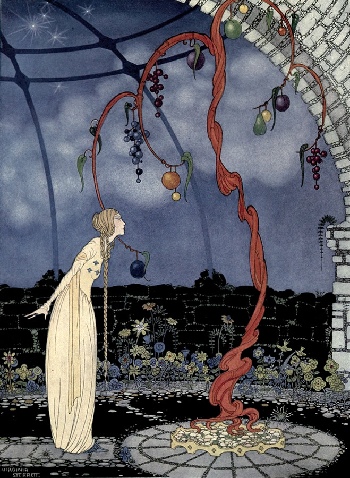
Illustrations from Old French Fairy Tales
Virginia Sterrett
http://www.subtlebody-images.com/virginia.sterrett/vs.fairy.tales.html


As an English teacher I think stories teach basic truths about the world humans inhabit. These stories are fiction and it would seem by definition are not true. It is something of a paradox, perhaps, that something that is fabricated, like a story, can illuminate so much and give such insight. The illustration above was done to illustrate a fairy tale. Fairy tales introduced most of us to the world as it is, a world of “evil stepmothers” that cannot be trusted and “fairy godmothers” that can. Yet there is in this something of a life lesson, many that should be trusted cannot be, and many that should be doubted can be trusted. Much of life revolves around sorting out these kinds of problems.

There was an article last week, “Mind your language,” also in the Guardian about language and how we use it. The specific word in question was the word “skeptic” and what that word literally means. According to the article a true skeptic is a seeker after truth and questions everything in order to discover what is true. Yet the word is being applied to those that question nothing their own ideology teaches and doubt everything that challenges that ideology, often without doing very much to sort out which is in fact true. In other words the very opposite of a skeptic in that they accept one body of knowledge without question and challenge any contradictory body of knowledge without examination.

Corner House
IstvĂ¡n Orosz
http://en.wikipedia.org/wiki/File:Cornerhousey.jpg


The illustrations above and below are interesting in this regard in the way they play with perspective. The one above is of a corner of a house. But is it an outer corner or an inner corner, does it open on a courtyard or a sidewalk. As I look at it the perspective changes, one minute it is turning a corner and the next it is at the back of a corner, one minute one window is invisible to the other, the next it is facing the other. Which is true? Of course, in this picture anyway, they are both true, it all depends on how we look. Is this a work of art or geometric gamesmanship? It is hard to say, but it is kind of fun to look at.

The picture below is of two roads, or bridges really, that cross a body of water but at some point beyond where the two cross each disappears into its reflection in the water. The pictures are Escher-esque in the way they play with perspective, but they offer a kind of pleasure in the way they play with how the eye focuses and sees. Stories often teach us that life is about maintaining our perspective on things, about seeing things correctly, even though life often presents itself in a confusing and incomprehensible manner. Is the nice lady in the gingerbread house inviting us for dinner or “having” us for dinner? The answer to this question, whether it is literal or metaphoric, often determines whether the day’s events have a happy or unhappy conclusion and as with the pictures, appearances can be deceiving.

Crossroads
IstvĂ¡n Orosz
http://en.wikipedia.org/wiki/File:Keresztut.jpg


A good story often challenges our way of viewing the world and in so doing reminds us we have to be careful in our judgments and not lean to heavily on our own understanding. It is not always easy to tell where the line falls between being gullible and being open minded, between being generous in our treatment of others and being foolish. Stories do not always help us resolve these problems but good stories make us aware of these problems and the need to resolve them while being true to our character and values. The most dangerous people in the world are those that understand us and what we believe and know how to exploit those beliefs and in the process exploit us. Stories cannot solve these problems perhaps, each situation must be addressed by its own merits, but they can make us wary and wise in our approach to circumstances and events.


The Dot and the Line
Metro Goldwyn Mayer


I like this little story because it addresses the romantic and the realist in all of us. Both the dot and the line are vulnerable to their romantic inclinations and these inclinations lead them to make unwise choices. Fortunately for them, and unfortunately for the squiggle perhaps, the story has a happy ending and both the dot and the line are able to experience romance realistically, though I am not sure that means of their deliverance is itself realistic. But we understand when the story ends that dot and the line are “right” for each other.

Is this story true to life, do things often resolve themselves so neatly? Probably not. The value of the story lies in its pointing out the blindness that romance can bring and hopefully put us on our guard against it. But than other stories, Great Expectations, perhaps, suggest that even when we realize that our emotions and romantic attractions are leading us astray we are powerless when it comes to resisting them. We often find out the hard way, through pain and disappointment, that our affections are not always reciprocated and that those we have never harmed will seek to harm us.


Screenshot from the film Metropolis (1927)
Karl Freund, GĂ¼nther Rittau, Walter Ruttmann (cinematograpers)
http://en.wikipedia.org/wiki/File:Metropolis-new-tower-of-babel.png


Anyone who knows Breughel’s painting of The Tower of Babel will recognize it in this landscape from the film Metropolis. This knowledge should shape the way we view this cinematic landscape and the story this film is going to tell before the film begins to tell it. The story of Babel ends in tragedy and it is about human arrogance and presumption. The film addresses another kind of human presumption and arrogance, one that has more to do with exploitation of others than of usurping the powers of God, though there is a bit of this as well. But allusion is one way stories tell stories without actually telling the story, they prepare us for what is coming and help create a frame of mind in the reader (or in this case the viewer) that attunes itself to what appears to be coming. We see this picture and knowing its origins we know that what follows will be tragic, or with a different set of cultural signals, comic. The film The Music Box with Laurel and Hardy is, at least in part, a comic retelling of the Myth of Sisyphus. We catch on to how the film plays with the myth early on but because it is a Laurel and Hardy film, we expect a comic and not tragic retelling of the tale.

Poster for the 1911 Ballet Russe season showing Nijinsky in costume for "Le Spectre de la Rose", Paris.
Jean Cocteau
http://en.wikipedia.org/wiki/File:Nijinsky_-_Poster.jpg


Nijinsky was an influential Russian dancer and the ballet Russe an influential dance company. The ballet is The Spirit of the Rose. I know nothing about the ballet, but the name is suggestive. “A rose by any other name” and The Name of the Rose are just a few of the literary associations of the rose. It represents beauty and a kind of excellence. Another odd bit of serendipity in this poster is the artist that painted it, Jean Cocteau. He would go on to become a 20th century pioneer of the French cinema. He told powerful film stories. One of his best known films was Beauty and the Beast, not the Disney version by any means, but still a forceful retelling of the original fairy tale, which kind of brings us back to where we started, or near to it. Fairy tales do not just prepare children for the cruel world they may face as adults, but they often remind adults of the darker side of the world they have grown into.

Cocteau’s film was not made for children, though its characters, themes, and settings come from a very well known and beloved children’s story. The story he tells is very dark, but at the same time childlike. There was also this week an obituary for the last Yiddish poet, Abraham Sutzkever. One thing he said that is true of stories and storytellers was "If you carry your childhood with you, you never age." As children the stories we read help us age wisely, as adults these same stories help us to age gracefully, preserving in us what is best of youth and maturity.


Wednesday, February 10, 2010

Spending Time


Who Knows Where the Time Goes
Sandy Denny

Spending Time

Woman Reading
Utagawa Kuniyoshi
http://commons.wikimedia.org/wiki/File:Kuniyoshi_Utagawa,_Woman_reading.jpg


There was an article recently in the Guardian, “Who stole our reading time?,” about time and reading and the encroachment of interests and obligations. Though it is true for many that work and other obligations are consuming more of their time, it is other leisure activities that are most responsible for a decline in the number of hours spent reading, even on the part of, at least at one time, avid readers. When I first started teaching an English teacher at the school said that being a teacher left him little time to read. This seemed strange to me at the time but less strange now. Not only do papers need to be graded, but everything now has to be documented. Documentation is not a bad thing, but there are only so many hours in the day and that cannot be changed, but the expectations change regularly and it is amazing how much some seem to think can be done in the course of a day. I envy the woman in the painting who is so engrossed in her book; but of course not being a reader of Japanese I do not really know what it is she is reading; it may be local gossip, it may be epic poetry.

The song asks where the time goes. The harder we work the faster the time seems to pass and the more easily it is lost. At the end of each day there is satisfaction over what has been accomplished, but also a bit of frustration over what has been set aside for another day. Where did the time go? Perhaps management is part of the problem but can it be the whole problem. Why at the end of the day is looking at a film often more attractive than reading a book? Is it that our energies are drained by the things that we must do such that there is not sufficient energy for what we would like to do. The more passive the activity the less energy it requires, but also the less satisfaction and enrichment it supplies. What happens to a people whose minds and imaginations are inadequately nourished?

The elephant clock from Al-Jazari's manuscript
al-Jazari
http://en.wikipedia.org/wiki/File:Al-jazari_elephant_clock.png


Clocks are interesting machines that keep track of time and how much of it has passed. We may not know where the time goes, but we always know how much of it has gone. The images above and below are of clocks that to me do not look like clocks. It is said that replicas of these clocks have been built and that they keep good time, but for the life of me, I do not know how, I do not see the clock faces that I am accustomed to seeing that indicate the time of day, but there must be a way of reading them. Perhaps it takes little imagination to read these clocks once one understands how they work, but the images suggest that the clocks telling the time are also telling a story.

Clock of al-Jazari
al-Jazari
http://en.wikipedia.org/wiki/File:Clock_of_al_Jazari_before_1206.jpg

These images also suggest that simple things, like telling time, can be infused with a bit of imagination and magic. These clocks are not purely utilitarian; in fact, they probably serve more of a decorative than a practical purpose. Still, if the story surrounding these clocks is true, they did not merely decorate. I think this speaks to something inside us that wants our tools to be more than merely functional, that they ought to please us as they work for us; they ought, like great poetry, to delight and instruct (or perhaps, merely inform). Who knows, perhaps the work that most deeply satisfies is work that delights us in its performance and enriches us in its contemplation.

The Corpus Clock & Chronophage
John Taylor


The film is of a clock that “consumes” the time. Its maker calls it a “Chronophage” or “time eater.” This clock, too, requires us to “read” time differently, we have to work harder, pay more attention, to the clock to get the time. But like many great clocks it is a thing of beauty to look at; we can lose time in the act of telling it, the clock beguiles and enchants. Perhaps this is another aspect of time and its passing. It is seductive, it charms us into believing we have ample amounts of it and as a result we are at times a bit profligate in its use. A good book in the reading of it also beguiles and enchants and is also a “chronophage” of sorts, though at the end we, hopefully, know more than just the number of hours consumed. For some the “ages” of their lives are marked by books that give their names to aspects of their personal history. They go through a “Beatrix Potter” phase, perhaps, or a “Fitzgerald” phase.

Iliad VIII 245-253 in codex F205
http://en.wikipedia.org/wiki/File:Iliad_VIII_245-253_in_cod_F205,_Milan,_Biblioteca_Ambrosiana,_late_5c_or_early_6c.jpg


There was an article in this weekend’s Boston Globe, “Looking at ‘The Iliad’ and seeing ourselves,” about how the present moment shapes our understanding of the literature of the past. The specific book in question is Homer’s Iliad, but the principle is true for any book. When reading a story it is important to be aware of the setting. One aspect of setting is time, but time is a bit tricky, it operates on many levels, there is the time day, the time of year, and the time in history. A story takes place in a certain time, the eighteenth century, for example, but it also takes place in the afternoon of a day in summer. In most books historical time is constant, there are exceptions, H. G. Wells’ The Time Machine for example and other science fiction stories like it, that move around in time, but most stories occupy at most a single lifetime. Events in the story happen at different times of day or during different seasons, but the whole story moves through a specific period of time.

Sometimes stories are set in the past in order to comment on the present, or at least the present of the author at the time the story was written. Readers reading that story have to be aware of the historical context (the events taking place when the story was written) and the historical setting (the historical events surrounding the period of time in which the story takes place). But there is a third factor the reader must take into account and that is what is happening in the reader’s present and how the reader understands the past, both the past as it existed for the writer and the past as it exists in the story.

I remember reading The Once and Future King for the first time. The book retells the King Arthur legend. Arthur lived about 300 AD, but everyone in the story behaves like an English gentleman of the fifteenth century. So when T. H. White retells the story he sets it not in the time when Arthur lived, but in the age that informs Arthur’s and his knights’ behavior. This gave me some trouble, because I knew Arthur did not live in the late Middle Ages even if he behaved in the stories as though he did. I had the same problem with Jonathan Strange and Mr. Norrell. On the other side of the coin Philip Roth’s The Plot Against America or Michael Chabon’s The Yiddish Policeman’s Union did not trouble me, though they were playing similar games with history. Perhaps this is a third element of time the reader must acknowledge, the extent to which her or his knowledge of history as it happened can be suspended so that the story can have its way with it.

But this is not what the article was getting at when it talked about the way we read the literature of the past. Katherine Powers, who wrote the article, is suggesting that how we understand the events of The Iliad is shaped by the events of our own time. There was a film version of Euripides’ Trojan Women that was made in the 1970’s. The play presents Euripides’ view of war. He was using the Trojan War to comment on the conflicts of his day. The film was using Euripides’ presentation of the Trojan War to comment on the Vietnam War. Perhaps Euripides would have shared these views, perhaps not. Powers suggests that modern readers of The Iliad see the story not as a tale of heroism and glory, but of the futility of war and the arrogance of some of those that wage it. She wonders to what extent this is a modern reshaping of Homer’s tale that violates Homer’s intent. But she also points out that Agamemnon is a dubious general at best, and that Homer created him that way and that Achilles’ concerns are not entirely unfounded. She points out that some modern readers see in this poem a commentary on war that is relevant today and speaks to present day concerns.

As readers I suppose we are captured by time. We must fight with time to find the time to read in the first place. We must look at the times being depicted in what we read and shape our understanding of those times in light of what we know of how those times played out and what is true for the time in which we live. We must recognize that how we understand the time may not be how the author understood the time and we must make some decisions about what we will concede to the author. We may enjoy stories that involve knights engaging each other in jousts by the roadside, but we may not be willing to concede to others the right to pursue similar interests in the present day. We may be able to enjoy a story about magicians shaping the outcome of the Napoleonic Wars without being able to take it seriously as even a remote commentary on the history of the time. We accept it in fun and fancy, not in fact. Time may consume the moment but we in our choices may determine how the meal will be seasoned.

The Reader
Jean Honoré Fragonard
http://en.wikipedia.org/wiki/File:Fragonard,_The_Reader.jpg


Tuesday, February 2, 2010

Ennui


Wondering Where the Lions Are
Bruce Cockburn

Ennui

Composition with Yellow, Blue and Red
Piet Mondrian
http://en.wikipedia.org/wiki/File:Mondrian_CompRYB.jpg


There was an article recently in the New York Times, “Our Boredom, Ourselves,” about boredom. Fredrick Nietzsche said that “Boredom is a necessary precondition to creativity” and perhaps there is truth in this. The article suggests that boredom is hard work and that when we are doing nothing the creative centers of our brains are hard at work imagining things, being, as Nietzsche suggested, creative. The song is about finding “ecstasy,” overwhelming joy. That joy is found in simple experiences of the natural world, watching waves or smelling the trees in a forest. Perhaps boredom is represented by the lions that do not frighten him so much anymore.

The paintings by Mondrian are found boring by some because not much seems to be happening and even after close study and scrutiny some still find the paintings boring because they just aren’t to everyone’s taste. This suggests other aspects of boredom that have to do with the cultivated mind and individual likes and dislikes. Many do not like opera the first time they hear it, but many that did not like opera on a first hearing go on to become quite enthusiastic about it once they have learned something about how it works and are exposed to the music as performed by those that know how to perform it well. For many opera is something you grow into and perhaps the same is true of Mondrian’s paintings, they need to be grown into.

Of course it must be remembered that one can like opera without liking all operas and perhaps the same is true with painting, that one can enjoy some abstract paintings without enjoying all abstract paintings. The issue is not one of exposure so much as not having a taste for certain things and this is true of people with the most cultivated tastes. There are of course others who feign an interest in something because they are trying to impress others. No one, whatever the stage of cultural development they live at, enjoys everything. Out tastes are defined as much by what we do not like as they are by what we do like.

The Piet Mondrian - Nike Dunk Low SB
http://www.kicksonfire.com/2008/04/26/piet-mondrian-nike-dunk-low-sb-available/


On the other hand it is difficult to know what will excite people and some things, like a Mondrian painting, that might bore a person if they were encountered in a museum might excite that same person if they were found on a tennis shoe. If we are attracted at all to the Mondrian painting it is probably the design that we find attractive and the design does not have to be found solely on a canvas to excite our interest, in fact a design that does not attract us in one venue may attract us in some other. As with fine dining, presentation is an important part of design.

I suppose the whole issue of what is art and why we ought to appreciate it is at the heart of boredom. There are aspects of culture that we feel guilty for not appreciating and other aspects of culture for which we feel the need to suppress our appreciation. In some parts of the world sports are at the heart of one’s cultural experience in others it may be the ballet. But in any culture there are things folks feel compelled to know and other things that are more discretionary. In America it is more acceptable, I suppose, to be bored at the opera than at a football game.

The Human Condition
René Magritte
http://en.wikipedia.org/wiki/File:The_Human_Condition_1935.jpg


This painting plays with the idea of art imitating life to the extent that it is difficult to see where “life” ends and the painting begins. But is it the purpose of art to imitate life. I remember reading somewhere that E. B. White (writing under a pseudonym) once said that “art should not only “not” imitate life, it had better be a helluva lot more interesting.” I do not know if I remember correctly and I have not been able to verify the quote anywhere, still the quote is apt. A work of art may be true to life, but to keep the work from boring its audience the artist is selective about what is put into the work and what is kept out.

A Young Hare
Albrecht Durer
http://en.wikipedia.org/wiki/File:Durer_Young_Hare.jpg


The choice of what to put in does not need to be “exciting in and of itself, it just has to have a quality about it that holds our interest. A painting of a rabbit could be maudlin or “cute” but it can also been done from life and catch our interest. The rabbit in the painting seems a serious fellow deep in thought. I think what attracts me is the level of realism, the texture of the fur, the facial expression, the tension in the body. But the point is simplicity is often exciting and capable of holding our interest. Perhaps the ability to find pleasure in simple things is an essential life skill, one that frees us from all the busyness and activity that goes on around us. Often what makes a good reader is the ability to see beyond the plot of a story, to see the well drawn details that help establish the reality of the story without contributing that much to what happens in the story. In some stories (Hardy’s Tess of the d’Urbervilles comes to mind) the scenery and the weather and the “actions” of the natural world reinforce or give insight into what is happening inside the characters.

I think that we read stories, poems, plays, and essays (and whatever else that is out there requiring us to decipher symbols on a page) to help us answer questions about life and how to live it well. Perhaps we become bored with a story when it stops answering questions that are relevant to our own existence. A story may be a good story for others without being a good story for me, or it may not be a story I need for this stage in my life. There was a review in the Guardian recently of a new biography of Michel Montaigne, “How to Live: A Life of Montaigne in One Question and Twenty Attempts at an Answer by Sarah Bakewell.” Montaigne’s life was radically changed by an encounter with death. He lived in a time when death was a much more common occurrence than it is for us, at least on a personal level. And, as is often the case with things we have in abundance, he took death for granted, until he had his accident.

Michel Eyquem de Montaigne
Thomas de Leu
http://en.wikipedia.org/wiki/File:Michel-eyquem-de-montaigne_1.jpg


Montaigne went on to invent the essay (well he didn’t really invent the essay so much as give it a name). He used the form to answer questions, how should we live, what should we do with the time that we have? Primarily, he thought, we need to stop worrying about death. But he also thought we should read more, though not remember that much of what we read (we must wade through a lot of nonsense I suppose before we find things of real value), take things slowly, be curious. His essays help us understand friendship, the importance of learning from the experience of others, and knowing the difference between those that would deceive and those who can be trusted. But can someone find these essays interesting if she or he is not already aware of the importance of coming to grips with the issues the essays address. Often what bores us is not the work itself, but our own immaturity that blinds us to the need to confront the problems the work confronts.

The Snows of Kilimanjaro
20th Century Fox


This clip from the film The Snows of Kilimanjaro raises another issue of story telling. How does the storyteller make a static scene interesting? I suppose this is an especially serious problem for the filmmaker. How do we hold the audience’s interest in a man in bed who is slowly dying? A large part of the responsibility falls on the actors who must capture the audience almost solely with their words and the emotions that can be packed into the words. What we watch, I imagine, is the behavior, is it true, is this how a person would act and speak and “be” under these circumstances? Because under the surface of the action, such as it is, is the same question Montaigne raises, how do we face our own mortality without “worrying about death.” If a scene like the one in the film is boring, it is either because we do not feel our own mortality or because the actors failed to convince us they were confronting their own.

In a good story it is not the action entirely that holds our interest. A good story, for me anyway, is one we can come back to and read again and still draw something from the experience. Where all a story has to offer is a plot, a series of events, unfortunate or otherwise, there is nothing to hold our interest on a second reading. If the action of the story is presented exceptionally well it may succeed in arousing our interest on one or two more readings, but once we get to the point we can “tell the story” to ourselves without needing the book there will be nothing left to draw us back in.

But in a well told story where real questions of human existence are being confronted, where the characters confront these questions in a meaningful and honest way, there will always be something to hold our interest. We are not reading because we have been captured by what people do but because we have been captured by the people themselves and they hold us, at times perhaps, against our will.